
ARACOELI. — In the oldest recension of the Mirabilia urbis Romae (ca. mid-12th century), the name A. occurs for the first time, indicating the church dedicated to the Virgin on the Capitoline.
There the well-known legend is reproduced of Augustus, who erected an altar to the Son of God on Rome’s famous hill. The legend is already found inserted in the universal Chronicle of Giovanni Malala (6th century), who cites the source from which he drew it, namely the Byzantine chronographer Timothy, from the end of the 5th or the beginning of the 6th century. Probably originally a single legend, it later acquired two versions: one more widespread in the East, the other in the West. The latter rests more decidedly on the concept of Paolo Crosio (Adversus paganos histor., VI, 22), namely that, since Christ was born when the whole world was at peace, Augustus did not allow himself to be called lord, because the Lord of the world had been born among men. The former seems to reflect another concept, no less important and more spontaneous among the Christians of that time: that, when Christ was born or was about to be born, the false oracles fell silent (Arabic Gospel of the Infancy of the Savior).
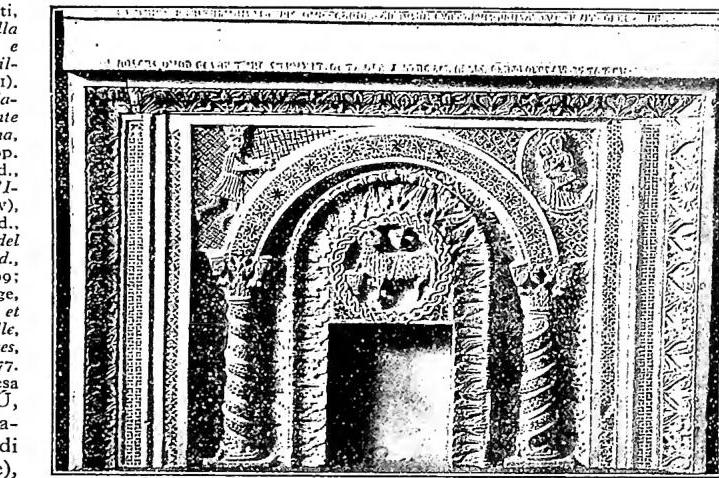
The Eastern and older version already appears in Malala and, in Rome during the 8th century, also received a Latin recension (Cod. Vat. Pal. lat. 277, f. 63), in which S. Maria in A. is mentioned for the first time. The Western version appears for the first time in the Mirabilia urbis Romae; yet we find it represented in the artistic composition of an altar still preserved in the church, which may date from the time of the antipope Anacletus II (1130–37). The legend sheds some light on the origins of the church and makes it possible to suppose that already in the time of the chronographer Timothy, that is, at the end of the 5th or the beginning of the 6th century, on the Capitoline citadel the Christian sanctuary of the Virgin may have succeeded the pagan temple of Juno. Its dimensions cannot be known, just as it is impossible to determine its orientation. The designation S. Maria in A. was preceded by that of S. Maria in or de Capitolio. Among the numerous theories that have sought to explain the origin of the name A., that of Ch. Huelsen, namely that it derives from the inscription on the altar of the Augustan legend, is the simplest and also the most probable; nor can it be accused of anachronism if the chronology we have proposed for that altar is accepted. A monastery for its custodians must soon have arisen beside the church.
The presence of Benedictines in this monastery is documented for the year 883 (Cod. Sessor. 217 [2116], f. 19), but an inscription of an abbot, discovered during the excavation work for the monument to Vittorio Emanuele II (Notizie degli scavi, 1892, p. 407 ff.), has led scholars to think
(Alinari photograph)
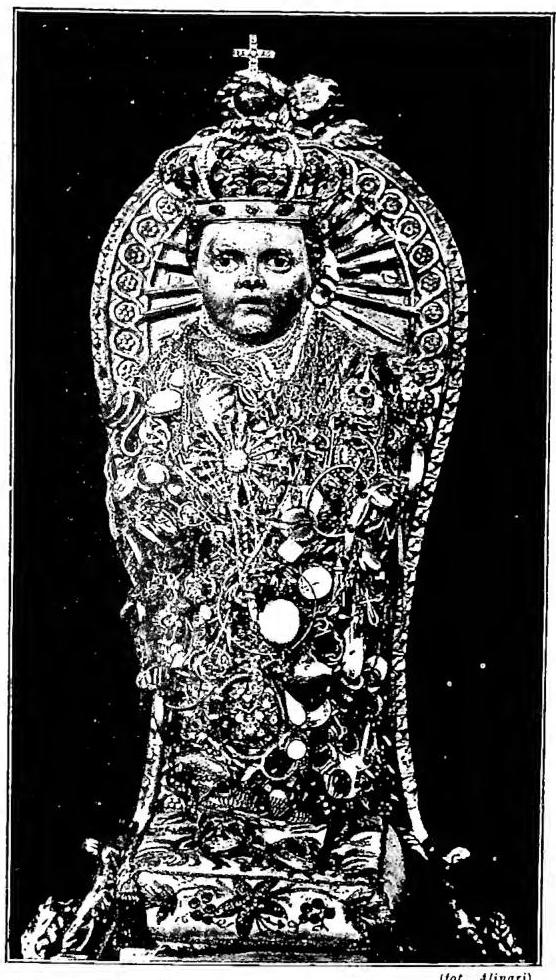
ARACOELI – The Holy Child. Wooden sculpture (perhaps from the 14th century), covered with votive offerings from various centuries – Rome, S. Maria in Aracoeli.
Even today, as in the Middle Ages, A. is the church of the municipality of Rome. The historic Franciscan convent, which until 1886 was the seat of the Order’s minister general, has almost completely disappeared to make way for the monument to Vittorio Emanuele II by Saccon