
MIRABILIA URBIS. – The M. contain information concerning the most notable Roman and Christian monuments and their history, compiled by grammarians and scholars on the basis of identifications and traditions that are not always accurate and very often legendary. In their formation they reflect an Ottonian historical climate, when, under the third Otto, the consciousness of the Urbe’s imperial function seemed to awaken among the Roman people.
In the climate of the renovatio Imperii, what is discussed is solely the assertion of rights that were still alive and operative in the consciousness of the Roman people; and the ancient ruins no longer constituted a decorative backdrop against which, with the splendour of evocative attraction, the ceremonies of the coronations of popes or kings were held, but took on the appearance of eloquent witnesses to rights transmitted through the centuries. The idea of the Empire thus remained almost naturally connected with the traditions of Rome, and among the Romans awareness of their imperial destiny was renewed through concrete and specific juridical arguments. The immense success these M. can claim lies in their perfect adherence to the spirit of the age, and in the skilful fusion of the two elements, realistic and poetic, which arose in the form of legend to reconcile the prestige of Roman greatness with the work that
Providence reserved for so great a power. This premise explains the adaptation of the M. as a guide for pilgrims, arriving from all over the world almost at the cradle of Christian traditions, and coming to see those monuments which, through legend, were connected with the arcane dispositions of Grace.
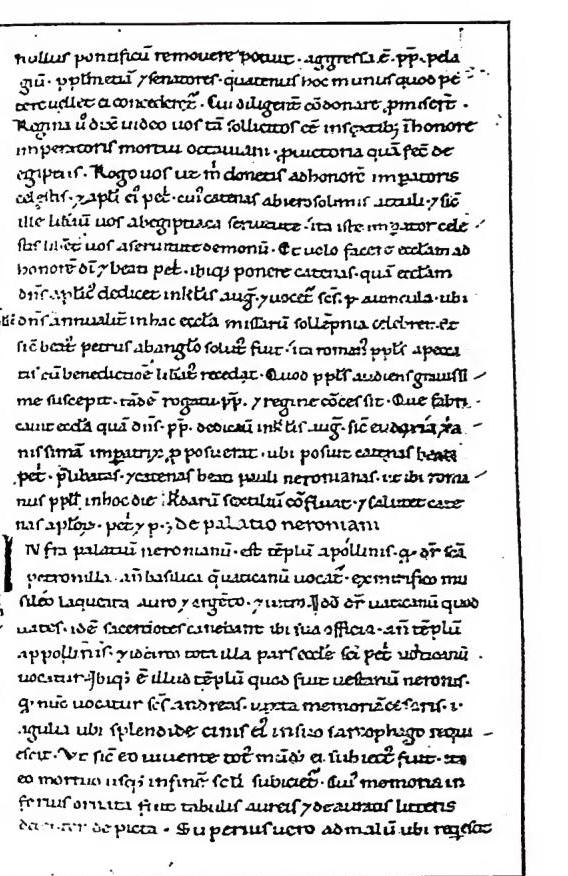
The oldest version of the M. is contained in the Lib. Politicus of Benedetto Canonico, written between 1140 and 1143. From a topographical standpoint, the M. may be regarded as a periegesis, followed in a definite order: from the Vatican by Castel S. Angelo to the Campus Martius, then to the Capitoline, descending from the Fora to the Arch of Titus and crossing the Roman Forum. Having reached the Palatine, one descends to the Colosseum, then, by way of the Aventine, to the Circus Maximus, the Caelian, the Lateran, the Esquiline, the Viminal, the Quirinal, and once again to the region of the Circus Maximus, ending again near Castel S. Angelo, keeping to the left bank of the Tiber. The periegesis ends with a visit to Trastevere and Tiber Island, proceeding beyond the Porta Appia. The M. are then found in the collection of Bosone (1154–81), in the compilation of Albino (c. 1190), and in the Liber Censuum of 1192; then in the Graphia aurea Urbis, composed between the end of the 10th century and the first half of the 11th, whose author also drew information from the Bible, the Cronica di S. Girolamo, the Constitutum of Constantine, Vegetius, Isidore, Severus, and Paul the Deacon.
Le Miracole de Roma render into the vernacular, around the middle of the 13th century, the oldest text of the M., with additions taken from the Regionaries and the Graphia. The treatise of the master Gregorio, De mirabilibus urbis Romae, concerning almost exclusively pagan monuments, should be dated to the end of the 12th century or the beginning of the 13th. A different arrangement of the material is found in the compilation De mirabilibus civitatis Romae by Nicolas Rosell, known as the Cardinal of Aragon (1314–62).