
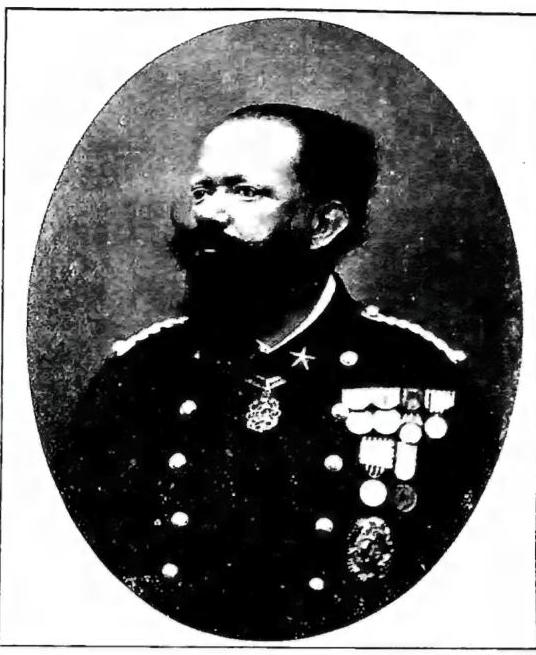
VITTORIO EMANUELE II, king of ITALY. — Born in Turin on 14 March 1820, died in Rome on 9 January 1878. The firstborn of Carlo Alberto di Savoia-Carignano, later king of Sardinia, and of Maria Teresa d’Asburgo-Lorena, he spent his early childhood in Florence, with his paternal grandfather, and then moved to Turin, where King Carlo Felice arranged for the boy, heir presumptive to the throne, to receive a careful education, especially from the religious and political point of view.
But
V. E
whom his father, immediately after ascending the throne (1831), appointed duke of Savoy — gained little from his studies, since his exuberant character inclined him rather to physical exercise and military life. Although nourished by a sincere and profound faith, he soon yielded to the overmastering sensuality of his nature, hence the serious shortcomings of his private life. Married, from 12 April 1842, to Archduchess Maria Adelaide d’Asburgo-Lorena (d. 1855), who bore him six children (Clotilde, Umberto, Amedeo, Oddone, Maria Pia and Carlo Alberto), in 1869, when in danger of death, he regularized through a morganatic marriage his twenty-four-year relationship with Rosa Vercellana, created countess of Mirafiori. Kept, in accordance with Savoyard traditions, apart from politics during his father’s lifetime, he devoted himself passionately to the military commands entrusted to him and in 1848 behaved courageously at the head of his troops, especially on the day of Goito. It is calumnious to claim that he had brought about the defeat at Novara in March 1849 through his inaction in order to assume the crown more swiftly. Having become king through the abdication of Carlo Alberto (23 March 1849), the following day he met the victorious Marshal Radetzky at Vignale and concluded an armistice with him on severe but not dishonourable terms, nobly refusing to abrogate the Statuto granted by his father. V. E. thus became the only European sovereign to keep in force the Constitutions granted in 1848.The events of his thirty-year reign are too well known: firmly resolved to secure Italy’s independence and unify it under his own sceptre, he knew how to direct towards this goal both the legal and revolutionary forces and to place the question of Italian liberty within the framework of international politics, thanks above all to Cavour’s diplomatic skill; thus his name remains inseparably linked to the so-called “decade of preparation” (1849–59), the Crimean expedition of 1855, the second war of independence, won with the support of Napoleon III (1859), the annexations of the Duchies, the Legations and the Mezzogiorno (1859–60), the proclamation of the Kingdom of Italy (1861), the campaign of 1866 which led — despite Custoza and Lissa — to the liberation of Venetia, and finally the capture of Rome in 1870. A constitutional sovereign, he often claimed the right to pursue a personal policy: such was the case with the skilful clause inserted in the approval of the preliminaries of Villafranca, designed to leave the future arrangement of central Italy undecided; with the direct relations he maintained with Garibaldi during the Expedition of the Thousand; and with the agreements secretly concluded with Mazzini in 1864 for the purpose of fomenting revolts against Austria in Galicia and in the Danubian Principalities. A courageous soldier rather than a skilful commander, he fought personally at Palestro and played a leading part in the victory of S. Martino, but his command proved entirely ineffective at Custoza. After 1870, for the good of the country, he did not hesitate to sacrifice his sentiments and travel to Vienna and Berlin to seal the new policy of friendship with the Central Empires, just as he accepted the accession to power of the Left (1876), although his sympathies lay rather with the defeated party.
The events of autumn 1859 confronted V. State. Bitterly torn between the demand for Italian unification and respect for the Pontiff, after energetically preventing Garibaldi from crossing into the Marches, he appealed directly to Pius IX (the Stellardi mission) in the hope that the Pope might be induced to grant him spontaneously, in the form of a vicariate, the government of the provinces of central Italy. This was the first in a series of attempts pursued by the King — often without his ministers’ knowledge — to achieve the unity of Italy with papal consent. The secret correspondence between Pius IX and V. E, besides documenting the enduring cordiality of the personal relations between the Pontiff and the Sovereign, would seem to testify to the King’s sincere anxiety “not to offend the immutable principles of Religion.” Some historians, however, have believed they could observe that V. E. had made an abundance of commitments and promises in order to calm the Pope’s apprehensions, although resolved later to shelter behind the easy excuse of his constitutional duties; and this suspicion of duplicity does indeed occasionally emerge in Pius IX’s letters. In any case, these secret contacts were repeated even after the occupation of the Marches and Umbria (1860), leading to the highly confidential missions of Vegezzi and Tonello in 1865 and 1866 and to the confidential assignment entrusted by the King concerning the Pope to Lord Clarendon in December 1867, immediately after Garibaldi’s attempt at Mentana, which V. E. had tried to prevent or at least contain through the energetic action of General Menabrea, whom he had called to the government through an audacious extra-parliamentary solution to the ongoing ministerial crisis. Even on the eve of 20 September, V. E. hoped to induce Pius IX to renounce Rome peacefully; and while General Ponza di S. Martino was delivering to the Pope the King’s letter with
(phot. Alinari)
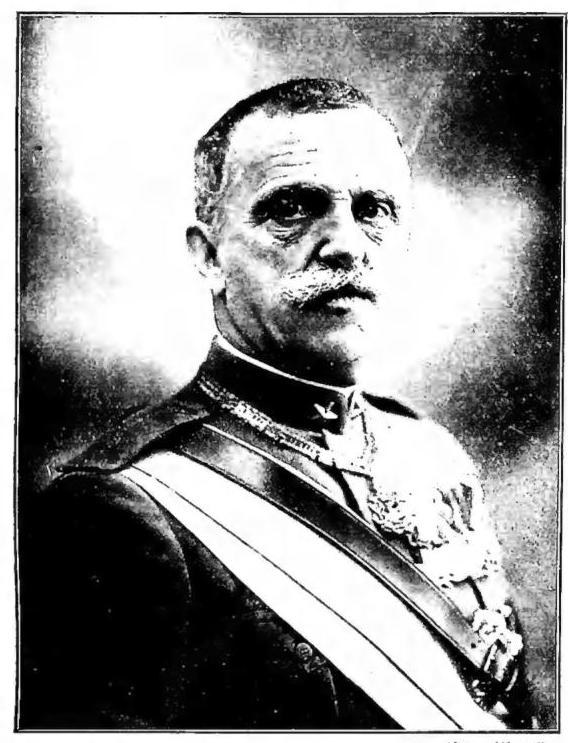
Extremely popular for his generosity of spirit, his genuinely democratic manners, and his tireless charity, V. E. earned the noble title of Father of the Fatherland, and his premature
death constituted a genuine national mourning. His remains rest in the Pantheon of Rome, in a monument cast from the bronze of cannons wrested from the enemy.