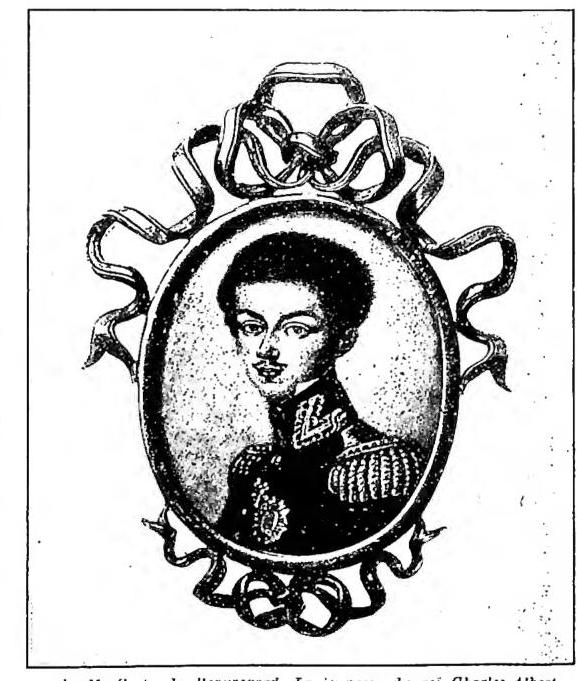
CARLO ALBERTO, RE DI SARDEGNA

CARLO ALBERTO, King of Sardinia. — Born on 2 Oct. 1798 at Turin, died on 28 July 1849 at Oporto. Son of Carlo Emanuele, Prince of Carignano, of the cadet branch of the House of Savoy, he lost his father at the age of two. He was educated in a boarding school in Paris and Geneva, and returned to Piedmont after the Restoration as the presumptive heir to the throne, since neither King Vittorio Emanuele I nor his brother Carlo Felice had any sons. Born and raised in the revolutionary and Napoleonic climate, Carlo Alberto, by natural inclination, was inclined toward the new ideas and principles; yet alongside this sympathy for revolutionary achievements, he had a keen sense of duty and the interests of the State: sacred to him was the majesty of the king, genuine was the religious sentiment that beat in his heart, and necessary appeared to him reforms, including constitutions, only insofar as they truly served to strengthen the fabric of the state.

When the revolution broke out in Piedmont in 1821, Carlo Alberto, assuming the regency after the abdication of Vittorio Emanuele I and in the absence of the new sovereign Carlo Felice, failed to contain the movement as he would have wished. Inclined to grant a Charter on the French model, he was compelled to grant a constitution along the lines of the Spanish one, and, reluctant in his innermost self to the movement itself, he lacked the moral courage and the feeble energy indispensable to take a firm stand. Disavowed by Carlo Felice and despised by the revolutionaries, he was obliged to leave Turin, by order of the king, after the suppression of the movement. Wishing therefore to demonstrate to the sovereign his aversion to revolutionary ideas, he did not hesitate to go to Spain, and in the train of the army of the Duke of Angoulême he took part in the capture of the Trocadero. This gesture served to dispel the doubts that Carlo Felice harbored regarding the ideological and political orthodoxy of his nephew, who was readmitted to the Sardinian states with his former rank of presumptive heir to the throne. Carlo Alberto became king in 1831, at a time when a severe crisis was disturbing all Europe.

The king, from the very beginning, showed his aversion to these upheavals, and warmly supported the cause of the legitimists, both French (the Duchess of Berry), and Spanish and Portuguese (Don Carlos and Don Miguel). In domestic policy, a cautious reform program was undertaken. The Council of State was established; new codes were promulgated, based on the Napoleonic ones but stripped, however, of any anti-Catholic intent; the economic and financial policy of the kingdom was inspired by new principles. In this sphere, Carlo Alberto particularly aimed to defend the Catholic religion, which was declared in Article 1 of the Civil Code to be “the only religion of the State.” In 1839 he began negotiations with the Holy See for the restoration of the nunciature in Turin, suppressed in 1753 by Carlo Emanuele III; these negotiations were successfully concluded the following year. Likewise, he obtained from the Holy See a concordat on the question of parish registers and the personal immunity of the clergy (A. Mercati, Concordati tra la S. Sede e le autorità civili, Rome 1919, pp. 825-38).

The awakening of Italian public opinion, in a national and anti-Austrian sense after 1840, also made an impression on Carlo Alberto. With sincerity he then embraced the

Article illustration
(from M. Costa de Beauregard, La jeunesse du roi Charles-Albert)

Article illustration
(from M. Cnata de Beauregard, *La jeunesse du roi Charles-Albert*, Paris 1913)

He viewed the Italian cause, though considering it from certain particularistic standpoints. In the second half of 1847 he granted further reforms and bestowed on 4 March 1848 the Statute, which would subsequently become the fundamental law of the kingdom of Italy until the proclamation of the republic nearly a hundred years later. Declaring war on Austria in March 1848, C. A., after the defeat at Novara in February of the following year, abdicated in favor of his son Vittorio Emanuele II and retired to Portugal, where he died a few months later.

BIBL.: The bibliography on Charles Albert is vast. Up to 1899 it is listed in D. Carum, *Bibliografia carlo-albertina*, Turin 1899. Fundamental now is the work by N. Rodolico, *C. A.*, 3 vols., Florence 1931–43. On the relations between State and Church under C. A. cf. T. Chiuso, *La Chiesa in Piemonte dal 1707 ai giorni nostri*, III, Turin 1888, pp. 168–280; P. Pirri, *La politica ecclesiastica di C. A.*, in *Civ. Coll.*, 1931, passim, pp. 385 ff., 495 ff.

Carlo Albario, de’ di Sarcéna – autograph letter of 20 April 1836 from Nice to Count Gerbaix de Sonnaz.

---

He viewed the Italian cause, though considering it from certain particularistic standpoints. In the second half of 1847 he granted further reforms and bestowed on 4 March 1848 the Statute, which would subsequently become the fundamental law of the kingdom of Italy until the proclamation of the republic nearly a hundred years later. Declaring war on Austria in March 1848, C. A., after the defeat at Novara in February of the following year, abdicated in favor of his son Vittorio Emanuele II and retired to Portugal, where he died a few months later.

BIBL.: The bibliography on Charles Albert is vast. Up to 1899 it is listed in D. Carum, *Bibliografia carlo-albertina*, Turin 1899. Fundamental now is the work by N. Rodolico, *C. A.*, 3 vols., Florence 1931–43. On the relations between State and Church under C. A. cf. T. Chiuso, *La Chiesa in Piemonte dal 1707 ai giorni nostri*, III, Turin 1888, pp. 168–280; P. Pirri, *La politica ecclesiastica di C. A.*, in *Civ. Coll.*, 1931, passim, pp. 385 ff., 495 ff.

Article illustration

---

CARLO BORROMEO, ST. – Cardinal, archbishop of Milan, born in the Borromeo fortress at Arona on 2 October 1538, second son of Count Gilberto Borromeo and Margherita de’ Medici, sister of Pope Pius IV; at the age of twelve he received the clerical habit and tonsure together with the abbacy of S. Gratiniano in Rome, which was a patronage of the family. Enrolled at the University of Pavia while still very young, on 6 December 1559 he obtained the degree in canon and civil law, with Francesco Alciato present at the disputation. At twenty-two he began his extraordinary career when summoned to Rome by his uncle the Pope Pius IV, who had recognized the active talents with which the young man was endowed, and he arrived in that city in January 1560. Created cardinal on 31 January, on 8 February he was given the archbishopric of Milan, but with the obligation to remain in Rome and govern the diocese through secretaries and resident representatives in Milan. These were first Gerolamo Ferragata and then Niccolò Ormaneto. During his Roman period C. devoted himself to noble pursuits of study and devoted service to his uncle the pope, who lavished upon him impulses, honors, and responsibilities. As cardinal he immediately took on the government of the papal legations of Bologna, Romagna, and the Marca of Ancona, as well as the office of protector of religious orders such as the Franciscans and Carmelites. To these early dignities were later added the post of protector of the Crown of Portugal, the Netherlands, the Catholic cantons of Switzerland, and the Knights of Malta: responsibilities which were surpassed in importance by his appointment to the presidency of the Consulta, instituted by Pius IV, for which B. may be said, in chronological order, to be the first Secretary of State of the Papal Government.

Thus promoted to such honorable offices, C. from those early years was able to deal with the highest affairs of the Roman Curia: in which he seemed perfectly prepared, above all for his prompt yet precise grasp of the needs of the age in relation to the Church and Christendom and for his energetic character in carrying out decisions that had been matured. In reality the times were difficult. The first seed of rebellion sown by Luther in Germany had already split the Catholic unity of Europe into two hostile camps, religiously and politically. In France and the Netherlands the religious wars were already raging; sharp controversies were also underway in Poland; in England Queen Elizabeth had forced her people into definitive separation from the Church of Rome. Less painful seemed the conditions in Italy, Spain, and Portugal, although even these regions felt the repercussions of the northern agitation. B. was among the first and most fervent in wishing to stem the movement that threatened the Latin countries from the north; therefore alongside his uncle he worked first with indomitable energy for the immediate reopening of the Council of Trent, then from Rome he actively participated in its labors, bearing the weight of a close and difficult correspondence, until its closure (3 December 1563). When Pius IV wished that the execution of the Council’s decrees be entrusted to a

A cardinalate, C. was elected among those members and was one of the promoters of the *Catechismus romanus ad Parochos*, whose compilation the Council had proposed and decided upon to establish a unified text for the religious education of the people.

In the meantime, he had received the orders of subdiaconate and diaconate in December 1560; but when, on 19 November 1562, his brother Federico died, some thought that he, with the necessary dispensation, should secularize himself to perpetuate the family succession. Instead, he intensified his life of austerity and, on 17 July 1563, was ordained a priest; on 2 December, having just reached the appropriate age, he was made bishop. It now remained for him to fulfill his duty of residing in the archdiocese of Milan, which, due to the absence of its own shepherd—despite the good governance of wise and valiant vicars—gave cause for grave concern to the archbishop in Rome, particularly regarding the danger of heretical infiltrations. Therefore, the Blessed One decided to assume personal governance and entered Milan on 23 September 1565, after a journey through the central and northern regions of Italy, in the capacity of *legatus a latere* of the pope. He had, however, to return immediately to Rome to assist his dying uncle the pope, and in the subsequent conclave he cooperated in the election of Cardinal Ghislieri, who took the name of Pius V. Returning once more to Milan on 15 April 1566, he remained there until his death, save for some further Roman interludes, such as the conclave from which Gregory XIII emerged and during the jurisdictional dispute with the Marquis of Ayamonte.

In the 24 crowded years of his Milanese period, the pastoral activity of the Blessed One was such as to merit being remembered as one of the most laborious and fruitful ever exercised by a shepherd of souls. The Milanese diocese was in itself vast, comprising lands subject to Venice, Genoa, and Novara, as well as entire valleys and Swiss cantons. Moreover, the ecclesiastical province over which he presided included 15 suffraganeal sees. It was due to the Blessed One that a good part of German-speaking Switzerland remained Catholic: he visited the three Swiss valleys in 1567, and again in 1570 undertook a journey through the German cantons, passing through Altdorf, Unterwalden, Zug, St. Gallen, Schwyz, and Einsiedeln, always with the intention of personally ascertaining the religious conditions of those lands. He then established relations and connections that served him well in preserving the spiritual life in that part of Switzerland affected by Protestant influence. On that occasion, the Saint even ventured as far as Hohenems in the Vorarlberg to visit his stepsister Ortensia, wife of Count Annibale Altemps. He traveled to Switzerland a third time in 1581 as visitor of the Rhaetian regions by commission of Gregory XIII, and again in 1583 among the Grisons.

Article illustration

To a tenacious and courageous activity, entirely devoted to the cause of the Church and the moral elevation of the people, the Blessed One joined an austere life of harsh penances and corporal mortifications, which served as an effective example of reform aimed at reaffirming the ecclesiastical discipline that had declined, at strengthening the liturgical sense of divine worship, and at preserving Catholic morality among the people. In the exercise of his high ministry, C. employed every just means at his disposal in that era, even those that sometimes seemed harsh and summary (cf. the proceedings against witches), and maintained cordial contacts with political and civil authorities, without ever yielding when it came to safeguarding the rights of the Church, as he demonstrated in the disputes over the Inquisition in his controversies with the Spanish representatives of Ayamonte and Requesens.

Yet to a man who struck so rigorously at the lax discipline of morals—even among the clergy and religious—there were not lacking oppositions from the clergy itself and the convents: of these, the resistance of the canons of the Scala on 24 August 1569, when the archbishop wished to enter their basilica and they repelled him, was but a minor episode. A far graver act was perpetrated on 26 October of that same year by Fr. Girolamo Donato, called Farina, who attempted to strike him with an arquebus while he was praying. The Humiliati were to blame, for their deep decline—caused by the wealth they had amassed through the wool industry—was indeed suppressed on 7 February 1571 by papal bull. But C. also received comfort and profound consensus from the entire people; he maintained good relations with the sovereigns of the time and even with the Spanish conquerors and rulers of Milan; princes and dukes of Italy, among them Emanuele Filiberto and Carlo Emanuele I of Savoy, held his friendship in high honor. Thus he was able to extend his beneficent zeal beyond the borders of his vast diocese, exercising a pastoral influence in various parts of Italy not subject to him and even in Switzerland, where he established the first nunciature with the Cremonese G. F. Bonhomini in 1579, and, through the good offices of the noble knight Melchior Lussy, obtained the establishment of the Jesuits in Lucerne in 1574 and the Capuchins in Altdorf in 1581.

Particularly admirable were the initiatives of the Blessed One for his own diocese. He began to reform his clergy and the regular clergy through the work of the new religious institutes of the Barnabites, Jesuits, and Theatines, founding himself a Congregation of Oblates, which had

It first originated in the church of the Holy Sepulchre in Milan in 1578, with rules definitively established on 13 September 1581. He reorganized worship by building new churches and shrines that became famous, such as those at Rho, Cannobio, the Sacred Mount of Varallo, and San Fedele in Milan. Above all, he devoted himself—and this was one of Borromeo’s greatest merits in relation to the Tridentine reform, which he consistently championed—to the establishment and founding of seminaries for the training of candidates for the priesthood, providing the model and setting the principles for the education and formation of students.

Thus arose the major seminary in Milan, built by the architect Meda, the Collegio Elvetico in Milan as well, and in the countryside the minor seminaries of Inverigo and Celana. He also established schools and colleges for lay education: the famous Brera College entrusted to the Jesuits; the Almo Collegio Borromeo in Pavia; the College of Nobles in Milan; the Pontifical College in Ascona on the upper Verbano; he founded in Milan the refuge of Santa Maria Maddalena for fallen women, as well as other hospices and charitable shelters for the sustenance and spiritual formation of various classes of citizens. He promoted the establishment of pawnshops and advocated the institution of free legal aid for the poor. He reformed the Pio Istituto di Santa Corona for poor sick people, founded the Confraternity of the Disciplini to comfort those condemned by public justice, and at his death left his own property to the Ospedale Maggiore of Milan. Then, too, throughout Christendom there became famous the institution of the schools of Christian doctrine, from which also sprang the elementary or popular schools, placed under the care of parish priests. The Confraternities of the Blessed Sacrament and of the Holy Rosary in the Milanese territory are also institutions of Charles Borromeo.

The Blessed visited personally the then more than a thousand parishes of the diocese, reaching even the most remote churches and chapels in the mountains, such as those in the Three Ambrosian Valleys of Switzerland. Not to be forgotten is the particular care he took to preserve for the Milanese Church its most ancient liturgical rite, reducing it to its genuine traditions. To this end he established a special congregation and produced a printed edition of the Ritual, the Missal, and the Breviary (1582), though he did not succeed everywhere in establishing the Ambrosian rite, as in Monza. During his twenty-four years as bishop he convened eleven diocesan synods, the first of which was presided over by his vicar, Ormaneto; the last was celebrated in his presence in 1584, a few months before his death. He held six provincial councils in the years 1565, 1569, 1573, 1576, 1579, and 1582, while at the same time visiting the suffragan dioceses.

The Saint became exceedingly popular when in 1576–1577 the plague struck and afflicted, aggravated by a preceding famine, both the city and countryside of Lombardy. His charity was inexhaustible at that time: he sold his substantial principality of Oria for the benefit of the plague-stricken, opened the church of San Gregorio at the Lazzaretto for them, and dedicated a votive temple to Saint Sebastian in Milan after the scourge had ceased.

If our Saint distinguished himself by an admirable life of action and labor, he did not on that account neglect good literature and culture. Indeed, he was precisely the restorer of the University of Bologna and, in his own education, knew the ancient philosophers such as Seneca, Epictetus, and Cicero, as is evidenced by his rich library, whose manuscript catalogue is preserved in the Ambrosiana. During his Roman period he associated with Sirleto and Alciato; moreover, he used to gather learned and cultured persons, even laymen, to discuss scientific and literary matters in the Vatican Palace. Thus, as an erudite diversion from diplomatic cares, he had organized those “Vatican Nights,” which were like a domestic academy and an exercise in oratory for his future. Even later he sought the acquaintance and friendship of scholars and men of letters, and he entrusted Silvio Antoniano with the drafting of a treatise on pedagogy and Cardinal Valerio with a work on rhetoric. He displayed his learning in the Instructiones fabricae et suppellectilia ecclesiasticae, his pastoral theology in the Sermones, in numerous conciliar and synodal sermons, in discourses or instructions to the people, in the Instructiones ad confessiones, in the Regulae for Congregations, and his governing activity in his important and extensive correspondence. He cultivated religious art with zeal, employing for churches and shrines such talented architects as the celebrated Pellegrino Tibaldi. He inscribed on his coat of arms the motto Humilitas, as if to symbolize a program of interior life.

C. B. died in Milan on the evening of Saturday, 3 November 1584, at the age of only forty-six, having returned the previous day with a fever after the pious days at Varallo and the opening of the college at Ascona, from the Sanctuary of Pietà in Cannobio on the Verbano, his gaze fixed on a praying Christ by Campi, now preserved in the Ambrosiana. He was canonized on 1 November 1610, when his cousin, Cardinal Federico Borromeo, was archbishop of Milan; in 1624 the latter began the erection of the famous colossus of Saint Charles on the Piedmontese shore of the lower Verbano. The ecclesiastical calendar fixes the feast of the Saint on 4 November.

The Saint’s fame spread so widely throughout Europe that associations and institutions bearing his name arose in the centuries that followed: one need only mention the Borromeans or Fate-bon-sœurs of Saint Charles, founded in Nancy as early as 1652 for the care of the sick and the poor, with later foundations in Trier, Prague, Trebnitz in Lower Silesia, and Maastricht in Holland (W. Hohn, Histoire des Soeurs de S. Charles, 3 vols., Nancy 1898); the extensive and culturally active Borromäusverein in Germany (1844), with headquarters in Bonn, for the diffusion of good reading and the education especially of youth through courses and lectures on culture; the Oblates of Saint Charles in Vercelli, the modern college of Saint Charles in Milan, and the Ursuline Sisters of Saint Charles in Lombardy; the Pontifical Seminary of Saints Ambrose and Charles in Rome, opened in the second half of the 19th century; and the Congregation, under the protection of the Blessed, of missionaries for Italian emigrants in the Americas, erected in 1887 by G. B. Scalabrini, bishop of Piacenza—quite apart from

Oblates of St Charles Borromeo have long been widespread even in the Americas; the archiepiscopal seminary of Kolozsvár in Hungary dedicated to St Charles Borromeo; the Societas seu congregatio Josepho-Carolina, a kind of chivalric order also established in Hungary by Kopik for the propagation and defence of the Catholic faith in Hungarian public life. Villages and hamlets in the Milanese area bear the name of St Charles Borromeo. The greatest theatre of Naples also takes its name from St Charles Borromeo. The Blessed Charles is also patron of the diocese of Lugano and the University of Salzburg, protector of Savoy and of the cities of Milan, Faenza, Guastalla, Arona and Rocca di Papa.

Churches were erected in his honour everywhere, most notably in Rome the 17th-century churches of S. Carlo al Corso and S. Carlo ai Catinari. Pope Pius X issued the encyclical Editae saepe on 29 May 1910 for the celebration of the third centenary of the saint’s canonisation (AAS, 2 [1910], pp. 357–80).

ICONOGRAPHY. — The iconography of St Charles Borromeo is numerous and varied in sculpture and medallic art, but especially in painting; it began immediately after the saint’s death and was a contest among minor and precarious artists to reproduce his features and characteristics, though for the most part he is shown in prayer, meditation, blessing, or often in the act of aiding the plague-stricken. At first the tendency was to depict the saint’s features in an expression of profound mortification and extreme emaciation, as though he were worn out by apostolic labours and daily bodily mortifications; this tendency ceased, however, after his canonisation, when the saint began to be represented in fuller, more human forms, albeit with his characteristic angular and marked facial features. At the end of the 16th and the beginning of the 18th centuries a whole school arose in Milan, rich in famous names in painting, who interpreted the figure of our saint on canvas and also in bronze and marble. These names include, for painting, G. B. Crespi, known as il Cerano, Giulio Cesare Procaccini, il Morazzone, Guido Reni, il Borgianni, Daniele Crespi and il Maratta, whose works on Carolingian subjects, often expressed in grand compositions on canvas, are scattered through Milan, Rome, Bologna, Florence, Pavia, Arona, to name only the principal cities: the Duomo of Milan annually exhibited, on the occasion of the saint’s feast on 4 November, no fewer than forty grand compositions by the Cerano, il Morazzone and Procaccini (who worked in Milan)—artists all in their maturity who were able to express themselves in forms that often constitute the best of Cerano’s art (L. Ferretti, S. C. B. nell’arte, Rome 1923). Yet the depictions of St Charles Borromeo are part of the patrimony of the universal Church, for they are found in every corner of the world where Catholicism is professed. In the words of Cardinal Federico Borromeo, cousin of St Charles and a connoisseur of art, the best portrait of the saint would be the painting by Ambrogio Figini preserved in the Ambrosiana gallery in Milan. Also notable is the colossal copper statue, known as the S. Carone of Arona, which stands 35 metres high on a hill overlooking Lake Maggiore: designed and conceived by the Cerano, its execution was commissioned by Cardinal Federico Borromeo himself. A rare portrait of the young saint at the age of 26, already cardinal archbishop of Milan, is preserved in the Palazzo Borromeo in Senago (Milan), a work by Giorgio Solerio for the entry of Charles as archbishop into Milan; a replica is kept in the Ambrosiana. For observations of a mystical-psychological nature on the saint’s features, cf. W. Schamoni, Das wahre Gesicht der Heiligen (Leipzig 1938, pp. 134–39).

BIBL.: Complete works of St Charles Borromeo, published by G. B. Sassi, 5 vols., Milan 1747; 2nd ed., 2 vols., Augsburg 1758.

For the work of St Charles Borromeo, in addition to publications on the history and acts of the Council of Trent, the following should be particularly cited: A. Ratti (Pius XI), Acta Ecclesiae Mediolanensis, Milan 1860–1921; F. Steffens and H. Reinhardt, Die Nuntiatur von G. F. Bonhomini (1579–81), I, Solothurn 1906 and subsequent volumes; P. Herrer, Papsttum und Papstthum im Zeitalter Philipps II., Leipzig 1907; G. Susta, Die Römische Kurie und das Konzil von Trient unter Pius IV., Vienna 1909, passim; L. von Pastor, C. B., Die Münster eines tridentinischen Bischofs, in Katholische Reformations, Freiburg 1924, pp. 105–37; id., Storia dei Papi, VII, VIII, IX, passim; A. G. Roncalli, Gli atti della visita apostolica di s. C. B. a Bergamo (1575), in Fontes Ambrosiani, vols. 13–18 (1936–49).

Among the most notable biographies of the Blessed Charles are the fundamental work by C. Bascapé (Basilicapetra), De vita et rebus gestis C. B., Ingolstadt 1591 and Brescia 1602; and another, De vita et rebus gestis C. B. lib. VII quos ex G. P. Giussano B. Rubens latine reddidit B. Ottorchi notis uberrimis illustravit, Milan 1751; A. Caillet, Vie de s. C. B., archevêque de Milan, translated and abridged from the Latin of Fr Basilicapetra, Paris 1825; A. Sala, Documenti circa la vita di s. C. B., Milan 1857–61; C. Sylvain, Histoire de s. C. B., 3 vols., Paris 1884; L. Celler, S. C. B., 11 vols. 12, Italian trans.; C. Orsenigo, Vita di s. C. B., 3rd ed., 2 vols., Milan 1929 (German ed. by G. Brunner, Freiburg 1929, pp. 1838); A. Rivolta, S. C. B. Note biografiche, Milan 1938; D. Franceschi, S. C. B., Turin 1938; P. Gorla, S. C. B., 2 vols., Milan 1939. A lengthy biographical summary of St Charles: F. Weiner, s.V. in DTHC, II, cols. 2267–72, with bibliographical notes. For further biographical information, cf. Echi di s. C. B., Milanese publication of contributions on the history of religion and culture, ed. by Giovanni Galbiati, fasc. 19–20 (1938), p. 727 ff. For particular aspects of the life and work of St Charles: G. A. Sassi, Archiepiscopum Mediolanensium series historiae-chronicarum, III, pp. 111–116, Milan 1755; K. A. Martaux, Karl B. Kardinal der Römischen Kirche und Erzbischof von Mailand, Augsburg 1796; G. Borgo, Risposta a Vincenzo Gioberti sopra le lettere di s. C. B., Milan 1850; F. Bertani, La Bulla Cena, la giurisdizione ecclesiastica in Lombardia, etc., 11 vols. 1888; C. Camenisch, C. B. und die Gegenreformation im Veltlin, Chur 1901 (cf. F. Segmüller, S. C. B. vindicatus, Einsiedeln 1924); Atti di s. C. B. riguardanti la Svizzera e i suoi territori, ed. by P. D’Alessandri, Locarno 1909; L. Berra, L’accademia della Notte Vaticane fondata da s. C. B., Rome 1915; U. Mannucci, S. C. B. e s. Francesco di Sales nella storia della Controriforma, 11 vols. 1910; G. Cahannes, Die Pilgerreise C. B.’s nach Einsiedeln im August 1581, in Zeitschrift für schweizerische Kirchengeschichte, 18 (1924), pp. 136–65; L. Gramatica, Diploma di laurea in diritto canonico e civile di s. C. B., Milan 1917; id., S. C. B. e la Terra Santa, Monza 1919; A. Castellucci, Un episodio della vita di s. C. B., Rome 1927; P. Paschini, Il primo soggiorno di s. C. B. a Roma (1560–65), Turin 1935; A. Saba, La Biblioteca di s. C. B., in Fontes Ambrosiani, 12 (1936); G. Galbiati, I Duchi di Savoia Emanuele Filiberto e Carlo Emanuele I nel loro carteggio con s. C. B. secondo gli originali della biblioteca Ambrosiana, Milan 1941; L. Prosdocimi, Il diritto ecclesiastico dello Stato di Milano dall’inizio della signoria risorta al periodo tridentino, 11 vols. 1941. On ascetical aspects: A. Ratti (Pius XI), S. Charles et les Exercices de s. J. Ignace, 2nd ed., Paris 1922; K. Morawski, St. Karol B. na tle odrodzenia religijnego w XVI wieku, Warsaw 1922; C. Gorla, Le più belle pagine delle Omelie di s. C. (Biblioteca dei santi, ed. by G. Galbiati, 10, Milan 1928).

Rich in information and notices on the saint, his work and his age are the two periodical publications S. C. B. nel III centenario della canonizzazione, Milan 1908–10 and Echi di s. C. B., Milan 1937–38. The periodical La Scuola Cattolica of Milan also published a large miscellany in 1910; G. Galbiati, Albero genealogico della principesca famiglia Borromeo, Milan 1938. Extremely useful for information are some of the Nuntiaturberichte from Germany and Switzerland, variously published. We may also cite K. Fry, Guc. Ant. Volpe, Nuntius in der Schweiz 1565–58, I, Freiburg 1936; II, Stans in Switzerland 1946; Fontes Ambrosiani, vols. 9–10; a work that complements in this regard J. G. Mayer, Das Konzil von Trient und die Gegenreformation in der Schweiz, 2 vols., Stans 1901–1903, and Ed. Wymann, Karl B. und die Schweizerische Eidgenossenschaft, 11 vols. 1903. To this day the most recent general biography of the Blessed Charles is that by G. Soranzo, S. C. B., Milan 1944, with appropriate references to sources in the introduction. Various contributions on St Charles Borromeo and the Franciscans, from unpublished documents, have been published by P. Sevesi in Studi francescani, 22 (1925), pp. 156–86; 24 (1927), pp. 400–405; id., in Archivum franciscanum historicum, 31 (1938), pp. 73–126; 387–439; 37 (1944), pp. 104–64; 38 (1945), pp. 231–33.

Sources for knowledge of the saint and his work are to be sought in the archives of the archiepiscopal curia of Milan and in the Ambrosiana library, which, besides preserving since 1947 that archive of exceptional importance for the period, also holds the vast Carolingian correspondence with the saint’s own drafts, as well as other manuscript documentation year by year on the religious and political affairs handled by the saint, not to mention outlines of sermons and homilies, ascetical drafts and designs of theological treatises. The acts of the canonisation process are kept in the Congregation of Rites in Rome; the Vatican Library, the Vatican Archives, those of the Barnabites of S. Carlo ai Catinari in Rome, and the Borromeo archives in Milan hold other

documents, as well as in Brussels with the Bollandist Fathers in preparation for the life of the Saint to be published in the Acta Sanctorum. Nascadola.
GIOVANNI GALBISTI