
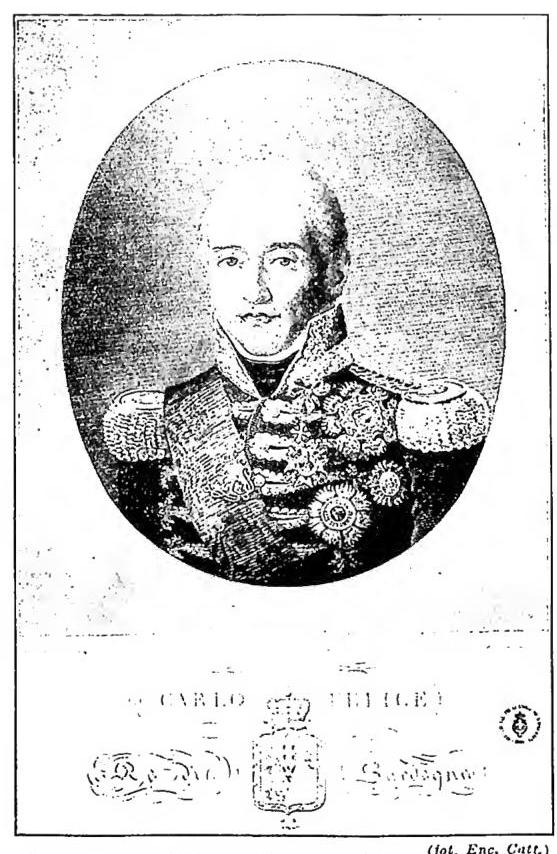
CARLO FELICE, king of SARDEGNA. — Born in Turin on 6 April 1765, died there on 27 April 1831. Fourth son of Vittorio Amedeo, who was the third king of that name, and of Maria Antonietta Ferdinanda, daughter of Philip V of Spain. In 1798 he left Turin in the retinue of his brother, King Carlo Emanuele IV, whom the French had forced to renounce the throne. The sovereign, having withdrawn to Sardinia, remained there no more than six months, and then returned to the mainland. On the island C. F. assumed the office of viceroy (19 September 1799) and retained it even after the abdication of Carlo Emanuele IV (5 June 1802), until the arrival of the new sovereign, his brother Vittorio Emanuele I (18 February 1806).
A strict guardian of the established order, C. F. worked to restore calm and tranquility to the island, which had not been immune to the influence of revolutionary ideas. Upon the arrival of the new sovereign, C. F. withdrew from public life, but resumed the office of viceroy in August 1815, after the sovereigns’ return to Turin, and nominally remained in that position until 1821. At the abdication of Vittorio Emanuele I (March 1821), following the uprisings that demanded a constitution and war against Austria, C. F. was in Modena; he began his reign by ordering his nephew Carlo Alberto, appointed regent, to break off all relations with the revolutionaries and to go to Novara to join the government army. For his part, C. F., after the uprisings had run their course and been repressed, inaugurated a policy of iron-handed action against all those who had been compromised in the recent events, on which occasion he displayed a severity that was at times excessive. During his reign he concerned himself with regulating the question of ecclesiastical property, which had remained unresolved since the French Revolution, and for this purpose sent a plenipotentiary to Rome. The negotiations had a favorable outcome, and in May 1828 Leo XII approved compensation for the ecclesiastical properties seized by the State and the new distribution of capital and funds among the dioceses of the kingdom.
(phot. Catholic Encyclopedia)
CARLO FELICE — Portrait drawn by Boucheron and engraved by Isac and Toschi at Parma — Rome, Museum of the Risorgimento.