
BERLIN, DIOCESE OF. - A name of Slavic origin, designating the capital of the German Republic and of the Prussian state. The diocese of the same name was erected by virtue of the concordat between Prussia and the Holy See of 14 June 1929, through the bull Pastoralis Officii of 13 August 1930; it forms part of the ecclesiastical province of Breslau. In addition to the territory of the city of Berlin, it embraces a large part of the Prussian provinces of Brandenburg and Pomerania, with a total area of about 35,000 sq. km., where, among a population of over 5,656,259 inhabitants in 1948, there were 611,003 Catholics. There are 232 parishes, served by 350 diocesan priests and 113 regular clergy. At the present time, however (1949), there is no possibility of verifying these statistical data.
I. HISTORY
In the Middle Ages this territory belonged to the dioceses of Havelberg, Brandenburg, Lebus and Kammin. After the introduction of Lutheranism, in Pomerania with the ecclesiastical ordinance of Treptow of 1534, in Brandenburg with the ecclesiastical ordinance of the Elector Joachim II of 1540, Catholicism was almost completely extinguished. Only in the chapels of the Austrian and French embassies in Berlin, by virtue of the privilege of extraterritoriality, could Catholic worship be maintained. Later King Frederick William I, out of consideration for the numerous Catholic soldiers serving in the Prussian army, erected, at his own expense, churches or chapels first in Berlin (1722), then also in Potsdam, Spandau and Stettin, entrusting their spiritual care to the Dominicans of the convent of Halberstadt; some of them, such as Fr. Bruns, enjoyed the particular trust of the king. The Catholic community of Berlin obtained parochial rights for the first time after the completion of the church of St. Hedwig, built with the help of Frederick the Great, in 1773. The entire territory from 1699 to 1806 was under the jurisdiction of the Apostolic Vicar of Lower Saxony, a jurisdiction not yet recognized by the State. Repeated attempts by the kings of Prussia to establish in Berlin a vicariate dependent on the king, for all Catholics of the monarchy, with the aim of practically separating them from Rome, did not succeed.The bull De salute animarum of 1821 constituted for the territories of Brandenburg and Pomerania (with the exception of the deaneries of Cottbus, Neuzelle, Schwiebus, Lauenburg and Büttow, belonging to the diocese of Breslau) an Apostolic delegation, entrusting its direction to the Prince-Bishop of Breslau; the temporary provost of St. Hedwig in Berlin was designated as his permanent representative. The intimate union with the large and wealthy diocese of Breslau made it possible to organize, from the ecclesiastical point of view, the masses of workers, employees and merchants who flocked to Berlin, which had become an industrial centre, and from
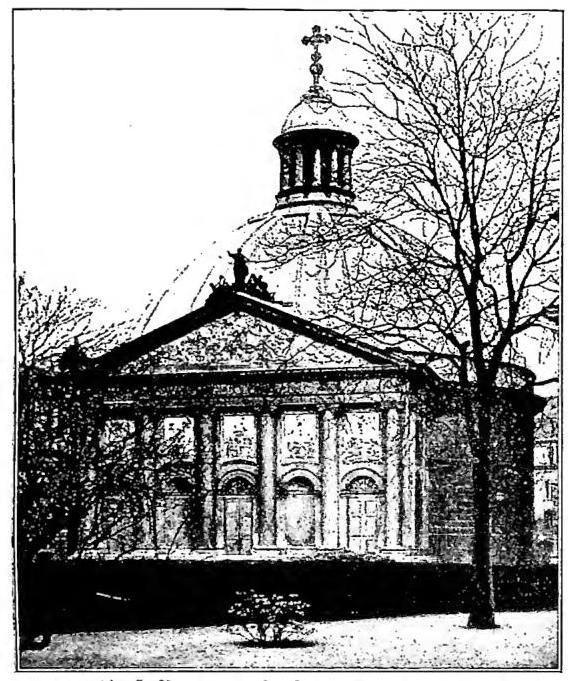
BERLINO - Church of St. Hedwig built to the design of Jean Legeay (1747-73), half-destroyed in 1945.
When, after the end of the First World War, the number of Catholics reached half a million, Catholic life had become so powerful, and the number of priestly vocations so high, that the idea of an autonomous administration of the delegation arose. The provost of St. Hedwig exercised powers roughly equivalent to those of a vicar general, and from 1923 he was also a bishop. When in 1930 the diocese of Berlin was erected, its boundaries were those previously maintained by the delegation. At St. Hedwig a cathedral chapter was created, composed of a provost and six canons. The first bishop was Msgr. Christian Schreiber (1930-33), transferred from the cathedral of Meissen; he was succeeded by Nikolaus Bares, formerly bishop of Hildesheim; since 1935 the see has been held by Count Konrad Preysing, formerly bishop of Eichstätt, whom Pius XII created cardinal in the Consistory of 20 Feb. 1946.
Sources: M. Lehmann-H. Granier, Preussen und die katholische Kirche, 9 vols., Leipzig 1878-1902 (for the period 1648-1807); Ph. Hiltebrant, Preussen und die römische Kurie, I, Rome 1910 (stops at 1740).
II. THE MUSEUMS AND THE INSTITUTE OF CHRISTIAN ARCHAEOLOGY IN B
Important objects of Paleochristian art are found in various places in B., such as the Museum of Antiquities, the Egyptian Museum, the Castle Museum, the State Library, and the Institute of Christian Archaeology at the University. The collection of the Kaiser-Friedrich-Museum is one of the most complete in the world, since it contains objects from different countries (Italy, Byzantium, Egypt) and periods. Some important pieces, especially Paleochristian bronzes such as the statuette of St. Peter, already come from the “Kurfürstliche Kunst-Kammer,” purchased with the Bellori Collection in Rome.The first collector of medieval art was King Frederick William IV, who from 1834 onward had numerous sculptures purchased in Italy, especially for the decoration of the churches in Potsdam; such as in 1842 the mosaic of St. Michael in Affricisco from Ravenna. In 1841 he acquired in Berlin the Pajaro Collection with many medieval marbles from Venice. The greatest increase occurred around 1901–1902 with a large collection of Coptic art, purchased in Egypt. For the inauguration of the Kaiser-Friedrich-Museum, Wilhelm von Bode, in 1904, grouped these and other objects into a special section for Paleochristian, Byzantine, and Italian medieval art; after Oscar Wulff was appointed as inspector, the collection was organized and a two-volume catalogue was published. Other objects reached Berlin from excavations at Abu Mina, Althmim-Panopolis, Arsinoopolis, and Antinoopolis. Many architectural fragments were found in the excavations
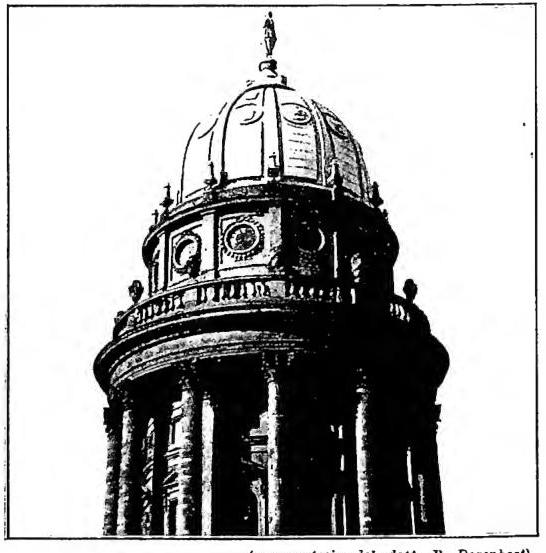
BERLINO - Dome of the French church, a work by K. von Gondardt (1780-85), half-destroyed in 1945.
Items from Asia Minor or purchased in Constantinople were also added to the collection, such as the fragment of a sarcophagus of Psammatica with Christ and the Apostles; in addition to originals, casts and many copies of frescoes were gathered in the Museum for convenience of study, including those from Latmos or Macedonia, mostly of Byzantine date and in danger of being lost.
With the inauguration of the Pergamon Museum around 1931, it became possible to arrange the collection more effectively in new halls. At that time, the Egyptian Museum transferred to the new institution the excavations from Antinoopolis and Arsinoopolis, with many Coptic stelae, fabrics, bronzes, etc. The Museum of Industrial Art in the Castle also contributed large painted Coptic fabrics. A hall was added for the art of Greek and Russian icons.
For students at the University, the small collection of the Institute of Christian Archaeology is available, containing a lead plate, lamps, and especially casts of ivories. Founded by Ferdinand Piper (1849-55), the Institute, with a good library, serves especially Protestant theology students. The above refers to the state of the museum up to the last war, and no positive data is available regarding its current state.
III. ART
1) Local art. — In Kölln, inhabited mostly by fishermen, the parish church of St Peter is recorded in 1237 and was rebuilt in 1379. The new Gothic church was destroyed by fire in 1730 and then rebuilt in a barbarous Gothic style. The patron of Berlin was St Nicholas, to whom the parish church, mentioned in a document of 1244, was dedicated. Around 1250 a third church was founded in honour of Our Lady, not far from that of St Nicholas. A great fire in 1380 also destroyed these two churches. That of St Nicholas, rebuilt in brick with Gothic forms, was particularly solemn, also thanks to the notable stained-glass windows. In modern times two bell towers were added to the base of the tower, which clash with the simplicity of the building. The church of St Mary is also a Gothic construction and preserves a fine 15th-century baptismal font. Famous is the Dance of Death, a fresco painted between 1460 and 1470 and very well preserved. The chapel of St Gertrude, consecrated in Kölln in 1411 with the attached hospital, was destroyed in the 19th century.Around 1250 the Franciscans came to Berlin and built their first convent with an attached church. It was the first brick Gothic church. It still exists today, and since 1576 a higher school has been housed in the monastery, which in its name (Gymnasium zum grauen Kloster) preserves the memory of the friars and of which Bismarck was the most famous pupil. Among the 14th-century buildings there still exists the small Gothic church of the Holy Spirit, which was once the chapel of the hospital of the same name.
Of the great commandery of the Templars to the south of the city, which later passed to the Order of St John after the suppression of the former (1312), Berlin preserves no other memory than the name of Tempelhof for a district and the airport located there.
With the Reformation introduced by Elector Joachim II in 1540, all the churches passed to Protestantism, and for two centuries the Catholics possessed no place of worship. As their numbers grew, under Frederick II the Great (1740–86) a church dedicated to St Hedwig was built for them (1746), probably according to plans drawn up by Jean-Laurent Legeay. It was round, of simple forms but very harmonious proportions. The king provided the land and timber, while the rest had to be collected from Catholics of all countries. Construction lasted almost thirty years, and so it was consecrated with great solemnity in 1773 by the bishop of Ermland. In 1778 it became a parish church. The great king gave the Catholics a second place of worship in the chapel of the military hospital for invalids, dedicated to St Sebastian. It served to gather Catholic soldiers and was replaced by a church for the garrison in the 19th century. Several Catholic churches then arose, mostly built in brick in the neo-Gothic style characteristic of the second half of the century. Notable among them are St Sebastian, St Louis, St Matthias, St Boniface, St Clement Hofbauer; the church of St Michael, instead, is round and neo-classical (parish since 1851).
2) Art collections. — The State Library possessed a fine collection of medieval manuscripts, including a Gospel of Prüm from the mid-10th century, the Psalter of Louis the German of the same period and an Epistolary from the school of Reichenau (last quarter of the 10th century). Another rich collection of manuscripts was in the Print Room. Notable among them are the so-called Gospel of Henry IV (second half of the 11th century), that of the monastery of Abdinghof (c. 1060) and the Passio Sanctae Lucia (12th century).
The principal museums are: the National Gallery dedicated to modern German art, the Old and New Museum, the German Museum, and the Kaiser-Friedrich-Museum. All these buildings are on Museum Island, where the castle is also located; its oldest parts date back to Margrave Frederick II the Iron (1420–70) and it was the residence of the Hohenzollerns. The collections of Catholic art are housed in the last two museums mentioned above. In the Kaiser-Friedrich-Museum there was a collection that gave an exact idea of the art of painting in Europe from the 13th century to the beginning of the 19th. Among the German works are several altarpieces from the school of Cologne of the late 14th century, the Adoration of the Magi and the fine head of an Apostle by Hans Baldung called Grien (c. 1480–1552), the Rest on the Flight into Egypt, the Nativity of Christ, St Francis and St Jerome by Albrecht Altdorfer (1480–1530). There were also the Holy Family, St Ulrich and St Barbara by Hans Burgkmair the Elder (1473–1531). Important was the collection of works by Albrecht Dürer (see BAMBERG), including the Madonna of the Pear, an adoring Madonna, the magnificent Portrait of Jerome Holzschuher. One must also recall the Mater Dolorosa by Hans Holbein the Elder (c. 1465–1524) and the Portrait of the Merchant Gisze by his son Hans Holbein the Younger (see BASEL). In the last war these treasures were kept in a place presumed to be safe; it is not possible at present (1948) to know the condition of the monuments and the whereabouts of the works of art. — See Tavv. LXXXV–LXXXVI.
(from Della Corte-Pannain, Storia della Musica, III, p. 121)
BERLIOZ — Portrait painted by G. Courbet (19th cent.).
Paris, Louvre.