
PAUL III, POPE. — Alessandro Farnese, b. at Canino in Feb. 1468, belonged to the baronial Farnese family, with possessions on Lake Bolsena and south of Viterbo.
Having received a humanistic education in Rome and Florence, he was appointed cardinal in 1493 by Alexander VI (who had illicit relations with his sister, Giulia). He administered the bishoprics of Corneto, Montefiascone, Parma (where Bartolomeo Guidicci, later a cardinal, was his vicar general), and Benevento; he nevertheless received in
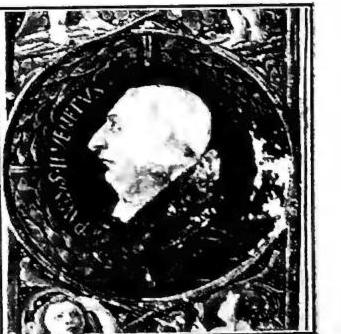
PAOLO II, PAPA - Miniature, Detail of the frieze on fol. 1 of the Codex containing the Antichità romane by Dionigi di Alcarinasso (Treviso 1480) - Vatican Library, cod. Vat. lat. 1819.
At that time he had received only Minor Orders. From a relationship with a noble Roman woman he had two sons, Pierluigi and Paolo, and later a third son, Ranuccio, and a daughter, Costanza. Highly esteemed for his political wisdom and his great experience, in 1524 he received the bishopric of Ostia and became dean of the S. Collegio. He kept himself apart from the unfortunate policy of Clemente VII. On 13 Oct. 1534 he was elected pope after only one day of Conclave and immediately announced the council and reform as his programme.
While the convocation of the Council at Mantua and Vicenza, despite the numerous postponements, came to nothing because of the war between Carlo V and Francesco I, he began the reform of the Church by calling excellent men to the College of Cardinals, such as Contarini, Carafa, Pole, Sadoleto, Cervini, Cortese, Badia, Morone, and others. A commission for Reform, convened in the autumn of 1536, presented him on 9 March 1537 with the Consilium de emendanda Ecclesia, the most important reform project prior to the Council of Trent, and in some respects excessively radical. It became the starting point for lengthy discussions on the reform of the curial authorities, especially the Dataria: some abuses were halted, but there were no vigorous changes, particularly with regard to the obligation of residence for bishops. The approval of the Society of Jesus on 27 Sept. 1540 and the growth of the Theatines, Barnabites, and Somaschi, together with attempts to reform the older Orders, secured for the Church numerous able collaborators. By founding the Roman Inquisition (1542), he created a central authority for the struggle against Protestantism in Italy.
The Peace of Crépy (17 Sept. 1544) made the Council of Trent possible, after it had already been unsuccessfully convoked in 1542. Against the Emperor’s desire that discussions on Reform should take precedence, the Pope insisted on defining the dogmatic controversies and approved the compromise at Trent of treating dogma and Reform simultaneously. The transfer of the Council to Bologna (11 March 1547), carried out without his knowledge, nevertheless corresponded to his wishes. The Emperor’s protest against this transfer, the subsequent arbitrary regulation of Germany’s ecclesiastical affairs in the Interim of Augsburg, and above all the assassination of his son Pierluigi with the complicity of the governor of Milan, Ferrante Gonzaga (10 Sept. 1547), brought the Pontiff into open conflict with Carlo V, a conflict that lasted until the death of P. III on 10 Nov. 1549.
In the war between Carlo V and Francesco I, P. III was neutral, although personally inclined toward France, in which he saw the necessary counterweight to the Emperor’s superiority. The latter held predominance in Italy as lord of Milan and Naples and, according to the Pope, threatened the independence of the Holy See. After Francesco I allied himself with the Turks and with the German Protestants, Carlo V repeatedly and unsuccessfully attempted to induce the Pontiff to abandon neutrality. P. III’s distrust of the Emperor persisted even after the formation of the League (1545) to overthrow the Schmalkaldic alliance and the dispatch to Germany of his nephews Alessandro and Ottavio at the head of the papal troops. The publication of the major excommunication against Enrico VIII of England (1538) completed the Anglican schism, and all the Pontiff’s attempts to induce the continental powers to impose economic and military sanctions likewise failed.
To his family P. III first gave the Duchy of Camerino and then those of Parma and Piacenza, his aspirations regarding Milan having failed because of the Emperor’s opposition. The creation of the Farnese dynasty in Parma was the last grand manifestation of papal nepotism. It is undeniable that the Pope’s aspiration to give his family a place among the Italian princely houses influenced the whole of P. III’s political
and ecclesiastical conduct. Pope Farnese (whose physical appearance was handed down to us in the celebrated paintings by Tiziano) belongs among the great figures in the history of the popes. His pontificate marks the transition from the Renaissance to the Catholic Reformation: the splendid monument by Guglielmo della Porta is located in the apse of S. Pietro. - Vedi tav. LV.