
PARMA, DIOCESI di. – City situated 49 m above sea level and traversed by the river of the same name, not far from the right bank of the Po.
It has an area of 2,100 sq. km, with a population of 300,000 inhabitants, of whom 299,000 are Catholics, distributed among 310 parishes served by 356 diocesan priests and 125 religious priests; it has 14 male and 74 female religious communities (Ann. Pont., 1952, p. 311).
Ruled first by the Etruscans and then by the Celts, it became a Roman colony in 183 B.C., assigned to the Pollia tribe. A marsh and woodland, it was reclaimed by M. Emilio Sisauro in 115 B.C. and flourished through the wool industry; the Via Emilia connected it with the other cities of the region.
Finally, on 1 June 1035, the Emperor Corrado invested Bishop Ugo, his chancellor, with the city and county of P., quantum episcopatus ipsius comitatus distenditur; the concession was repeated on 13 February 1036. Thus the bishops of P. became counts. After all this, it is hardly surprising that P. was the stronghold of the imperialist party; as soon as the struggle for reform and the liberty of the Church emerged, P. took the opposition. This occurred Cadalo (v.), originally from Verona, elected antipope in 1061 in opposition to Alessandro II under the name of Onorio II. The Parmigiano Guiberto (v.), who also became antipope under the name of Clemente III, was formed in his school and won over Eberardo, bishop of P., to his side. Yet P. too was not untouched by the spirit of Gregorian reform and Pataria (v.), and after the Council of Guastalla Pasquale II was able to consecrate the cathedral of P. (4 November 1106) and a few days later appoint as its new bishop s. Bernardo degli Uberti (v.), Vallombrosan abbot general and cardinal, who had already been his legate in Lombardy.
The new spirit of liberty that animated the communal claims against feudal institutions gradually undermined the countly authority of the bishop of P. over his city, which progressively contracted to the advantage of the Commune. This did not prevent Bishop Aicardo from siding with Barbarossa and his antipope Vittore IV, from being appointed podestà of P. by him, and from receiving favors; however, the people, having risen up, compelled him to leave the see. Naturally, in order to broaden its power, the people did not fail to oppose their bishop; nevertheless, under Innocenzo IV the Guelph party, led by the Rossi family, regained strength and, after overcoming the harsh siege of Federico II, destroyed the new city of Vittoria that he had established in opposition to it (18 February 1248), dealing the Emperor a serious defeat. As a result of these events, Giberto da Gente temporarily obtained lordship over the city; after his deposition in 1259, the Rossi, the lords of Correggio, and the society of the Crociati gained power. In 1346 the Visconti began to rule, followed by the Sforza. After a temporary period of French rule, in 1521 P. passed under the dominion of the Church, and Paolo III, in order to remove it from foreign rule, in 1445 formed it, together with Piacenza, into a duchy for Pier Luigi Farnese. Moreover, Paolo III himself had held the episcopal see of P. since 1509 and transferred it to his nephew Alessandro, who resigned it in 1535 in favor of his relative, Cardinal Guido Ascanio Sforza di Santafiora; in 1560 it passed to Alessandro Sforza (cardinal in 1565), and then in 1575 to Ferrante Farnese.
When the Farnese became extinct with Elisabetta, who had become the wife of Filippo V, King of Spain, rule of the Duchy passed to the Bourbons; until, in 1806, it was incorporated into the Kingdom of Italy and P. became the capital of the department of the Taro. The Duchy was reconstituted in 1815 in favor of Maria Luisa d’Austria, Napoleon’s second wife, and returned to the Bourbons from 1847 to 1859, when it became part of the Kingdom of Italy.
An illustrious bishop in the early 19th century was the Capuchin Adeodato Turchi; an illustrious preacher in more recent times was the Parmense Guido Conforti (v.).
The diocese, which in 1583 Gregorio XIII had made subject to the metropolitan see, established by him, of Bologna, in 1875 passed under the direct dependence of the Holy See.
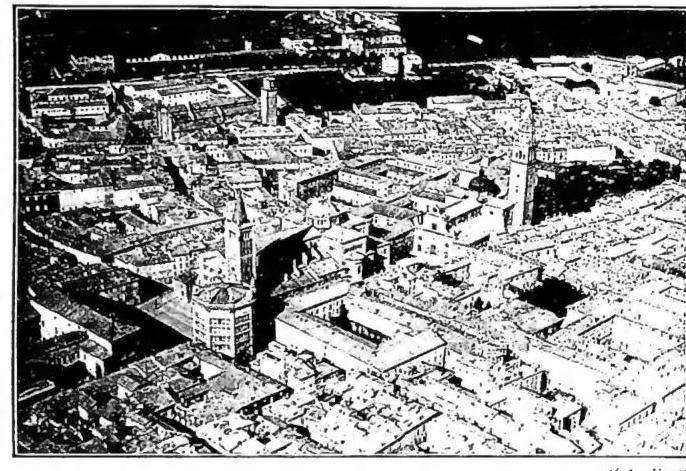
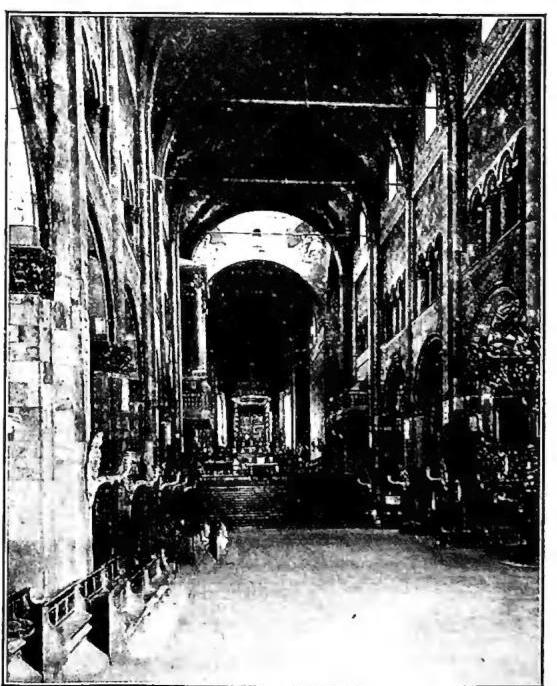
The cathedral of P. stood within the ancient city, and as early as the 9th century it is found dedicated to the Virgin and served by a Chapter of canons, for whom Bishop Vigbodo obtained donations from King Carlomanno on 29 December 877; rebuilt in 923, it suffered a fire together with the city in 1058. Its complete reconstruction in cut stone, with three naves and galleries, transept, crypt, and dome, is due to Bishop Cadalo. A magnificent monument of Romanesque art, at the beginning of the 16th ACCORSO DA REGGIO (v.) with the Assumption of the Virgin on the dome and images of saints in the pendentives; later in that same century came the paintings on the walls and vaults by Girolamo Mazzola and his son Alessandro, Michel Angelo Anselmi, Orazio Sammachini, Lattanzio Gambara, Francesco Testi, and Pomponio Allegri. On the square in front stand the tower begun in 1284, the octagonal baptistery, begun in 1196 and built entirely of Antelami (v.), and the Bishop’s Palace, recently restored to its original 13th-century appearance.
Alongside the churches that arose in the medieval period, the sumptuous sanctuary of S. Maria della Steccata was built in the 16th century, in the form of a Greek cross surmounted by a dome and containing paintings by accomplished artists; its underground crypt preserves the tombs of the Farnese, the Bourbons who ruled P., and their relatives. In 1566 Ottavio Farnese began the church of the Annunciata, in an elliptical form; it was completed only in 1692. The adjoining convent was entrusted to the Friars Minor.
For the collegiate church of Borgo S. Donnino, governed by an archpriest and soon made exempt, V. FIDENZA.
As in the other dioceses of Emilia, monasticism underwent considerable development in the diocese of P. In the immediate outskirts arose the Benedictine monastery of S. Giovanni Evangelista, founded by Bishop Sigifredo II at the urging of Abbot Maiolo in 983; it obtained a diploma from the Emperor Conrad II in 1037 and privileges from Paschal II, Innocent II, and Lucius II. Subordinate to it were the monasteries of S. Bartolomeo of Pistoia and S. Salvatore of Fonte Taone. On 17 July 1477 it became part of the Congregation of S. Giustina, and the credit for calling Correggio to fresco the cupola of their rebuilt church belongs to the munificence of those abbots. The monks were expelled at the suppression of 1810 and restored in 1816; they took part in the uprisings of 1848, were expelled again in 1849, and readmitted in 1852 through the efforts of Abbot Casaretto.
To that same Bishop Sigifredo is owed the foundation in 985 of the Benedictine nunnery of S. Paolo; it obtained privileges from Otto IV (1210) and Frederick II (1216). Correggio frescoed there, on commission from the abbess, the celebrated hall. The Benedictine nunnery of S. Alessandro was founded in the 9th century by Cunegonda, widow of Bernardo, the unfortunate king of Italy; subordinate to it were the monasteries of S. Bartolomeo at P. and S. Tommaso near Reggio; it paid a census to the Apostolic See, to which it swore allegiance. Innocent VIII subjected it to the abbey of S. Giovanni Evang. on 27 May 1486.
Brescello (v.), after the bishopric had ceased to exist, the Benedictine monastery of S. Genesio arose through the agency of the marquises of Tuscany; it paid a census to the Roman Church, while the monks claimed exemption from the jurisdiction of the bishop of P. It was granted in commendam in 1409. The monastery of S. Maria at Castione de’ Marchesi was founded in 1033 by the marquis Adalberto and his wife Adelaide and remained under the patronage of the Pallavicini marquises. In 1143 it passed under the Apostolic See, to which it paid a census; granted in commendam, it was given to the Olivetans in 1487.
Bishop Lanfranco of P. founded the abbey of S. Maria di Fontevivo in 1142, entrusting it to Cistercian monks whom he summoned from the abbey of La Colomba. In 1518 it passed under the authority of the monastery of S. Paolo in Rome, and then into the possession of the Farnese family in 1605.
P., which hosted Francesco Petrarch for some time, and had him as archdeacon of its cathedral, was not without schools that at intervals also bore the name of universities, until Duke Ranuccio I granted them special privileges in the 17th century. Du Tillot (v.) gave the university a better organization as part of his reforms (1768). At this time G. B. Bodoni (v.) established his celebrated printing house at P., and, following in the footsteps of the monk Benedetto Bacchini, the Conventual Ireneo Affò pursued his historical studies. The University, closed because of the political events of 1831, was revived after several disputes in 1854; it is now limited to the Faculties of Law and Medicine.
The State Archives possess part of the Farnesian Papers, while the greater part went to Naples with Charles of Bourbon. The Deputation of National History rendered distinguished service through its valuable publications, thanks also to an excellent library. - Vedi tav. LXX.
BBL.: Among the ancient historians, mention should be made of the Chronicon Parmens, in RIS, IX, part 9°, edited by G. Bonazzi; the chronicle of the Parmesan friar Salimbene in MGH, Scriptores, XXXII, so rich in detail; the Carte dei re d'Italia in the collections
(Alinari photograph)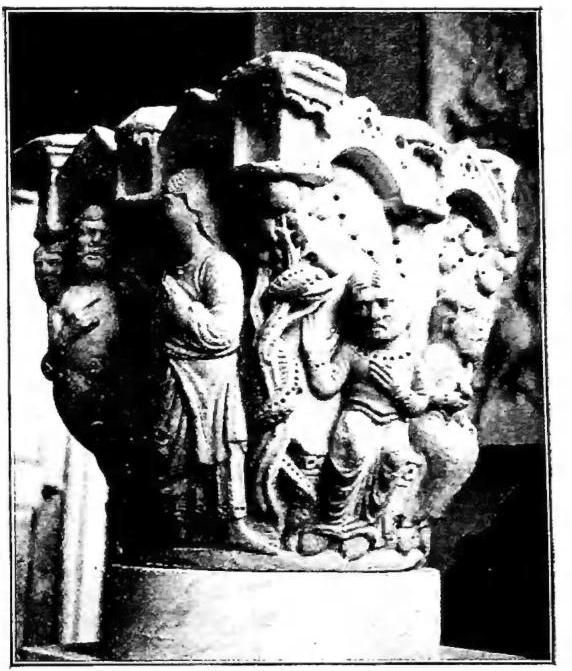
(Enit photograph)