
PATARIA. — This designation refers to a politico-religious movement that developed in Milan during the second half of the 11th century, in the period of the Gregorian reform and in its service. The p. was the reaction of the pure elements of the Ambrosian Church against the corruption spreading within it in the twofold form of simony and Nicolaitanism. The beginnings of the movement are not very clear. After the death of Ariberto d’Intimiano (1045), the Ambrosian Church received from the emperor Henry III a new archbishop, Guido da Velate; he appears to have been proposed by a group of nobles, while the clergy had put forward other names. The imperial appointment met with no resistance, but it should be noted that the reform movement later had as its leaders the ecclesiastics rejected by Henry III: Anselmo da Baggio, Landolfo Cotta, Arialdo da
The reform movement was led by Anselmo da Baggio, although in 1056 he had accompanied Archbishop Guido to the court of Enrico III, who had assigned him the episcopal see of Lucca: the Roman Church had already proclaimed the struggle against lay investiture. After Anselmo’s departure from Milan, the reforming group was led by Landolfo Cotta and Arialdo: the Emperor’s death and the absence of a strong government could permit a vigorous campaign against the simoniacal and Nicolaitan clergy and against Archbishop Guido, who was the indolent exponent of Milanese corruption.
Against the opponents, who had begun their propaganda in the churches and in public, the archbishop appealed to Pope Stefano IX and, at his invitation, summoned his accusers to clear themselves at the Synod of Fontaneto (Novara). Arialdo and Landolfo did not appear and were excommunicated in absentia.
At this point the term patari appears in the sources, first in Arnolfo (Gesta archiepiscoporum Mediolanensium), then in Bonizone and other writers. Arnolfo, however, saying «hos tales cetera vulgaritas hyronice Patarinos appellat», admits that he does not know the origin of the designation. Bonizone, on the other hand (Liber ad Amicum), says that patarini meant ragged people, tatterdemalions. Many attempts have been made to explain the term, and an effort has been made to connect it with the Milanese street called the «patari». The p. was soon to be transformed into a genuine organized party, thanks to the oath which, if at first it concerned only a commitment to a religious and temperate life, soon had to become a pledge of loyalty to the leaders.
In opposition to the excommunication of Fontaneto, the leaders of the p. appealed to the Pope; Stefano IX sent Anselmo di Lucca to Milan together with the Roman archdeacon Ildebrando (December 1057). The two apostolic visitors preached to the Milanese people, encouraging them to persevere in the work of purification, and admonished the clergy to cooperate in the reform. But now it was not only the high clergy who felt attacked, but also the Milanese aristocracy. Open struggles broke out in Milan, so that after the Council of 1059 Niccolò II sent two new commissioners to Milan, Anselmo di Lucca and Pier Damiani. The arrival of the two Roman legates caused serious disturbances: the anti-reform party tried to make the people believe that the apostolic delegates intended to threaten the traditional Ambrosian ecclesiastical liberties. Pier Damiani spoke to the people in the Cathedral and convinced them of the falsity of the accusations and the soundness of the reform program. The p. was thus the party of Rome, and Archbishop Guido submitted to the formula of recantation and the oath of obedience drawn up by Pier Damiani; indeed, he consented to undertake a penitential journey to S. Giacomo di Compostella and to appear at the Council of Rome in 1060, at which Niccolò II, having declared the royal investiture invalid, solemnly invested him with the archiepiscopal see of Milan.
(from Le Vie d'Italia e del mondo, Oct. 1955, p. 1107)
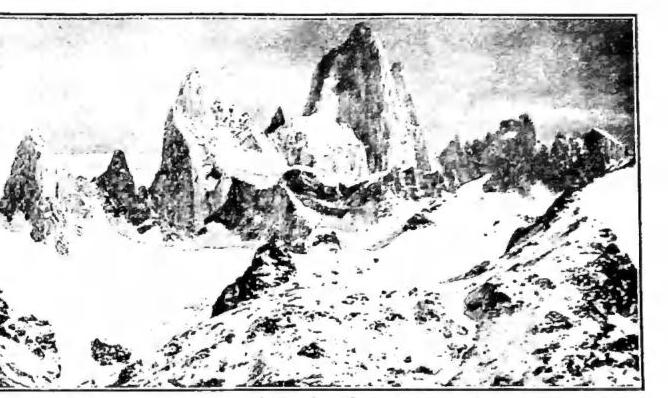
PATAGONIA - Cerro Fita Roy in the cordillera of Lago Viedma (3,375 m). The high peaks consist of dioritic rocks that split vertically.
the wounds sustained at Piacenza, he Erlembaldo (v.), a man of arms who gave the movement’s action a more political character. Arialdo was always at his side. The opponents attacked the p. with accusations of heresy ever more insistently; the chronicler Landolfo Seniore accused the patarini of being continuers of the heresy discovered around 1030 at Monforte, which appears to have been Manichaean in type. The accusation arose from the outward resemblance between the p.’s theories against the marriage of ecclesiastics and those of the heretics of Monforte, who were emphatically opposed to marriage and procreation. Some heretical element may have infiltrated the Milanese patarino movement, but there is no doubt that the conceptions of the p. have nothing in common with Manichaean heretical doctrines. Landolfo Seniore calls the patarini of Milan pseudo-prophets and false puri (falsis catharis). It is to be thought that it was precisely in the Milanese milieu that the term cathari first arose to designate the patarini, so that subsequently the two terms cathari and patarini ambiguously came to designate the heretics of Manichaean type, for whom no specific term yet existed in common usage; to say cathari and to say patarini was the same thing.
(photo. des)
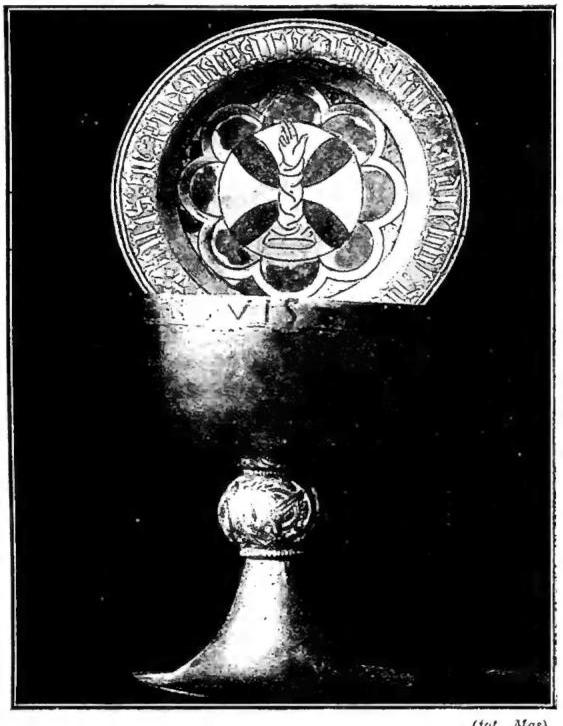
PATENA - Calice e p. d'argento dorato, detto di S. Rosenda. Il calice è del sec. XIII, la p. del sec. XV, provenienti da Celanova. Orense, Palazzo episcopale.
stere alla p.; questa inoltre con le sue violenze aveva offeso interessi, creato rancori, sì da permettere agli avversari di riprendere terreno. La morte di Erlembaldo nel 1075 segnò il crollo della p. La città ritornò all'obbedienza dell'Impero: l'aristocrazia chiese ad Enrico IV di designare un nuovo arcivescovo, che fu Tebaldo di Castiglione. Questi tenne un contegno ambiguo tra Chiesa ed Impero e nel 1078 fu scomunicato. Enrico IV entrò in Milano nel 1081 e trovò la città obbediente. Seguirono a Tebaldo due arcivescovi di parte imperiale, Anselmo da Rho ed Arnolfo, ma questi nel 1096 finì per sottomettersi ad Urbano II. La p. era scomparsa, ma aveva distrutto in Milano le tendenze imperialiste ed avviato la Chiesa ambrosiana al programma riformatore di Roma; anche l'aristocrazia aveva consumato le sue forze nella lunga lotta civile agevolando l'incipiente organizzazione comunale.