
FIDENZA, DIOCESI di. — In Emilia, in the province of Parma. The Church of F. traces its remote origins to the cult of the martyr s. Donnino, which developed on the site of ancient Iulia Fidentia. A legendary account (Passio s. Donnini, BHL, 2264), certainly later than the 5th century, relates that Donnino, cubicularius of the Emperor Massimiano, fleeing along the Via Aemilia, was seized 12 miles from Iulia Chrysopolis (Parma), near the river Sisterion (Stirone), and was there beheaded and buried. It does not appear that s. Donnino was a local martyr, but rather, on the basis of many significant indications, that he should be identified with the better-known Palestinian martyr commemorated in the Martyr. Hieronymianum on 5 November. Nevertheless, on the site there arose and became established that
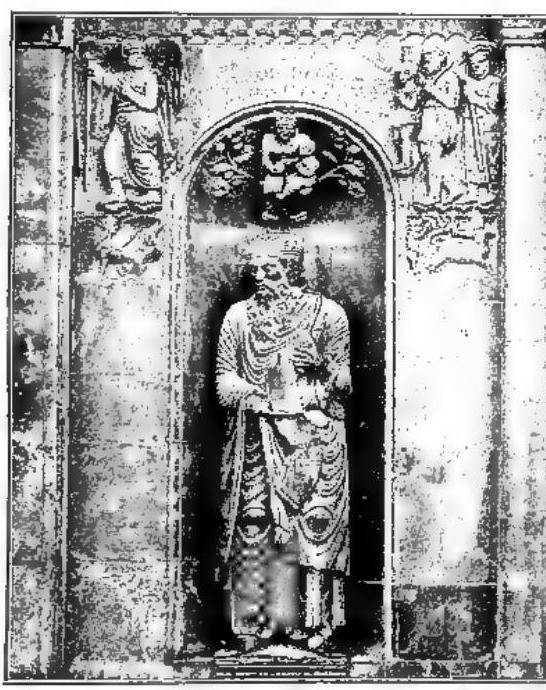
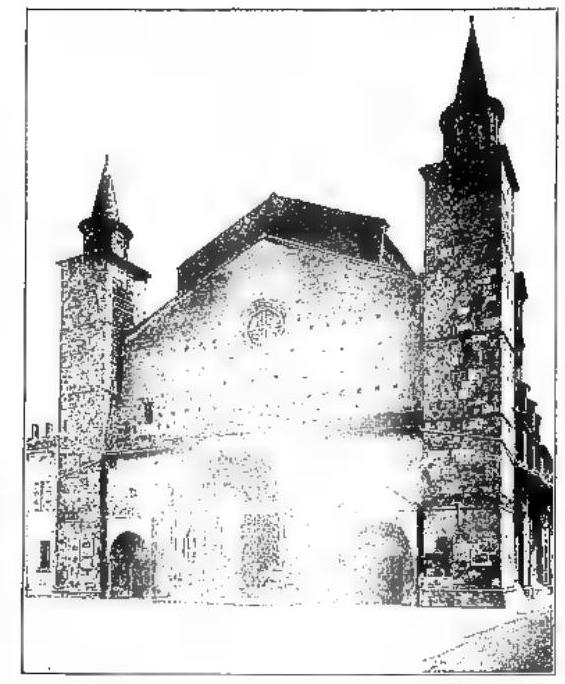
(Alinari photograph)
The primitive oratory of the 6th–7th century was succeeded by the older basilica of the 9th century and, in the 12th, by the new and monumental one, governed by a provost and a Chapter, which some hold to have been consecrated by Pope Pasquale II on 28 October 1106. The privileges of protection granted by Federico I in 1162 and of exemption from the bishop of Parma granted by Innocenzo III on 26 August 1198 (Potthast, p. 355) initiated and promoted, together with other factors, the process of freedom and autonomy of Borgo S. Donnino. In the 15th century it was granted in commendam with full exemption (nullus digiensis). With the bull Super universos of 12 February 1601, Clemente VIII established it as an episcopal see, confirming its status as a city, previously conferred upon it by Ranuccio Farnese (1592–1622), lord of Parma, to whom Borgo S. Donnino was subject, and appointing Papirio Picedi as its first bishop. In 1604 it became a suffragan of Bologna. It is now a diocese immediately subject to the Holy See, and has 63,000 inhabitants over an area of 62 km²; 86 churches, of which 57 are parishes; 3 male religious houses and 25 female religious houses.
MONUMENTS. – The most distinguished is in the Cathedral, a large Romanesque structure dating from the 12th century; the façade is unfinished, and there are Gothic completion structures on the exterior (apse) and in the interior (vaults), dating from the 13th century. The completed first level of the façade features an artistic porch with columns and two portals, as well as valuable sculptures (scenes from the life of s. Donnino, statues of David and Ezekiel) belonging to the school of B. Antelami. Of notable value are the two sculptures (David and Ezekiel), which seem closest to the master’s art. Inside, the 12th-century crypt stands on the site of the ancient basilica and preserves the marble urn of s. Donnino, with bas-reliefs illustrating the Saint’s life.
The Cathedral treasury possesses several examples of Romanesque goldsmithery, including a silver chalice with handles and two dragons, and a Eucharistic dove.