
CORTONA, DIOCESE OF. — In Tuscany, in the province of Arezzo, immediately subject to the Holy See. The date of the foundation of the episcopal church of Cortona is not very ancient, since the city was included within the territory of the very extensive diocese of Arezzo until the 14th century. The civil and religious disputes of the comune of Cortona (Guelph) with the bishops of Arezzo (Ghibelline) led to a definitive separation: John XXII
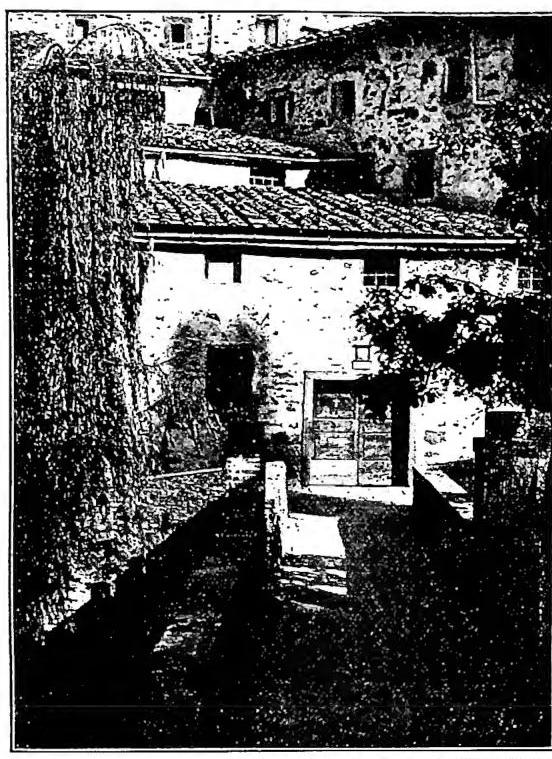
CORTONA — Partial view of the Convent of the Celle.
In the past, the city was distinguished by illustrious figures such as Fra Elia da C. (q.v.), companion of St. Francis, Cardinals Egidio Boris and Silvio Passerini, and especially the popular St. Margherita (q.v.; 1248–97).
Santa Maria di Farneta, one of the largest and most famous Italian abbeys, flourishing in the 11th century but of uncertain origins, was located within the city’s territory and, after 1325, incorporated into that of the diocese. When it was suppressed by the grand-ducal government in the 18th century, its assets were assigned to the Cathedral Chapter.
C. possesses a large number of monumental sacred buildings, not to mention the significant ones that reflect its finest civic history in the past. The Cathedral, dedicated to the Assumption of Mary, preserves few traces of the ancient 11th-century parish church: the entire interior was renovated in the 15th century and later (by Giuliano da Sangallo); the bell tower is a 16th-century construction. In the other buildings, one may say that all the ages of Christian architecture are worthily represented. A fine group of churches belongs to Gothic art: San Francesco, San Domenico, Sant’Antonio, Sant’Agostino. To the Renaissance: Santa Maria delle Grazie al Calcinaio, with its luminous, harmonious dome, begun in 1485, a model of style; Santa Maria Nuova, with a central plan, from the mid-15th century. The art of the 17th century is represented by the churches of Santo Spirito and San Filippo. A famous sanctuary is the temple of St. Margherita, dedicated to the Cortonan saint, begun in the 13th century but rebuilt in the past century; it houses the ogival tomb of the saint, carved by Angelo and Francesco di Pietro (1362), Cortonan artists.
Noteworthy for their quantity and quality are the works of sacred art. Among them are mentioned: the paintings of the great Cortonan Luca Signorelli (1441–1523), whose works today are collected in the church of the Gesù in C. in a singular picture gallery (Pinacoteca Signorelliana), and those of the other Cortonan Pietro Berrettini or da Cortona (1596–1669), some of whose paintings are preserved in the Civic Picture Gallery (Palazzo Pretorio). Some archival material of interest is preserved in the Chapter Archive and in the Municipal Library.
At present, the diocese, covering an area of 340 sq. km, comprises 52 parishes, 61 diocesan priests, 38 regular clergy, and 32,861 inhabitants, of whom 32,847 are Catholic (1948). — See plates XXXV–XXXVI.