
CIVITA CASTELLANA, ORTE AND GALLESE, DIOCESE OF. — In Latium, in the province of Viterbo, immediately subject to the Holy See. The three united dioceses each boast a considerable antiquity. At C. C., which arose near ancient Falerii, Christianity, as throughout suburban Tuscia, penetrated very early, according to the hagiographic traditions of the region concerning the martyrs Gratiliano and Felicissima (BHL, 3630), and according to the presence of an ancient Christian cemetery discovered in 1880. In the Passio of St. Mustiola (BHL, 4455, 4456), a St. Felix is mentioned who was martyred on 22 June at Falisca (C. C.); the same martyr appears on 23 November in the Martir. Hieronymianum (p. 617), immediately after Mustiola. The episcopal see, with the certain names of its first bishops, is already attested at the end of the 5th century, whereas for the immediately following period we have no information owing to the scarcity of documents.
Situated within the diocesan territory of C. C. were the once-famous abbeys of: S. Silvestro del monte Soratte, ancient and distinguished for its historical associations; in the 6th century it was directed by St. Nonnosus, so well known from the accounts of St. Gregorio Magno, and in the 8th he withdrew there
CIVILTÀ CATTOLICA (LA) — Chirograph in which Pius IX thanks and blesses the writers of C. c. (20 October 1852) — Rome, archive of C. c.
CIVITA CASTELLANA, ORTE E GALLESE - CIVITAVECCHIA
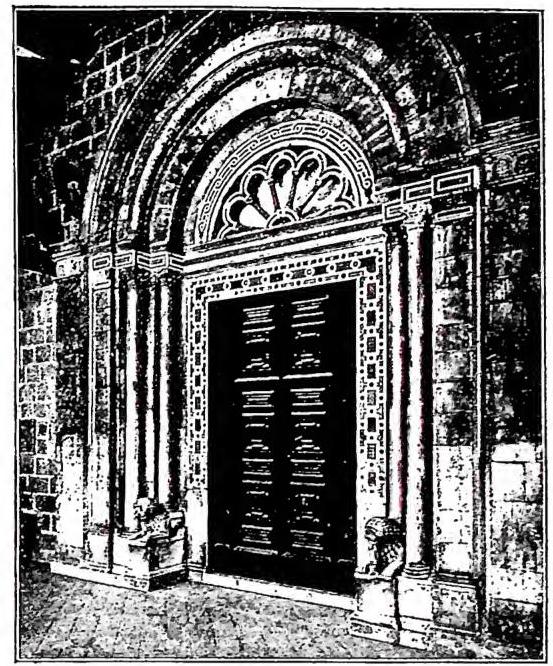
monastic life the Frankish prince Carlomanno; S. Maria di Falleri, whose church of the 12th century has fortunately survived, although not completely preserved, with its five apses: a typical Romanesque example of the Cistercian Order. Of the monuments, the most notable is undoubtedly the cathedral of S. Maria, which preserves the grandiose crypt supported by 45 columns. It was rebuilt after the 11th century; the portal is by Jacopo di Lorenzo, who in 1210, in collaboration with his son Cosma, built the splendid portico preceding the façade, which in its central arch takes on aspects of renewed magnificence. This portico undoubtedly represents one of the highest points in the trajectory linking the architectural art of classical antiquity with the Renaissance. In its central theme it truly anticipates the portico of the Pazzi chapel at S. Croce in Florence, by F. Brunelleschi.
The imposing fortress of C. C. was built by Alessandro VI largely during the two-year period 1500–1501 (G. Zucchini, Un documento, per la rocca di C., in Palladio, 1 [1938], p. 27). It has a pentagonal plan, to which Giulio II had Sangallo add the octagonal keep and the four drawbridges.
The oldest documents of C. C. were destroyed by fire, and consequently the archives of the curia, the cathedral, and the city are devoid of them.
The diocese of C. C. was joined by Eugenio IV in 1437 to that of O. (v.), and by Pio VII the other diocese of G. was added to it in 1803. Since 1925 the bishop of C. C. has been delegated for the parishes of Ponzano Romano and S. Oreste, formerly belonging to the nullius abbey of SS. Vincenzo ed Anastasio alle Tre Fontane.
The three united dioceses comprise 33 parishes over 700 sq km, with 130 priests for 60,000 inhabitants (1948).
Per O. e G., v.: GALLESE, DIOCESI di; ORTE, DIOCESI d