
CIVILTÀ CATTOLICA (LA) – Bimonthly journal of culture, published by the Italian Jesuits. The Jesuits had already been considering a periodical publication intended to impart a direction of sound orthodoxy to modern civilization before 1848; but the dispersal of the Society of Jesus in Italy and political events caused the project to fail. Father Carlo Curci, a Neapolitan (1810–91), a combative opponent of Gioberti, returning to Italy toward the end of 1849, brought with him a concrete plan, carefully worked out in all its details. Through Cardinal Antonelli,
at Portici, he presented it to Pius IX, who received it enthusiastically, insisted on its prompt implementation, and also provided the initial means necessary for its financing. Curci gathered around himself a select group of collaborators, including Father Luigi Taparelli d’Azeglio, already the celebrated author of the Saggio teoretico, the man of letters Antonio Bresciani, Matteo Liberatore, philosopher, Giovan Battista Pianciani, scientist, and others.
The first issue of the C. c. appeared in Naples on 6 April 1850, with a programmatic article by Curci, others by Taparelli and Liberatore, and the first installment of Bresciani’s novel L’Ebreo di Verona, which, by interweaving the great events of the preceding period with its romantic plot, aroused immense interest and was the principal factor in the new journal’s immediate and general success. The success was such that the first volume had to be reprinted as many as eight times; by the end of the first quarter there were already 6,307 subscribers, and the number soon rose to 11,800. Its outward form and the arrangement of its contents (in articles, a review of the press, and contemporary chronicle; the bibliography was introduced in 1856; the serialized novel) have remained more or less unchanged. Until 1933 the authors remained anonymous; from that year onward the articles have been signed.
Curci remained, at least nominally, in charge until 1864; from as early as 1861, however, he was moving toward new political orientations and gradually distancing himself from the journal he had founded. After leaving the Society in 1877, he also began attacking it in virulent writings. The C. c. presented itself as an organ intended to lead civilization, which from the sixteenth century onward had been polluted by heterodox infiltrations, back to its original and legitimate Christian and Catholic sources: hence the reason for its title. Politically, it professed respect for every legitimate form of government, including representative government. In practice, however, it did not take long to subject constitutional governments and modern democratic forms to implacable criticism, as infected with heterodoxy. Thus, while on the one hand it incurred the wrath of Ferdinand II of Naples, who prohibited the entry of the C. c. into the kingdom, on the other it became exceedingly unwelcome to the liberal governments of the time, especially Piedmont. Farini established the Turin journal Il Cimento (1852–1856) as an antidote to the influence of the C. c.; Bertrando Spaventa refuted its doctrines there in articles that G. Gentile collected in a volume (La politica dei Gesuiti, Rome 1908); and Francesco de Sanctis published there a celebrated demolition of Bresciani’s novel.
In October 1850 the C. c. moved to Rome and, after occupying other premises, settled in the Palazzo dei Convertendi at Sossacavalli (now the S. C. della Chiesa orientale on the Via della Conciliazione). Because of the occupation of Rome in 1870, it had to emigrate, but after a brief interruption it reappeared in Florence; it returned to Rome once again in 1877, on the Via Ripetta, where it still resides. It possesses a richly stocked library, a valuable archive, its own printing press, and also its own publishing enterprise. Today the work is supported by a society of friends scattered throughout the peninsula, connected with one another by a special organ entitled Gli Amici della C. c. At present the journal has approximately 20,000 subscribers, the highest number reached thus far.
The history of the C. c. is closely bound up with the religious, moral, and political life of the past century: it remained uninvolved in none of the great events that took place. Anyone wishing to become informed about the great religious events (the dogma of the Immaculate Conception, papal infallibility, the Syllabus, the Vatican Council, Americanism, Modernism, the condemnation of Action française, the Conciliation, etc.) would find in it valuable sources of information; likewise, the historian of either the Risorgimento or Italian national life will be unable to dispense with consulting the political articles and the rich, highly informative chronicles of the C. c., which constitute a kind of continuing documentation and critical commentary on them. The restoration of the doctrines of St. Thomas Aquinas and
CIVILTÀ CATTOLICA - CIVITA CASTELLANA, ORTE E GALLESE
The restoration of the doctrines of s. Tommaso d'Aquino and that of sacred music owe much to the prolonged and tenacious action of members of the C. c.: the former to Taparelli and Liberatore, the latter to A. De Santi.
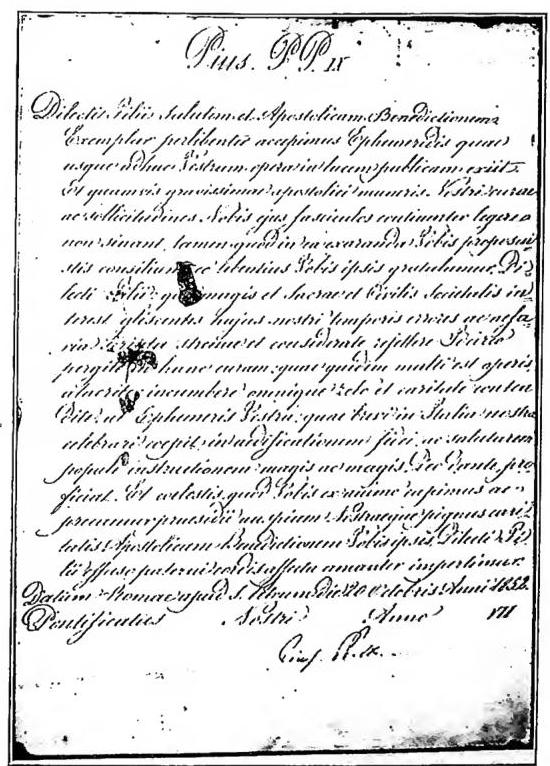
The Holy See has honored the journal with repeated public expressions of trust and esteem. In 1866 Pius IX constituted its editorial staff as a special college; in 1890 Leo XIII gave it a more clearly defined character and assigned to it, as one of its proper tasks, the defense and propagation of the doctrines of the Angelic Doctor. Its faithful adherence to the directives of the Holy See and the inspired character of some of its publications confer upon the C. c. a high authority not only in Italy but throughout the Catholic world.
Its editorial staff has always included eminent men in the various branches of knowledge, such as, in the juridical and moral sciences, Taparelli d'Azeglio (1793-1862) and Salvatore Brandi (1852-1915); in theoretical philosophy, Matteo Liberatore (1810-92), Giovanni Cornoldi (1822-1892), and Giovanni Busnelli (1866-1944); in the historical sciences, Raffaele Garrucci (1812-81), Giuseppe Brunengo (1821-91), Hartmann Grisar (1845-1932), and Ilario Rinieri (1853-1941); in Christian art, Carlo Bricarelli (1857-1931); in the history of ancient peoples, Antonio De Cara (1835-1905); in addition, the Dante scholars Francesco Berardinelli (1816-93), Cornoldi, and Busnelli; the apologists, polemicists, and polymaths Gaetano Zocchi (1846-1912), Angelo De Santi (1847-1922), Enrico Rosa (1870-1938), and Mario Barbera (1877-1947); in narrative art, Antonio Bresciani (1798-1862), Raffaele Ballerini (1830-1907), Giovanni Giuseppe Franco (1824-1908), De Santi, and Barbera; in the social and economic sciences, Matteo Liberatore and Antonio Pavissich (1851-1913).
(phot. Alisoni)
CIVITA CASTELLANA, ORTE E GALLESE, diocese of - Main portal of the Cathedral, Cosmatesque work by the masters Lorenzo and Jacopo (early 13th century).