
DE SANCTIS, FRANCESCO. – Literary critic and politician, born at Morra Irpina (Avellino) on 28 March 1817, died at Naples on 19 December 1883. Having begun the study of jurisprudence in Naples, he instead attended with enthusiasm the private literary school of Basilio Puoti, later leaving it by moving from lexical purism to livelier methods, in which words were valued as living “things” situated within their own history: with this orientation he opened a school of his own and taught at the Military College.
Meanwhile he became passionate about the new political ideas, following the parliamentary events of that country in the French press. In 1848 he took part in the insurrection in Naples, urging his pupils to join it with the famous cry: “Are we an Arcadia? Literature is life.” Arrested in Calabria after the Bourbon restoration, in December 1850, he was held in prison until 1853, in Naples, at the Castel dell’Ovo. There he devoted himself to the study of the German language, especially in order to read the Romantics and Hegel’s works in the original; he also translated Rosenkranz’s handbook of the universal history of poetry, in which Hegelian aesthetic theories were applied and disseminated. From this point onward D. S., while maintaining his own originality in relation to the German philosopher’s rigid aesthetic system, resolutely oriented himself toward idealistic historicism. In
1853, exiled from Malta, he took refuge in Turin, where he taught at a girls’ boarding school and wrote articles for the Turin press. In 1855 he wrote fervently against the Muratist projects in the Kingdom of Naples, as contrary to Italian ideals and interests. From 1856 to 1859 he taught Italian literature at the Zurich Polytechnic and came into direct contact with German-language culture. In 1860, following the political upheavals, he became governor of Avellino; then director of public education in the lieutenancy of Naples, and subsequently Minister of Public Education (22 March 1861–5 March 1862) of the new Kingdom.
He then devoted himself intensively to journalism. For the proper constitutional functioning of the State, he considered a strong opposition to the party in government necessary and, having left the Cavourian-tradition majority, moved to the Left.
From 1871 he was professor of comparative literature at the University of Naples. After the Left came to power (26 March–14 December 1878; 25 November 1879–1 January 1881), he served twice more as minister.
He felt the appeal of Machiavelli’s “effective truth” and interpreted Vico’s historical teaching along the lines of Hegelian immanentist schemes. In him, religious problems were completely absorbed into an earthly morality, and the Church, as to many other men of the Italian political Risorgimento, appeared predominantly as a political institution in conflict with Italian unity.
D. S. is considered the leader of Italian aesthetic criticism, in opposition both to the preceding classical, rhetorical and content-based criticism and to contemporary historical criticism, whose leader was considered to be Carducci and which was inspired by positivistic philological rigor: developing Foscolo’s method, which investigates the author’s poetic biography as the reason for the work’s existence, D. S. studies the work as a “living individual,” as a “whole” in which the universe is organically summarized, so that all the values of the universe appear in the work insofar as they have become organically internal to II. On the other hand, he was influenced by the Risorgimento conception of literary history as civil history, and this conception inspires his History of Italian Literature (1870), which has been defined as a history of Italian culture.
This history contrasts far too simply a Middle Ages, conceived in an Enlightenment manner as a cultural period dominated by the tendency toward an abstract hereafter, with the Renaissance as a recovery of the sense of this world, but accompanied by the hypertrophy of the intellect to the detriment of the will and of moral commitment to life. In the seventeenth century and in the Arcadia he therefore sees poetry dissolving into generic musicality, whereas from Parini onward he sees the revival of human ideals which in Manzoni are perfectly “brought down into reality.” A Romantic prejudice remains in D. S. in the form of a certain taste for “passion”: this prejudice leads him to characteristic errors, such as his failure to understand the poetry of Manzoni’s Lucia and his confusion, in connection with Segneri, between psychological sincerity and artistic sincerity.
D. S. nevertheless remains the greatest Romantic critic: his teaching is civic education and, at the same time, education in autonomous artistic contemplation; the two demands are reconciled in the conviction that there can be no great poetry where intense moral life is not present simultaneously. In his final years, however, D. S. felt the appeal of evolutionary positivism, as witnessed by some of his last essays on Zola and on Darwinism in art (1877–83). His critical itinerary as a whole, therefore, is far more complex than it appears from the simplification made of it by Croce.
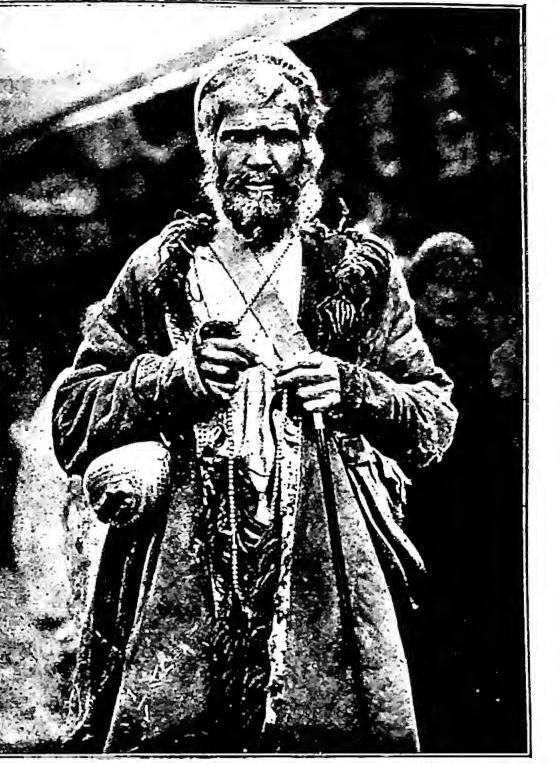
DERVISCI – A Muslim mendicant in Peshawar (India).