
### AVELLINO, diocese of
In Irpinia, in the province of Avellino. Divided into 50 parishes, it has 124 diocesan priests and 27 regular priests; 120,000 inhabitants, all Catholic (1948). The patron saint of the diocese is St Modestinus.
The ancient Abellinum, a station of the Samnite Hirpini, is mentioned by Frontinus among the Roman colonies whose territory was assigned to veterans. It declined with the barbarian invasions, only to rise again in the 9th century in a nearby location at the foot of Monte Vergine, above which the homonymous sanctuary was built (1119) on the ruins of a temple of Cybele. The ruins of the ancient city attest to its grandeur and level of civilization. In 1130, at Avellino, there took place the meeting between the antipope Anacletus and Duke Roger, from which arose the constitution of the Kingdom of the Two Sicilies. Innocent II and Emperor Lothair, having allied themselves, reconquered (1137) Naples and Campania and, having taken up residence in Avellino, elected there a new duke of Apulia and Calabria in the person of Ranulf, count of Avellino. But Roger, having landed at Salerno, took and sacked the city, making the Pope prisoner. Avellino later obtained recognition of its conquests and of royal dignity. In 1586 the Royal Chamber of Naples alienated its lordship to the Caracciolo family.
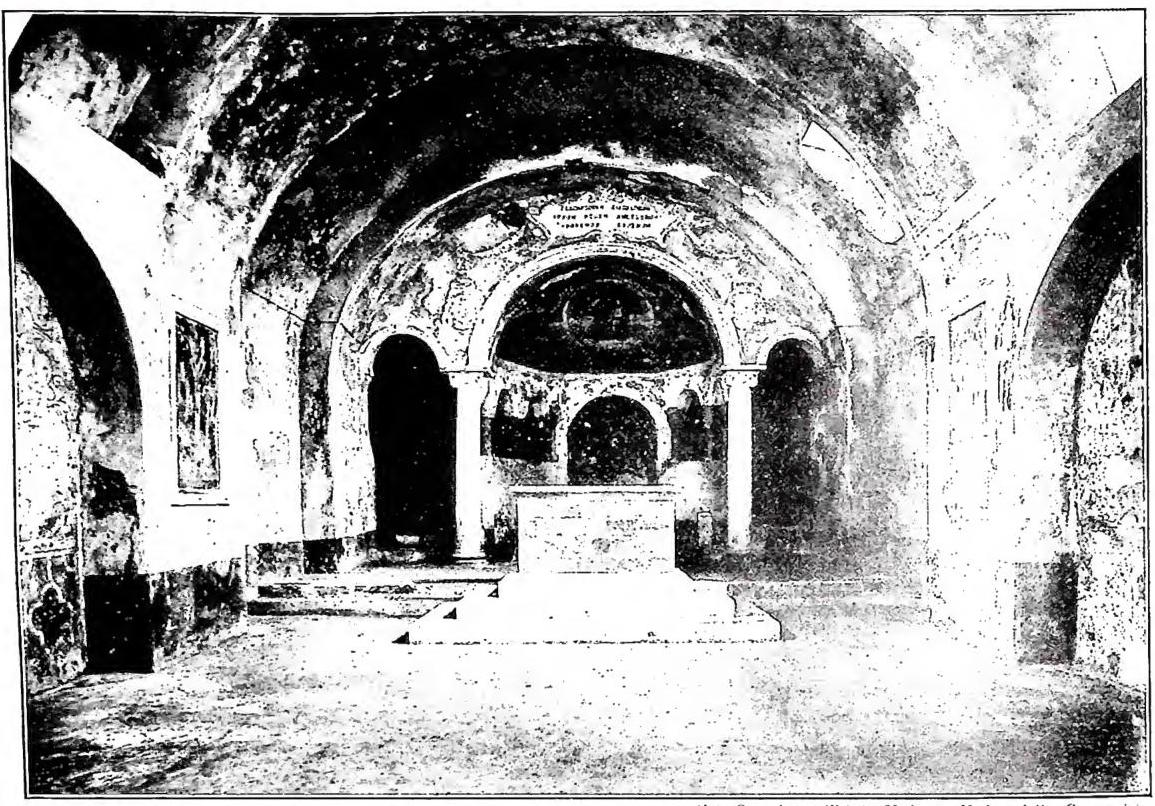
(photo Saynaint, at the Medicean Arts, Modern Campania)
AVELLINO — Small basilica of Prata. Apsed basilica with ambulatory (8th century).
The most ancient documentation for Christianity in the diocese of A. is provided by a Christian sepulchral inscription of the year 357 containing the expression “cum sanctis sociatus” (CIL, X, 1191).
As regards the bishops, the earliest known so far is a Thimotheus of the end of the 5th century, present at the Roman Synod of the year 499 where he signed as Timotheus episcopus ecclesiae Abellinatis (Gesta Synodorum Romanorum, in MGH, Auctores Antiquissimi, XII, 399-455); of a bishop Sabinus there remains the sarcophagus where, between two candelabra, the sepulchral inscription in verse is carved (CIL, X, 1194), of the same type as that on the sarcophagus of his deacon Romolus (CIL, X, 1195); both sarcophagi and inscriptions seem to belong to the 6th century, as do two other inscriptions relating to a priest Ioannis of the year 541 and a reader who died in the year 558.
One kilometre from Prata are the remains of a series of small cemetery basilicas excavated in the rock. Two columns delimit an elliptical space closed by walls up to half their height, above which spolia columns with rough capitals support arches on which a vault is set, decorated (in the 15th century) with a representation of the Lord between two angels. In the centre a small niche, and below runs a bench. Beyond this space there is a round crypt with arcosolia and two terracotta sarcophagi, and a cubicle with faded and undecipherable paintings.
In 969 the diocese became a suffragan of Benevento. In 1446 Paul III united with A., aeque principaliter, Frigento (which had united Acqua Putrida and Eclana); the bishop bore the two united titles until the concordat of 1818, in which Frigento was suppressed as an episcopal title and became a simple collegiate church. A. is the birthplace of the blessed Franciscan Giovanni d’Arminio Monforte, d. 1313.
The cathedral was begun in 1132 by Bishop Roberto. In the collegiate church of Atripalda a large group of martyrs’ tombs is venerated, among them St Sabinus, bishop, and St Romolus. Abbeys and monasteries: S. Benedetto (united in 1452 with the cathedral), S. Paolo, S. Giovanni Battista.