
ASTI, DIOCESI di. — City of Piedmont, on the hills south of the Tanaro, near the confluence of the Borbore and the Versa. An important agricultural and wine-producing center, it is the capital of a recently established province (1,510 sq km). The diocese, suffragan of Turin since 1817, has 162,000 inhabitants, almost all Catholics, and comprises 120 parishes, 235 diocesan priests, and 35 religious priests (1948).
It was a Roman colony and municipium (Asta or Hasta) mentioned by Pliny. Occupied at the fall of the Empire by the Goths and the Burgundians, devastated by Alaric and Alboin, it rose again under the Lombards, who made it an important duchy, later transformed by Charlemagne into a county. Around 1100 it became a commune. Internal factions and conflicts with the neighboring cities of Pollenza, Alba, and Alessandria, and with the marquises of Monferrato and Saluzzo, forced it to undergo alternating periods of freedom and subjection to the Savoyards, the Angevins, the Palaeologi, and the Visconti. In 1378 A. was given as a dowry by Gian Galeazzo Visconti to his daughter Valentina, wife of the duke of Orléans; it remained under the rule of this house until the Peace of Cambrai (1529), when Charles V ceded it to Beatrice of Portugal, wife of Charles III of Sa-
voy, who took definitive possession of it in 1538. In the following centuries it endured sieges by the Spaniards and the French, always returning under the rule of the House of Savoy.
The diocese of A. arose at the end of the 4th century, like others in northern Italy, through the division of the diocese of Milan, of which it remained a suffragan until 1817. The oldest episcopal catalogue, compiled in 1605 by order of Bishop Aiazzo, begins with Pastore, who took part in the Milanese Synod of 451. It is unlikely that St. Evasio, as the legend asserts, was bishop of A. in 789. Likewise St. Secondo, patron of the city, mentioned in a long cyclic passion, known as that of the Saints Faustino and Giovita (BHL 2836 and 5263), as having lived under Hadrian, was erroneously transformed into a local bishop. The diocese, initially very extensive, underwent divisions with the establishment of the neighboring dioceses of Alessandria, Mondovì, Casale, Saluzzo, and Fossano. The diocese of Alba was united with it for a short time (985–992; 1803–1817). The present boundaries were established by Pius VII in 1817. Vittorio Ame-
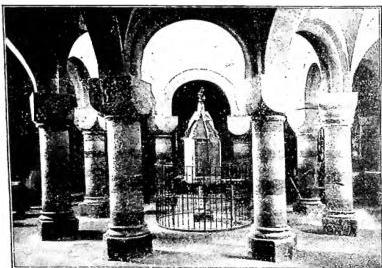
Amedeo granted the bishops of A. the title of prince.
(photo Alinari)
The cathedral, built on the foundations of a temple dedicated to Juno, consecrated in 1090, and destroyed in 1323, changed its appearance several times during the early centuries; it assumed its present Gothic form in the 14th century and was completed only in the 18th. The Romanesque bell tower of the 13th century remains from the original church. The interior is noteworthy for its imposing Gothic framework; four holy-water stoups are preserved there, made from two Roman and two Romanesque capitals. The first cathedral is said to have been built near the crypt of s. Secondo, where the collegiate church dedicated to the same saint was erected.
Other important monuments are: S. Secondo, in 13th-century Romanesque-Gothic forms; S. Pietro in Conzavia, with terracotta decorations and, in the interior, a small temple, now a baptistery, said to be the remains of a shrine dedicated to Diana; S. Maria (in the hamlet of Viatosto); the abbey of Vezzolano, near Albugnano, built in the 10th century and recently restored; at Cavagnolo, the Benedictine abbey of S. Fede, a pure example of Romanesque-Lombard architecture. - Vedi Tav. XXI.
Noemi Crostarosa Scipioni