
FOSSANO, DIOCESE of. — Suffragan of Turin.
In the province of Cuneo, it comprises the territory extending to the left of the Stura River, at the intersection of the railway lines and state roads connecting Turin with Ventimiglia and Savoy, a flourishing area for commerce and industry. Over an area of 264 sq. km., it has 39,000 inhabitants, all Catholic; 30 parishes, 7 chaplaincies, more than 200 churches and oratories, 88 diocesan priests and 10 religious priests, numerous educational and charitable institutions, major and minor seminaries, the latter annexed to the retreat house at the renowned sanctuary of Cussanio (3 km. from F.), built in 1872 on the site of the Augustinian church and convent (17th century), and dedicated to Maria S.ma Madre della Divina Provvidenza in remembrance of the twofold miraculous apparition to a deaf-mute (1521). Patron: St. Giovenale, bishop of Narni, where he died in 376. Feast on 3 May.
HISTORY. — The body of the Saint, stolen and abandoned near F. by a canon from Toulouse, was found around 1220 and deposited in the collegiate church of Romanisio, a settlement of Roman origin. After F. was constituted as a commune (1236), the inhabitants of Romanisio transferred there with the collegiate church, and on 29 Dec. 1279 they brought the Saint’s relics there, adding his name to the church of S. Maria.
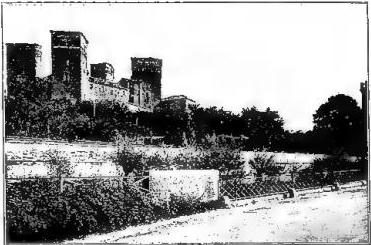
After passing under the dominion of Marquis Manfredo IV of Saluzzo (1304), of Charles II of Anjou (1307), and again of Saluzzo, in 1314 F. entered, by a pact of submission, the dominion of Prince Filippo of Savoia-Acaia (who built the four-towered castle between 1324 and 1332). When the Acaia line died out in 1418, F. passed directly under Amedeo VIII, duke of Savoia from 1416. After the Peace of Cateau-Cambrésis (1559), F., which had remained constantly faithful to the Savoia, evading French occupation in 1536, 1553, and 1557, received Duke Emanuele Filiberto on 9 Oct. 1560; he granted it the title of city and the coat of arms bearing the motto Fidelitatis insignia (20 Feb. 1566), and immediately began proceedings to have it made an episcopal see. The first three bishops appointed died before the negotiations were completed; these lasted more than 30 years, until Carlo Emanuele I proposed Msgr. Camillo Daddeo of Mondovì, and Pope Clement VIII acted (15 Apr. 1592), raising the collegiate church of S. Maria and S. Giovenale to cathedral status and detaching 15 parishes from Torino and 4 from Asti. Twelve bishops succeeded one another, with a single interruption (1701–27), until the suppression of the diocese on 12 Aug. 1803, following the Concordat between Pius VII and Napoleon, by which it was united with that of Mondovì. The diocese was reconstituted on 17 July 1817 by Pius VII himself, at the request of Vittorio Emanuele I, but with greatly diminished territory. The bishops were: from 1821 L. Franzoni (archbishop of Torino in 1832); from 1836 Bruno di Tournafort; from 1848 Senator L. Fantini; see vacant from 1852; from 1871 E. Manacorda; from 1910 G. Signori; from 1919 Q. Traviani; from 1934 A. Soracco; from 1943 D. Borra.
Among the distinguished ecclesiastics, the following should be remembered: the provost Blessed Oddino Barotti (1344–1400); Blessed Bartolomeo da Cervere, inquisitor of the Waldensians, martyred on 21 Apr. 1466; Ancina (v.); the canon L. Craveri
Of the various religious orders that existed in F. (Templars, Benedictines, Augustinians, Somaschi, Filippini, etc.), only the Capuchins and Salesians remain, in addition to a monastery of Cistercian Benedictine nuns and other women’s religious congregations.
Noteworthy monuments include: the cathedral Basilica, in Baroque-Neoclassical style, by Querino
(1778), with a fine Supper by Clàret and paintings by L. Morgari; the massive bell tower dates from 1397; the church of the Most Holy Trinity, by Gallo, and the church of S. Filippo, two jewels of pure Piedmontese Baroque, with frescoes by the Pozzi brothers; the major hospital, also by Gallo; the castle and remains of ancient walls. Precious and artistically valuable holy-water fonts, vestments, and sacred vessels are also found in the churches outside the city.
Virginio Marco dell'Agnola