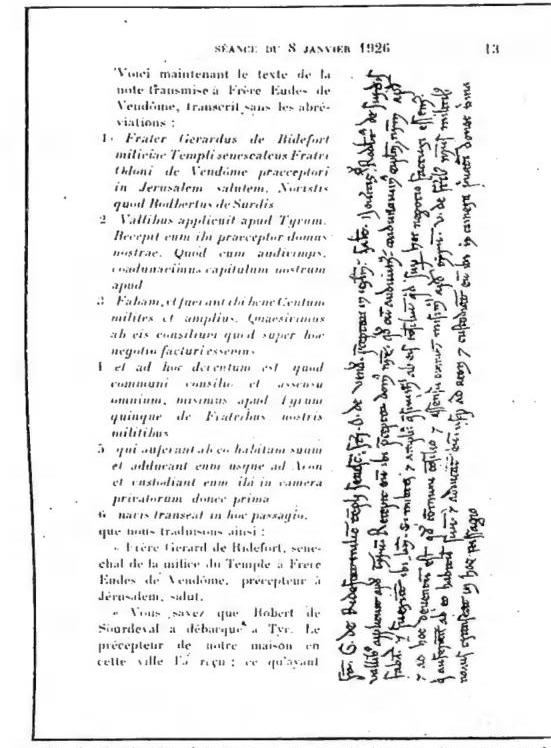
TEMPLARS. - The Order of the Temple owes its origin to Hugh of Payns, who persuaded a group of knights to go to Jerusalem to secure the passage of pilgrims from Jaffa to the Holy City. The newcomers settled around 1119 in a part of the royal palace called the Templum Salomonis, from which they took their name of Templars. Subsequently, all the numerous houses they built, both in the Holy Land and in the West, were designated by the name of “Temples.” The Council of Troyes (January 1128) regularized their juridical status, and St. Bernard drew up for their use a strict rule (cf. H. de Curzon, *La règle du Temple*, Paris 1886; G. Schnürer, *Die ursprüngliche Tempelregel*, Freiburg in Br. 1903).
The members of the Order were divided into three distinct classes: knights, recruited from the nobility; sergeants, or squires, drawn from the bourgeois classes; and chaplains, charged with the service of worship. The knights wore a white mantle, and the sergeants a black or reddish mantle. Eugenius III added a red cross to their habit. In addition to the three religious vows, the Templars took an oath to defend the Holy Places. Recruited as they were from among knights, they possessed the virtues and defects of that class. Of exemplary courage and disciplined obedience to their superiors, they fought the infidels and performed deeds of arms that filled their contemporaries with admiration. The Grand Master William of Beaujeu fell heroically in the disaster of St. John of Acre (1291). Yet these valiant warriors were guilty of reckless daring, for they too often allowed themselves to be slaughtered by the enemy, launching themselves against it before the main Christian forces arrived. Proud of their exploits, they succumbed to arrogance and pride and, pursuing a policy of their own, opposed interests contrary to those of the kings of Jerusalem; they imprudently broke useful truces and, instead of allying themselves with the Mongols to their advantage, drove them to war. They also imprudently came into conflict with the Hospitallers and took part with the Venetians against the Genoese. All in all, their conduct contributed to the collapse of the Latin Kingdom of Jerusalem.
The Templars also suffered another misfortune: while they indeed earned a reputation as skilled financiers in administering the considerable properties they held throughout Christendom—whose revenues provided the means indispensable for maintaining their troops—they were also seen as selfish, even avaricious. Economical with their treasure, on 6 May 1250 they refused to advance to St. Louis the money needed to ransom prisoners taken by the infidels in the disaster of Damietta; Joinville recounts that the King, seizing an axe, threatened to break open their coffers, which forced them to yield (cf. ed. by N. de Wailly, Paris 1838, §§ 380–85).
Driven from Syria and unable to establish themselves on the island of Cyprus, the Templars settled in the West and rendered important services to merchants and kings by acting as bankers who ensured, without risk, the transfer of sums deposited with them.
S. SEE.
Brought before three cardinals in Paris, the Grand Master James of Molay protested his innocence. Philip the Fair would not allow him to present proof; indeed, by his order, this unfortunate man was burned at the stake (18 March 1314).
The question of whether the Templars were guilty or innocent arises only with respect to France, and even today it remains controversial. Some historians uphold the good faith and religious zeal of Philip the Fair; others, however, believe that he committed an abuse of power and a denial of justice. It seems that the latter view is correct. If the Templars made confessions, this occurred only under the pressure of the fear of capital punishment. The orders given by the King of France to his officials were peremptory: “he promised them pardon if they confessed the truth, returning to the faith of the Holy Church, otherwise they would be condemned to death” (cf. G. Lizerand, *Le dossier de l'affaire des Templiers*, Paris 1923, p. 27). Moreover, it is certain that the prisoners underwent frightful tortures. The friar Ponsard de Gisi “confessed that he had been placed in a pit, his hands bound behind his back so tightly that blood spurted from his fingernails... protesting that, if he were subjected to torture again, he would recant everything he had said and say whatever they wished” (G. Lizerand, *ibid.*, pp. 157–59).
The use of torture explains the large number of confessions collected by the royal officials. Yet as soon as the Templars appeared before the cardinals charged with examining them, they retracted their confessions. Furthermore, there is no material evidence of the alleged crimes. The royal sergeants did not find a single copy of the supposed secret rule that proclaimed heresy and infamous customs, nor any of the idols to which their accusers claimed the Templars rendered idolatrous worship. Without doubt Philip the Fair desired the Templars’ ruin, for, always short of money, he coveted their wealth. In any case, he exerted such pressure on Clement V that the Pope suppressed the Order without, however, condemning II.
TIME. - In general, it is the interval between two successive events and is often imagined as a homogeneous and immutable flow in which events occur; more precisely, time is the duration of mutable things. A distinction is made between real time, which is the very duration of reality; physical time, studied by physics and measured by clocks; biological time, which governs the growth and decline of living beings; psychological time, experienced in consciousness; and absolute and imaginary time, a purely incorporeal, immutable, unlimited flow independent of other things. It is exceedingly difficult to define (cf. St. Augustine, *Confessions*, XI, 14: “What, then, is time? If no one asks me, I know; if I wish to explain it to one who asks, I do not know”; cf. B. Pascal, *De l'esprit géométrique*, ed. L. Brunschvicg, Paris 1897, p. 170), and it raises the same problems as space, giving rise to three views: subjectivist (time is subjective), ultrarealist (time is a reality existing independently of other things), and moderate realist (time depends on the existence of mutable matter).
I. PHILOSOPHY
In Greek philosophy, time is conceived in a realistic sense. Pythagoras thought of time as “the sphere of all that encompasses” (H. Diels, *Die Fragmente der Vorsokratiker*, Berlin 1951, B, 33; cf. R. Mondolfo, *L'Infinito nel pensiero*).
Templars – Letter from the knight Gerard of Ridefort to Odo of Vendôme (c. 1184) concerning the capture and degradation of the knight Robert of Sourdeval.
Plato connects mutability with time and immutability with eternity (Tim., 37 d. sgg.). According to Aristotle, time is an aspect of the continuous motion (ἐννόησι) of bodies, upon which he bases its subjectivity. Time is not motion, because there are many movements, whereas time is unique; moreover, motion is more or less swift, but not so time (Phys., IV, 10, 218 b. 9 sgg.). Nevertheless, time depends on motion; and since magnitude is continuous, so too is the motion that traverses it and the time filled by motion (op. cit., IV, 11, 219 a 10 sgg.). There exists a before and an after in position (here and there); hence also in motion (passing through a point near and then far from the origin); when we note the before and after in motion, that is, when we distinguish two points in the motion and an interval between them, we recognize time. Time is thus «the number» (measure) of movement according to the before and after; ἀριθμός κινήσεως κατά τὸ πρόστερον καὶ ὀστέρον (ibid., 219 b 1). Time is then succession as such, the passing insofar as it is the passing of movement. Time is not the number with which we count, but what is numbered (ibid., 219 b 8). There is only one time for all things, because unique is the number that measures all movements (op. cit., IV, 13, 223 b 3-12). Events are in time insofar as they are measurable by it: they are thus in time as bodies are in place (op. cit., IV, 12, 221 a 9 sgg.). Since time is the measure of motion, it is also the measure of rest (ibid., 221 b 7 sgg.). Time is objective; if motion exists, time also truly exists (op. cit., IV, 14, 223 a 21-29).
The Stoics say that time is incorporeal, an interval of the motion of the universe (Diogenes Laertius, VII, 1, 141). Zeno asserts that «time is the interval of motion; and it is also the soul and the norm of speed and slowness of individual beings; and in conformity with it all things begin, end, and exist» (I frammenti degli stoici antichi, a cura di N. Festa, I, Bari 1932, p. 86). For Epicurus, time accompanies every movement (Stobaeus, Ecl., I, 8, 252). Lucretius observes that «tempus iterni per se non est», but exists together with the unfolding of things (De rerum nat., I, 459 sgg.). Neoplatonism understands time in a subjective sense. The Platonist links time not to the physical world, but to the soul and eternity; the universal soul, in producing the corporeal world, places it in time, which it itself creates, while «it produces its acts one after another, in a succession ever varied. Time is the life of the soul consisting in the movement by which the soul passes from one state of life to another state of life» (Enn., III, 7, 11). Time is then «a progressive extension of the life of the soul» (ibid., 12).
Particular consideration is given to time by St. Augustine, who, following Plotinus, incorporates subjective elements: «If nothing passed away, there would be no time; and if nothing were to come, there would be no future; if nothing were now, there would be no present» (Conf., XI, 14). «Time is a certain extension» (ibid., 23). «Time is not the motion of a body» (ibid., 24). With time we measure the motion and rest of a body (ibid., 24). But we also measure time: we measure it in our spirit, in which we find the expectation of the future, the attention to the present, and the memory of the past (ibid., 27, 28). Thus we measure «the impression, not the reality, of things; in measuring that, we measure time» (ibid., 27). Aristotle had affirmed that time is «numbered number» (Phys., IV, 11, 219 b 7-8) and then added that time is unique because the number that measures all movements is unique (ibid., IV, 14, 223 b 3-12), thus coming to say that time is «numbered number». The same difficulty recurs when he establishes the unity of time with the motion of the heavens, which measures other movements (ibid., 223 b 12, sgg.).
To remedy these incongruities, medieval commentators deepened Aristotle’s definition of time. Having defined time with Aristotle, Averroes writes that «we do not perceive motion nor time unless we perceive that we are being changed, because we exist in a state of change» (Phys., IV, 11, comm. 98, digressio, ed. Venezia 1560, p. 256). But such perception of our essential mutability occurs «when any motion is sensed, whether imagined or real» (ibid., p. 254). Moreover, we cannot sense our «being in a state of change» except through the motion of the heavens (ibid., p. 255); thus Averroes links

Time – Representation of Time. Fragment of a 12th-century pluteus, Torcello, Cathedral.
time to the movement of the heavens. St. Albert the Great holds that time is the measure of movement, primarily of the movement of the heavens, to which time is intrinsically related as to its proper subject, while it is an extrinsic measure of other movements (Phys., I, IV, tract. 3, c. 17). St. Thomas Aquinas follows Averroes and St. Albert: time is «the number of motion according to before and after. And it is numbered number and not numbering number» (I Sent., d. 19, q. 2, a. 1): a measure of motion and an intrinsic measure. The unity of time depends on the movement of the heavens, to which it is intrinsic as an accident to its subject, while it is an extrinsic measure of other movements (Sum. Theol., I, q. 10, a. 6), as St. Albert had said. In his *Physica*, St. Thomas makes the unity of time depend on the motion of the heavens, perceived through our «being in a state of change» manifest in every motion (IV, lectio 17), as Averroes had said, whose passage he summarizes here; yet in this and later works he no longer refers to the relation of time to the motion of the heavens in the sense of St. Albert, perhaps seeing therein an inconsistency and a certain subjectivism.
In later scholasticism, time is explained with a tendency toward subjectivism. Scotus asserts that time and motion are two ways of considering the same thing (De rerum principio, q. 18, a. 1, n. 4; ed. Wadding, Lyon 1549, p. 161). Thus time, in a material sense—that is, insofar as it is the same as motion—exists in reality; in a formal sense, it exists only in the soul, subjectively (loc. cit., a. 2, n. 16; p. 164; cf. a. 3, n. 32; p. 168). And since motion is really the same as time, then «as many motions, so many times in reality» (loc. cit., q. 20, a. 2, n. 16; p. 182). The unity of times is established by means of the movement of the heavens, whose intrinsic time is unique, universal, and an extrinsic measure of other motions and other times (loc. cit., n. 19; p. 183). William of Ockham also insists on the subjectivity of time, which properly belongs to the motion of the heavens, with which we measure other motions (Summulae, 4, 4); and in itself it is nothing beyond motion, which in turn is nothing beyond the movable (ibid., 3, 5).
Francis Suárez, following Scotus and Ockham, affirms that time is «the duration of successive things, which is itself successive» (Disp. Met., d. 50, s. 8, n. 4); it is really the same as motion (loc. cit., s. 9, n. 1), and thus every movement has its own time (loc. cit., s. 8, n. 6); time is divided into corporeal, which is the duration of the continuous and successive motion of a body, and spiritual, which is the duration of the continuous and successive local motion of a spirit (loc. cit., s. 8, n. 7). Besides the intrinsic time in every motion, there is a time that is internal to the motion of the heavens and is an extrinsic measure of other motions (loc. cit., s. 10, n. 11). In this sense, time is «the number of motion».
R. Descartes states that time, “which we distinguish from duration taken in general, and which we say is the number of movement, is nothing other than a certain mode by which we think of this duration”; time therefore, “outside the true duration of things, is nothing other than a mode of thinking” (Princ. phil., I, n. 57); for P. Gassendi, time is neither substance nor accident, yet it is real (Physica, I, 1, 2, c. 1; ed. Lyon 1658, p. 182); it is an “incorporeal extension, flowing,” in which past and future are contained (loc. cit., c. 7; p. 220 b); it is, in short, absolute time, analogous to absolute space (ibid., p. 224 b). L. Newton writes that “tempus absolutum, verum, mathematicum, in se et natura sua absque relatione ad externum quodvis, aequabiliter fuit, alioque nomine dicitur duratio: relativum, apparens et vulgare est sensibilis et externae durationis per motum mensura” (Philosophia, 1723, p. 5). Moreover, Newton (op. cit., p. 483) and more clearly S. Clarke hold that time, like space, is a necessary consequence of the existence of God and one of His attributes, without which God would not be eternal (Quatrième réplique de M. Clarke, n. 10; ed. L. Dutens, Geneva 1768, t. II, parte 1, p. 136; cf. pp. 176, 177). G. Leibniz notes the absurdity that “Dieu sera en quelque façon dépendent du temps... et en aura besoin” (Cinquième écrit de M. Leibniz, n. 5; ed. cit. p. 154; cf. p. 151); he insists that time is “purement relatif,” it is “un ordre de successions” (Troisième écrit de M. Leibniz, n. 4; p. 121), the order of inconstant possibilities that are therefore connected” (ed. cit., p. 91). Absolute time, which is outside temporal things, is nothing (Quatrième écrit de M. Leibniz, n. 16; p. 130. Cf. pp. 121, 166). G. Berkeley also criticizes Newton’s absolute time and maintains that “time is nothing, when abstraction is made from the succession of ideas in our mind” (Treatise on the principles of human knowledge, n. 98). According to D. Hume, time “derives from the succession of perceptions of every kind, whether these be ideas or impressions, or impressions of reflection or of sensation” (Treatise on human nature, I, I, parte 2a, s. 3, n. 3; Italian ed., Bari, 1926, p. 56); hence “it is impossible to conceive... a time without succession or change” (loc. cit., s. 4, n. 1; ed. cit. p. 61). In E. Kant, time is analogous to space (v.); “it is not an empirical concept derived from experience,” but a necessary representation that underlies all intuitions,” “not a discursive or, as it is called, universal concept, but a pure form of sensible intuition.” Therefore “time is not something that subsists by itself, or adheres to things as an objective determination, and hence remains even when all subjective conditions of intuition are abstracted from... Time is nothing other than the form of inner sense, i.e., of the intuition of ourselves and of our inner state.” And “since all representations, whether or not they have external objects, still in themselves, as modifications of our mind, belong to our inner state... time is the a priori condition of all phenomena in general; indeed, the immediate condition of internal (of our soul) phenomena, but mediately also of external ones” (Critique of Pure Reason, Italian ed., Bari 1945, p. 73 ff.). According to Hegel, the Idea becomes other than itself by extending into space and time. “Time is the being that, while it is, is not; while it is not, is—becoming intuited. The dimensions of time—present, future, past—are becoming as such in its externality” (Encyclopaedia of the Philosophical Sciences in Outline, Italian ed., 1923, p. 214). G. Gentile states that time is “a system of the manifold” (Teoria generale dello spirito come atto puro, Florence 1938, p. 112); “time is the spatialization of the unity of space” (op. cit., p. 115); that is, at any point in space, the elements of experience “exclude one another in that one succeeds the other in the same place,” (loc. cit.) this succession multiplies the unity temporally, i.e., the point of space.
In contemporary philosophy, time sometimes figures as a category of the real. In his Leibnizian-inspired idealism, J. Royce asserts that time is the point of passage of reality in its tendency from... toward... It is a constitutive moment of the real that, inasmuch as it contains within itself that tendency, implies in its definition past (from) and future (toward). In the concretely lived present are past and future, not represented, but in their full reality. Hence the present is an eternity within narrow limits; if we remove the limits, we have an unlimited eternity (The World and the Individual, New York 1901). H. Bergson distinguishes a tempus-longueur, which is the time of science, succession measured in space by a cinematographic method (temps spatialisé), and a tempus-invention, which is the same “durée réelle,” in which there is no before or after, the same reality as vital impulse grasped within us with indivisible unity (L’évolution créatrice, Paris 1912, p. 363 ff.; La pensée et le mouvement, 1934, p. 188 ff.; etc.). According to M. Heidegger, the ultimate sense of Dasein, which is the being of man, is a process of temporalization (Sein und Zeit, Halle [Saale] 1927, p. 19, 327), and time is not a thing that is, but a development that takes place in the unity of its movements; it is that which is not, but externalizes itself (op. cit., p. 329). The temporalization of Dasein is in the unity of its three ecstatic moments (past, present, future, which are not three parts of time), of which the principal is the future, inasmuch as time springs from the projection of a past that awakens the present toward the future.
Conclusion. — The critique of the notion of time is analogous to that of space (v.). Absolute time, independent of mutable realities, is imaginary and absurd. Illusory is the demand that a being cannot exist unless within a time to whose presupposition: “not even an absolute temporal flux is necessary to guarantee the validity of physical laws, as I. Newton claimed. To an absolute time divine properties would pertain: this is absurd. Thus Leibniz, Berkeley (op. cit., n. 98) and others clearly saw; S. Thomas observes that “ante principium mundi non fuit tempus reale sed imaginarium” (Q. d. de Pot., q. 3, a. 1, ad 10). The critique of Leibniz’s phenomenal time is similar to that of space; likewise for Kant, who identifies real time with imaginary time and introduces an a priori form of time to avoid the absurdities of absolute time (Critique of Pure Reason, ed. cit., pp. 80, 89). His assertion that a science of motion is impossible without the a priori form of time is gratuitous (op. cit., p. 75). The critique of time as a category is connected with the consideration of the entire system in which it is embedded. Hence time must be thought according to Aristotelian thought, perfected by Arabic and Latin Aristotelianism. It is passing in general as passing, the physico-chemical development of the universe as development, the real duration of the corporeal world; not of this or that body but of body in general, which in fact will then be this or that. The duration of a body is not in time but, together with the duration of other bodies, constitutes real time. Time, as real, is an aspect of the real duration of the corporeal universe, from which it is not distinct. In this sense time cannot slow down, accelerate, or go backward; these properties belong to movement, i.e., to passing, not to passing as such, which is time.