
TIME. — In general, the interval between two successive events, it is often imagined as a homogeneous and immutable flow in which events occur; more precisely, t. is the duration of changing things. A real t. is distinguished, which is the duration of reality itself; a physical t., studied by physics and measured by clocks; a biological t., which determines the growth and decline of living beings; a psychological t., experienced in consciousness; and an absolute or imaginary t., a purely incorporeal, immutable, unlimited flow, independent of other things. Extremely difficult to define (cf. s. Agostino, Conf., XI, 14 “What, then, is t.? If no one asks me, I know; but if I want to explain it to one who asks me, then I do not know”; cf. B. Pascal, De l'esprit géométrique, ed. L. Brunschvicg, Parigi 1897, p. 170), t. raises the same problems as space, giving rise to three opinions: subjectivists (t. is subjective), ultrarealists (t. is a reality existing independently of other things), and moderate realists (t. depends on the existence of changing matter).
I. FILOSOFIA
Nella filosofia greca il t. viene pensato in senso realistico. Pitagora pensava il t. «la sfera di ciò che tutto avvolge» (H. Diels, Die Frag. d. Vors., Berlino 1951, B, 33; cf. R. Mondolfo, L'Infinito nel pensierodei Greci, Firenze 1934, p. 46). Platone collega la mutabilità con il t. e l'immutabilità con l'eternità (Tim., 37 d sgg.). Secondo Aristotele, il t. è un aspetto del moto continuo (κίνησις) dei corpi, sul quale fonda la sua soggettività. Il t. non è il moto, perché esistono molti movimenti, mentre il t. è unico; inoltre il moto è più o meno veloce, non così il t. (Phys., IV, 10, 218 b. 9 sgg.). Tuttavia il t. dipende dal moto; e siccome la grandezza è continua, anche il moto che la percorre ed il t. riempito dal moto sono continui (op. cit., IV, 11, 219 a 10 sgg.). Esiste un prima e un dopo nella posizione (qui e là); perciò anche nel moto (passare per un punto vicino e poi lontano dal principio); quando notiamo il prima e il dopo nel moto, cioè quando distinguiamo due punti nel moto ed un intervallo tra di essi, riconosciamo il t. Il quale è dunque « il numero » (misura) del movimento secondo il prima e il dopo; ἀριθμός κινήσεως κατὰ τὸ πρότερον καὶ ἄστερον (ibid., 219 b 1). Il t. è allora il succedersi in quanto tale, il passare in quanto passare del movimento. Il t. non è il numero con cui numeriamo, ma ciò che è numerato (ibid., 219 b 8). C'è un solo t. per tutte le cose, perché unico è il numero che misura tutti i movimenti (op. cit., IV, 13, 223 b 3-12). Gli eventi sono nel t. in quanto sono misurabili mediante esso: sono quindi nel t. come i corpi nel luogo (op. cit., IV, 12, 221 a 9 sgg.). Siccome il t. è misura del moto lo è anche della quiete. (ibid., 221 b 7 sgg.). Il t. è oggettivo; se esiste il moto, esiste anche realmente il t. (op. cit., IV, 14, 223 a 21-29). Gli stoici dicono che il t. è incorporeo, intervallo del moto dell'universo (Diogene Laerzio, VII, 1, 141). Zenone afferma che « il t. è l'intervallo di moto; e insieme è anima e norma di velocità e lentezza dei singoli esseri; e in conformità di esso cominciano, finiscono, esistono tutte le cose » (I frammenti degli stoici antichi, a cura di N. Festa, I, Bari 1932, p. 86). Per Epicuro il t. accompagna ogni movimento (Stobeo, Ecl., I, 8, 252). Lucrezio osserva che « tempus item per se non est », ma è insieme con lo svolgimento delle cose (De rerum nat., I, 459 sgg.). Il neoplatonismo intende il t. in senso soggettivo. Plotino collega il t. non al mondo fisico, ma all'anima e all'eternità; l'anima universale, producendo il mondo corporeo, lo pone nel t., che ella stessa crea, mentre « produce i suoi atti uno dopo l'altro, in una successione sempre variata. Il t. è la vita dell'anima consistente nel movimento per cui l'anima passa da uno stato di vita a un altro stato di vita » (Enn., III, 7, 11). Il t. è allora « un allungamento progressivo della vita dell'anima » (ibid., 12).
Particolare considerazione ha il t. in s. Agostino, che sulla scia di Plotino ha degli elementi soggettivi: « Se nulla passasse non vi sarebbe il t.; e se niente venisse non vi sarebbe il futuro; se nulla vi fosse adesso non vi sarebbe il presente » (Conf., XI, 14). « Il t. è una certa estensione » (ibid., 23). « Il t. non è il moto di un corpo » (ibid., 24). Con il t. noi misuriamo il moto e la quiete del corpo (ibid., 24). Ma noi misuriamo anche il t.: lo misuriamo nel nostro spirito in cui troviamo l'aspettazione del futuro, l'attenzione del presente e la memoria del passato (ibid., 27, 28). Allora misuriamo « l'impressione non la realtà delle cose; misurando quella misura il t. » (ibid., 27). Aristotele aveva affermato che il t. è « numero numerato » (Phys., IV, 11, 219 b 7-8) e poi aggiunse che il t. è unico perché è unico il numero che misura tutti i movimenti (ibid., IV, 14, 223 b 3-12), venendo così a dire che il t. è « numero numerante ». La stessa difficoltà ritorna quando egli stabilisce l'unità del t. con il moto del cielo, che misura gli altri movimenti (ibid., 223 b 12, sgg.). Per ovviare queste incongruenze i commentatori medievali approfondirono la definizione aristotelica di t. Avendo definito il t. con Aristotele, Averroè scrive che « nos non percipimus motum neque tempus nisi cum percepimus nos transmutari, quia sumus in esse transmutabili » (Phys., IV, II, comm. 98, digressio, ed. Venezia 1560, p. 256). Ma tale percezione della nostra essenziale possibilità di mutare si ha « quando sentitur quicunque motus, sive fuerit imaginatus sive existens » (ibid., p. 254). Daltronde noi non possiamo sentire il nostro « esse in esse transmutabili » se non dipendentemente dal moto del cielo (ibid., p. 255); con ciò Averroè
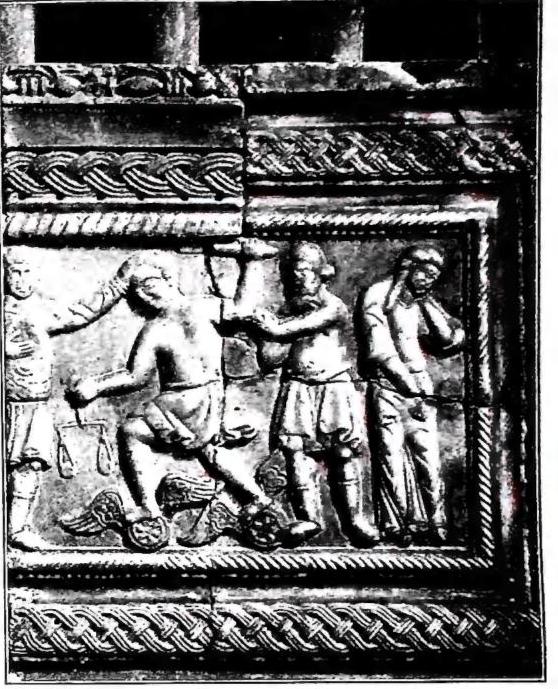
(fot. Alinari)
varum, quae successiva etiam sit » (Disp. Met., d. 50, s. 8, n. 4); è realmente lo stesso moto (loc. cit., s. 9, n. 1), perciò ogni movimento ha il suo t. (loc. cit., s. 8, n. 6); il t. si divide in corporeo, che è la durata del movimento continuo e successivo di un corpo, e spirituale, che è la durata del moto locale continuo e successivo di uno spirito (loc. cit., s. 8, n. 7). Oltre il t. intrinseco in ogni moto, c'è un t. che è interno al movimento del cielo e misura estrinseca degli altri movimenti (loc. cit., s. 10, n. 11). In tal senso il t. è « numerus motus ».
R. Descartes afferma che il t. « che noi distinguiamo dalla durata presa in generale, e che diciamo essere il numero del movimento, non è null'altro che un certo modo con cui pensiamo a questa durata »; il t. perciò, « fuori della vera durata delle cose, null'altro è che un modo di pensare » (Princ. phil., I, n. 57); per P. Gassendi il t. non è sostanza, né accidenta, ma pure è reale (Physica, I, 1, 2, c. 1; ed. Lione 1658, p. 182); è una « extensio incorporea, fluens », nella quale è contenuto il passato ed il futuro (loc. cit., c. 7; p. 220 b); è insomma il t. assoluto, analogo allo spazio assoluto (ibid., p. 224 b). I. Newton scrive che « tempus absolutum, verum, mathematicum, in se et natura sua absque relatione ad externum quodvis, aequabiliter fluit, alioque nomine dicitur duratio : relativum, apparens et vulgare est sensibilis et externa quaevis durationis per motum mensura » (Philos. natur. principia mathem., Amsterdam 1723, p. 5). Inoltre Newton (op. cit., p. 483) e più chiaramente S. Clarke pensano che il t., come lo spazio, è una conseguenza necessaria all'esistenza di Dio ed un suo attributo, senza cui Dio non sarebbe eterno (Quatrième réplique de M. Clarke, n. 10; ed. L. Dutens, Ginevra 1768, t. II, parte 1ª p. 136; cf. pp. 176, 177). G. Leibniz fa notare l'assurdità che « Dieu sera en quelque façon dépendent du temps... et en aura besoin » (Cinquième écrit de M. Leibniz, n. 50; ed. cit. p. 154; cf. p. 151); insiste che t. è « purement relatif », è « un ordre de successions » (Troisième écrit de M. Leibniz, n. 4; p. 121), l'ordine delle possibilità incostianti che hanno pertanto una connessione » (ed. cit., p. 91). Il t. assoluto, che è fuori delle cose temporali, è nulla (Quatrième écrit de M. Leibniz, n. 16; p. 130. Cf. pp. 121, 166). Anche G. Berkeley critica il t. assoluto di Newton e sostiene che « il t. non è nulla, quando si fa astrazione dalla successione delle idee della nostra mente » (Treatise on the principles of human knowledge, n. 98). Secondo D. Hume, il t. « deriva dal succedersi di percezioni d'ogni specie, siano queste idee o impressioni, e impressioni di riflessione o di sensazione » (Treatise on human nature, I, I, parte 2ª, s. 3, n. 3; vers. it., Bari 1926, p. 56); pertanto « è impossibile concepire... un t. senza successione o mutamento » (loc. cit., s. 4, n. 1; ed. cit. p. 61). In E. Kant il t. spazio (v.); « non è concetto empirico, ricavato da una esperienza », « è una rappresentazione necessaria, che sta a base di tutte le intuizioni », « non è un concetto discorsivo o, come si dice, universale, ma una forma pura dell'intuizione sensibile ». Perciò « il t. non è qualcosa che sussiste per se stesso, o aderisca alle cose, come determinazione oggettiva, e che perciò resti, anche astrazione fatta da tutte le condizioni soggettive dell'intuizione di quelle... Il t. non è altro che la forma del senso interno, cioè dell'intuizione di noi stessi e del nostro stato interno ». E « poiché tutte le rappresentazioni, abbiano o no oggetti esterni, pure in se stesse, quali modificazioni del nostro spirito, appartengono allo stato interno... così il t. è condizione a priori di ogni fenomeno in generale; condizione, invero, immediata dei fenomeni interni (dell'anima nostra), e però mediatamente anche degli esterni » (Critica della rag. pura, vers. it., Bari 1945, p. 73 sgg.). Secondo Hegel, l'idea diviene altro da sé estendendosi nello spazio e nel t. « Il t. è l'essere che, mentre è, non è, mentre non è, è: il divenire intuito. Le dimensioni del t. presente, futuro, passato, sono il divenire come tale nella sua esteriorità » (Encicl. delle sc. filos. in compendio, vers. it., ivi 1923, p. 214). G. Gentile afferma che il t. è « un sistema del molteplice » (Teoria gener. dello spirito come atto puro, Firenze 1938, p. 112); « il t. è la spazializzazione dell'unità dello spazio » (op. cit., p. 115); cioè in un qualunque
punto dello spazio, gli elementi dell'esperienza « si escludono a vicenda in quanto l'uno sottentra all'altro nello stesso luogo », (loc. cit.) questa successione moltiplica in senso temporale l'unità, cioè il punto dello spazio.
In contemporary philosophy, time sometimes appears as a category of reality. In his Leibnizian-inspired idealism, J. Royce maintains that time is the point at which reality passes over in its tendency from (from)... towards (towards)... It is a constitutive moment of reality which, insofar as it contains that tendency within itself, includes the past (from) and the future (towards) in its definition. In the concretely lived present, the past and the future are present, not as representations, but in their full reality. Hence the present is an eternity within brief limits; if we remove the limits, we have an unlimited eternity (The world and the individual, New York 1901). H. Bergson distinguishes a temps-longueur, which is the time of science, a succession measured in space by a cinematographic method (temps spatialisé), from a temps-invention, which is the same « durée réelle », in which there is no before and after, the same reality as a vital impulse grasped in our innermost being with indivisible unity (L'évolution créatrice, Paris 1912, p. 363 ff.; La pensée et le mouvant, ibid. 1934, p. 188 ff.; etc.). According to M. Heidegger, the ultimate meaning of Dasein, which is the being of man, is a process of temporalization (Sein und Zeit, Halle [Salle] 1927, pp. 19, 327), and time is not a thing that is, but a development taking place within the unity of its movements; it is what is not, but externalizes itself (op. cit., p. 329). The temporalization of Dasein lies in the unity of its three ec-static moments (past, present, future, which are not three parts of time), of which the principal is the future, insofar as time springs from the projection of a past, which arouses the present, towards the future.
Conclusion. — The critique of the notion of time space (v.). Absolute time, independent of changing realities, is imaginary and absurd. The demand that a being cannot exist except within a previously presupposed time is illusory: « neppure è necessario un flusso temporale assoluto, per garantire la validità delle leggi fisiche, come pretendeva I. Newton. Ad un t. assoluto apparterrebbero proprietà divine: è ciò è assurdo. Così videro chiaramente Leibniz, Berkeley (op. cit., n. 98) ed altri; s. Tommaso osserva che « ante principium mundi non fuit tempus reale sed imaginarium » (Q. d. de Pot., q. 3, a. 1, ad 10). The critique of Leibniz’s phenomenal time is similar to that of space; the same applies to Kant, who identifies real time with imaginary time and introduces an a priori form of time in order to avoid the absurdity of absolute time (Crit. d. rag. pura, ed. cit., pp. 80, 86). His assertion that a science of motion would be impossible without the a priori form of time is gratuitous (op. cit., p. 75). The critique of time as a category is connected with consideration of the entire system in which it is embedded. Accordingly, time must be conceived according to Aristotelian thought, perfected by Arab and Latin Aristotelianism. It is passing in general insofar as it is passing; it is the physical-chemical development of the universe insofar as it is development; it is the real duration of the corporeal world—not of this or that body, but of a body in general, which in fact will subsequently be this or that body. The duration of a body is not in time but, together with the duration of other bodies, constitutes real time. Time, insofar as it is real, is an aspect of the real duration of the corporeal universe, from which it is not distinct. In this sense, time cannot slow down, accelerate, or turn back; these properties belong to motion, that is, to passing, not to passing insofar as it is passing, which is time.
II. FISICA
Il t. fisico è quello che la fisica misura. La misura del t. si fa per mezzo del movimento; adattissimo, per precisione ed universalità, è il moto diurno della terra, che determina il giorno. Si distinguono il giorno sidereo, che è l'intervallo compreso tra due passaggi successivi di una stella per il meridiano locale; il giorno solare, più lungo del precedente di 4 minuti ca., che è lo stesso intervallo al passaggio del sole; il giorno solare medio, che è una media del valori del giorno solare, variabile durante l'anno, per la forma ellittica dell'orbita della terra intorno al sole.Nella fisica classica, il t. era pensato uniforme ed unico, nel quale era possibile paragonare tutti gli eventi dell'universo, comunque distanti tra di loro (simultanità assoluta). A. Einstein fece notare che questa simultaneità assoluta deve essere definita con esperienze (definizione operatoria), le quali sono possibili in un mondo statico con segnalazioni qualsiasi: ma nel mondo attuale, in cui tutti i corpi sono in continuo movimento relativo, con segnalazioni di velocità infinita; il che è fisicamente assurdo. La segnalazione migliore è di fatto quella elettromagnetica, la quale però, relatività (v.) ristretta, si postula avere la velocità costante (5, 10¹⁰ cm sec.) rispetto a qualunque sistema inerziale. Da questo postulato segue che due avvenimenti simultanei in un sistema, non lo sono per un altro in moto relativo: cioè nel sistema in moto relativo il t. si dilata; ogni sistema ha il suo t. relativo, ed ogni punto del sistema ha il suo t. locale. H. Minkowski (1908) collegò il t. allo spazio in un universo a 4 dimensioni. In esso il t. è omogeneo alle dimensioni spaziali e contiene il passato ed il futuro insieme esistenti, come un tutto già dato, mentre noi ne percepiamo le successive sezioni tridimensionali (che chiamiamo presente) le quali sono differenti per osservatori in moto relativo. Il divenire diventa allora illusorio, perché suppone il fluire del t., il quale invece è già tutto dato: «Non c'è più il divenire nello spazio a tre dimensioni, ma l'essere nello spazio a quattro dimensioni» (A. Einstein, Sulla teoria generale e speciale della relatività, Bologna 1921, p. 110). Nella teoria generale della relatività il t. partecipa alle modificazioni delle altre tre dimensioni dello spazio curvo riemaniamano, determinate dalla presenza della materia e dell'energia e dipende non solo dal moto relativo ma anche dal punto del campo gravitazionale in cui si trova l'orologio.
Siccome il moto è lo svolgimento di un atto, in ogni istante le attualità transeunti di tutti i corpi, che si muovono (durano), affiorano contemporaneamente alla realtà, hanno una concreta e metafisica paragonabilità, che noi possiamo benissimo concepire. La paragonabilità ontologica fonda la simultaneità ontologica assoluta. Pertanto la relatività della simultaneità è solo sperimentale, in quanto non è possibile paragonare fatti lontani accaduti in sistemi in moto relativo, se non per segnalazioni, che hanno una velocità finita, precisata dal postulato della velocità costante della luce rispetto ad ogni sistema in moto inerziale. Dal quale postulato dipende essenzialmente la relatività della simultaneità. Perciò il t. della relatività non può avere che un valore simbolico e sistematico: la reciprocità delle modificazioni dello spazio-tempo per due osservatori in moto relativo, non può avere significato ontologico; tanto più che, spazio (v.), il postulato della costanza della velocità della luce non è stato positivamente dimostrato ed il principio di equivalenza è ancora una ipotesi. Per quanto il t. della relatività è confermato dall'esperienza, riunisce in formule matematiche le letture degli strumenti di misura, senza voler spiegare la realtà ontologica del t.
théorie aristotéle, du temps chez les péripatéticiens médiévaux (Averroès, Albert le Grand, Thomas d'Aquin), in Rev. de phil. néoscolost., 36 (1934), pp. 275-307; S. Zawirski, L'évolution de la notion de temps, Cracovia 1936; G. Giorgi, La nozione e la misura del t., Milano 1940; C. Giacon, Guglielmo di Occam, ivi 1941, p. 542 sgg.; C. Mazzantini, Il t., Como 1942; J. San Valerio Apatisi, Tiempo y espacio en la historia primitiva, in Saitobi, 7 (1947), p. 144 sgg.; R. Paniker, La unitaf fisica del tiempo, in Congreso internacional de fil. Atti, II, Barcellona 1948, p. 373 sgg.; J. Echarri, Carácter cuasi-conceptual del espacio y del tiempo, ibid., p. 45 sgg.; R. de Bengy Puyvallée, La notion d'espace et la notion de temps en théorie cosmologique, ibid., p. 231 sgg.; J. Callahan, Four views of time in the ancient world, Chicago 1948; J. Monchamin, Le temps selon l'hindouisme et le christianisme, in Dieu vivant, 14 (1949), p. 109 sgg.; J. J. C. Smart, The river of time, in Mind, 53 (1949), p. 483 sgg.; E. Schrödinger, Spazetime structure, Londra 1950; E. A. Milne, A modern conception of the (discussion), in Philosophy, 25 (1950), p. 68 sgg.; E. Wasmuth, Über die Zeit, in Philos. Jahrb., Fulda, 60 (1950), pp. 200-217; S. Watanabe, Le concept de temps en physique moderne et la durée pure de Bergson, in Revue de métaphysique et de mor., 56 (1951), p. 128 sgg.; E. Biser, Postulates for physical time, in Philos. of science, 19 (1952), p. 50 sgg.; F. Selvaggi, Probl. della fisica moderna, Brescia 1952, p. 57 sgg.