
ATTEMPTED CRIME. — The notion of the t. (conatus) was delineated by the Italian jurists of the Middle Ages, who accurately identified its essence in cogitare, agere sed non perficere.
The Italian Penal Code posits this legal figure in the first paragraph of art. 56, with the following formula: “Anyone who performs suitable acts, unequivocally directed toward committing a crime, is liable for attempted crime if the action is not completed or the event does not occur.”
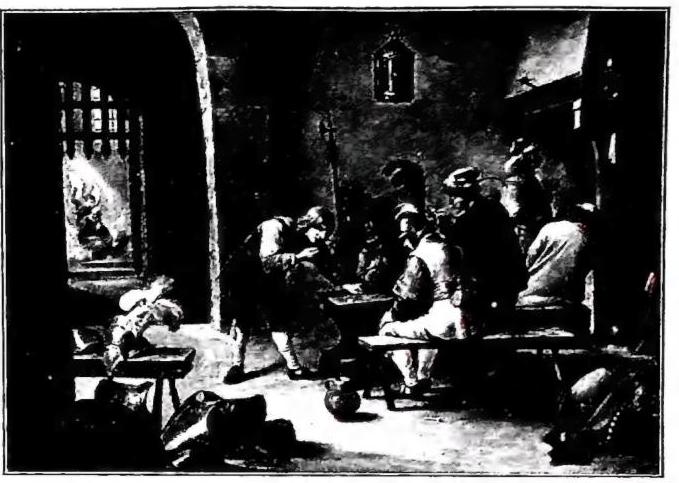
(Int. Alinari)
TENIERS, DAVID — The Liberation of St. Peter from Prison — Dresden, Picture Gallery.
new obligations, rendering punishable actions that would otherwise have no penal relevance: if it did not exist, a person who attempts to commit a crime and fails would not be punishable, since this would be precluded by the principle of strict legality enshrined in Article 1 of the Code.
While, from the subjective point of view, that is, in the sphere of the will, attempted crime does not differ from an intentional consummated crime, because in both there exists the intention to perform the act prohibited by law, objectively it appears incomplete, because the criminal hypothesis described by the legislator in a given penal provision is realized only in part. The incompleteness of the typical act may take two forms. In the first, the activity directed toward committing the crime is not brought to completion, as in the case of a thief who, surprised while breaking open a door, flees. In the second, the agent has indeed carried out the executive conduct, but the result required for the existence of the offense does not occur: one may think of a person who fires a rifle shot at another person but misses. It is these two forms, which are respectively called incomplete attempt and complete attempt, to which the Code refers with the expression “if the action is not completed or the event does not occur.” From the legislative formula contained in Article 56 it follows that, in addition to the intention to commit a crime and the incompleteness of the legal definition outlined by the penal provision, two requirements are necessary for the existence of an attempt: a) that the acts be unequivocally directed toward committing a crime, that is, the unequivocal character of the acts; b) that those acts be suitable for the purpose, that is, the suitability of the acts.
For a long time, criminalists have asked whether preliminary acts, ordinarily performed by the offender when he begins to put his criminal plan into effect, should—in the event that they lead to nothing—be punished, and they have generally answered in the negative. Indeed, not only do such acts have a highly uncertain significance (and, since the energy of the will has not yet manifested itself decisively in them, the likelihood of abandoning the criminal design is very high), but it must also be recognized that punishing these initial acts may lead to excessive repression based on mere suspicions. Thus arose the distinction between preparatory acts and executive acts, a distinction of great importance for the protection of individual rights, which was enshrined in most of the codes enacted in Europe after the French Revolution, including the Napoleonic Code, which required a commencement d'exécution for punishability. Nevertheless, the efforts made in legal scholarship to identify, starting from this general requirement, a criterion for distinguishing preparatory acts (exempt from punishment) from executive acts (punishable) cannot be considered successful, to such an extent that the German jurist Geyer, judging the problem insoluble, compared it to squaring the circle. In view of the difficulties arising from this distinction, the drafters of the current Italian Penal Code modified the formula appearing in the Zanardelli Code, limiting themselves to requiring, in addition to suitability, the unequivocal character of the acts. This solution, however, could not erase the distinction between preparatory acts and executive acts, which is found in reality even before it is found in the legal definition: indeed, on closer examination, the Italian legislator did no more than give the force of positive law to the classical criterion, also accepted by Carrara, for identifying executive acts. Along this path, it is clear that central importance is assumed by the problem of the meaning to be attributed to the requirement of unequivocalness. In this regard, it should be noted that, if it is true that an act is unequivocal when, by what it is and by the manner in which it is performed, it excludes every doubt that its author has undertaken to commit a particular crime, it is inevitably necessary to hold that the direction of the act must be inferred not only from the act itself, but also from the complex of elements accompanying or preceding its performance (such as the offender’s confession and circumstances of time and place, etc.).
As regards the requirement of the suitability of acts directed toward committing the crime, it must be borne in mind that, under the law of natural causality, every action that has not produced a certain result proves, in the concrete case, insufficient to produce it and is therefore, strictly speaking, unsuitable. It follows that the suitability or otherwise of the conduct cannot be judged ex post, that is, in light of all the circumstances actually existing in the individual case; rather, it must be judged ex ante, by returning to the moment when the action was performed and forming the judgment on the basis of the circumstances that could have been known at that moment. The action will therefore be suitable when, under an analysis conducted in this manner, it appears adequate in relation to the result toward which it was directed; it will be unsuitable in other cases. But since suitability, once established ex ante, is equivalent to adequacy in relation to a result prohibited by law, the consequence is that the suitability of the action means nothing other than its dangerousness. An attempt is therefore punishable when it takes the form of a dangerous action, that is, whenever, at the moment when it was undertaken, the subject’s conduct presented some probability of success.
Unlike other legal systems that prescribe for attempted crime the same penalty as for consummated crime, or that leave the judge free to impose the same penalty or a reduced one, the Italian legal system punishes attempted crime less severely than consummated crime. The second paragraph of Article 56 establishes, in fact, that an attempted crime is punishable by imprisonment for not less than twelve years if the prescribed penalty is life imprisonment, whereas in the remaining cases the penalty fixed for the crime is reduced by between one-third and two-thirds. If, moreover, during the execution of the offense and before it has been consummated, the offender abandons his criminal purpose by voluntarily interrupting the action, immunity from punishment is established, provided that the acts performed do not in themselves constitute a different offense (Article 56, paragraph III). If, on the other hand, the offender, having completed the executive activity, wishes, as a result of reflections or subsequent events, to prevent the occurrence of the result and succeeds in doing so, the penalty established for attempted crime is reduced by between one-third and one-half (Article 56, paragraph IV).
As regards canon law, the CIC, in canon 2212 § 1, establishes that an attempt exists when someone has performed acts qui ad executionem delicti natura sua conduncunt, but the crime is not committed either because of abandonment of the criminal design or because of the ineffectiveness of the means employed. To this, which is the comatus in the strict sense, the same canon, in § 2, contrasts the delictum frustratum, which occurs when, despite unequivocal and suitable acts, a cause other than the agent’s will prevents the crime from being completed (complete attempt). The action of a person who solicits others to commit a crime without succeeding is assimilated to an attempt (canon 2212 § 3).
Canon 2213 establishes that an attempt must be punished, except where the agent has spontaneously desisted from executing the crime and no harm or scandal has resulted from the attempt. If a particular penalty is prescribed for a specific attempt, it is to be regarded as a genuine crime in its own right (canon 2212 § 4).