
CLEMENTE V, POPE. — Bertrando de Got, born in Gascony, was bishop of Comminges (1295–97), then archbishop of Bordeaux (1297–1305). His election, after the lengthy Conclave of Perugia, was closely connected with the Bonifacian question, which deeply divided the Sacred College: its majority wished to vindicate the memory of Boniface VIII, outraged at Anagni, whereas a minority, which ultimately prevailed, did not wish to offend the instigator of that attack, Philip IV the Fair, king of France, and championed
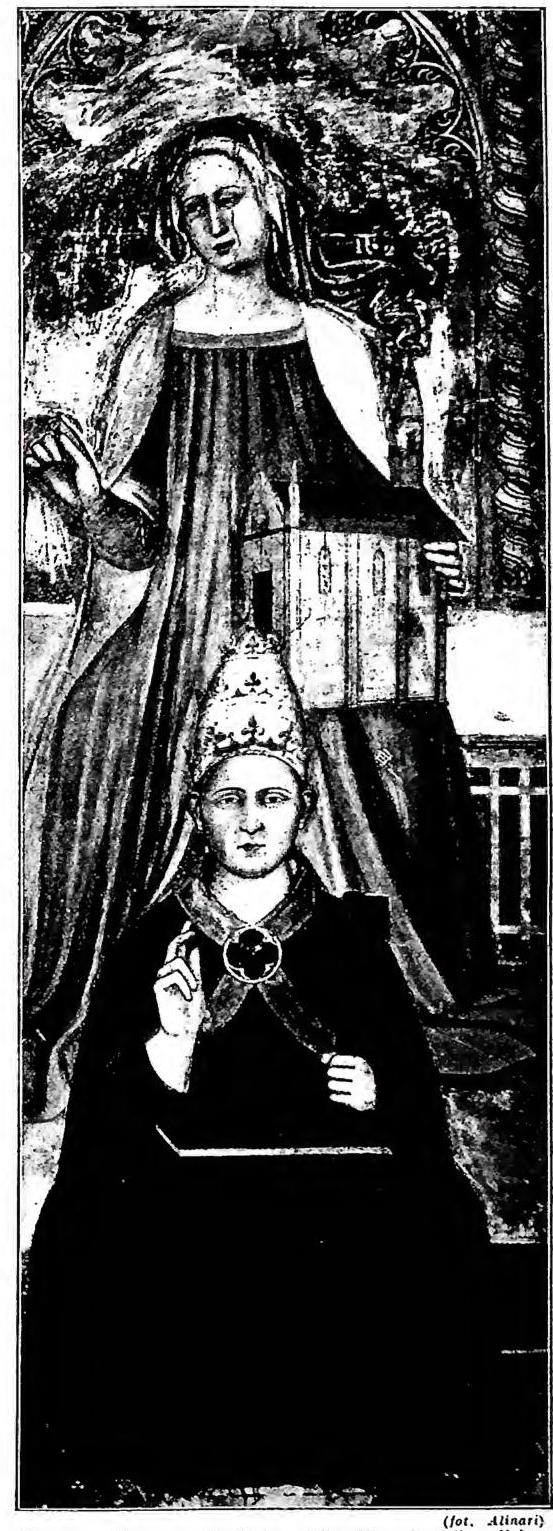
the cause of the two cardinals Colonna. Thus, on 5 June 1305, the archbishop of Bordeaux was elected, having shown himself deferential toward Boniface VIII while also maintaining good relations with Philip the Fair. The account, long accepted, given by G. Villani (VIII, 80; cf. L. A. Muratori, Rerum Ital. script., XIII, pp. 417–419) of a prior secret meeting deep in a wood near St-Jean-d’Angély and of an agreement concluded there between the archbishop and the king of France is entirely fanciful, being positively ruled out by the respective itineraries of the two men at the time of the Conclave.
Although the newly elected Pontiff initially expressed the intention of going to Italy as soon as the definitive peace between France and England had been concluded, in fact he remained in France, thus inaugurating the Avignon period with all its disastrous consequences for the Church. He was crowned at Lyons on 14 November 1305, in the presence of King Philip, who immediately began to exercise an undue influence over the Pope, who was weak and indecisive in character and also often ill. In the first creation of cardinals, on 15 December 1305, C. promoted nine Frenchmen and one Englishman and reinstated the two Colonna. French predominance in the Sacred College was further increased by promotions in 1310–12. The trial against the memory of Boniface VIII, whose condemnation the Pope only barely managed to avert at the end, as well as the trial and consequent suppression of the Templars, disliked by the monarch, who was eager to seize their considerable wealth, must be attributed to the insistent request of Philip the Fair, who was also concerned with the canonization of St Celestine V, which took place in 1313. French influence is also readily discernible in politics. The Pope appointed French legates and rectors for Italy and favored the Angevins of Naples, who were aligned with the Guelphs and succeeded in preventing the coronation of Henry VII in St Peter’s; this function accordingly took place, contrary to custom, in St John Lateran (1312). In Hungary, through the cardinal legate Gentile da Montefiore, the question of the succession to the throne of St Stephen was settled with the general recognition of the Angevin Caroberto, son of Charles II of Naples and Maria of Hungary (1308), and with the imposition of the crown of St Stephen (1310). In 1311–12 the Pope celebrated the Council of Vienne, which issued many salutary decrees for the purity of the faith and for ecclesiastical discipline, decrees later incorporated into the so-called Clementines (v. CORPUS IURIS CANONICI), published a few days before his death and therefore republished by his successor John XXII (1317). C. also sought to close the now-chronic dispute between the Spirituals and the community of the Franciscan Order, through the decretal Exivi, the fruit of lengthy discussions between the two parties before a commission of cardinals (1309–12). Also noteworthy was the zeal with which C. promoted missions among the Tartars in China, appointing the Franciscan Giovanni da Montecorvino the first archbishop of Beijing and giving him six suffragan bishops (1307). Under the influence of Raimondo Lullo, C. prescribed, in the interest of the missions, the teaching of Oriental languages at the principal university centers, such as Paris, Oxford, Bologna, and Salamanca. He also founded the Universities of Perugia and Orléans. He died at Roquemaure (Gard) on 20 April 1314. His testamentary provisions, which greatly favored his extensive family, led, at the wish of John XXII, to a trial.
Guidonia (two), Paolino da Venezia, Amalricio Augerii. The notes to the text by Baluzius and Mollat are in vol. II, there 1928, pp. 31–175; documents and illustrative texts are in vol. III, there 1921, pp. 42–241, 491–561; Regesta Clementis papae V. euro et studio monachorum O. S. B., 9 vols., Rome 1885–92; Ch. V. Langlois, Documents relatifs à Bertrand de Got (Clément V), in Revue historique, 40 (1889), pp. 48–54; id., Notices et documents relatifs à l'histoire de France au temps de Philippe le Bel, documents italiens, ibid., 60 (1896), pp. 307–28; F. Ehrle, Der Nachlass Clemens V. und der in Betreff desselben von Johann XXII. (1318-21) gefüllte Process, in Archiv für Literatur- und Kirchengeschichte des Mittelalters, 5 (1889), pp. 1–158 (with a genealogical tree of the Pope’s family); H. Finke, Aus den Tagen Bonifaz VIII., Münster in V. 1902, pp. 279–96 and pp. LXI–LXVI; id., Acta Aragonesia, Berlin and Leipzig 1908, pp. 197–99, 263–302. Monographs and studies: M. Rabanis, Clément V et Philippe le Bel, Lettre à M. Charles Davenberg sur l'entrevue de Philippe le Bel et Bertrand de Got à St-Jean-d'Angély, Paris 1858; C. Wenck, Clemens V. VIZI., Halle 1882; id., Aus den Tagen der Zusammenkunft Papst Clemens V. und König Philipps des Schönen zu Lyon, in Zeitschrift für Kirchengeschichte, 27 (1906), pp. 189–203; F. Apollonio, Un capitolo di storia venuta nei registri di C. V., Venice 1887; W. Otte, Der historische Wert der alten Biographien des Papstes Clemens V. (Kirchengeschichtliche Abhandlungen), 1, Breslau 1902, pp. 3–73; H. Finke, Papettum und Untergang des Templerordens, I, Münster in V. 1907, pp. 86–110; A. Eitel, Der Kirchenstaat unter Klemens V., Berlin 1907; G. Lizerand, Clément V et Philippe IV le Bel, Paris 1910; G. Mollat, Les papes d'Avignon, there 1912 (6th ed. there 1930, with a rich bibliography); Ewald Müller, Das Kauszil von Vienna 1311-12, Seine Quellen und seine Geschichte, Münster in V. 1934; B. Homan, Gli Angioini di Napoli in Ungheria, Rome 1938, pp. 107–115. Cf. also Fr. Zambrini, Le opere volgari a stampa dei secc. XIII e XIV, 4th ed., with appendix, Bologna 1884, col. 305 ff.; E. Casanova, Visita di un pane avignonese ai suoi cardinali, in Archivio della R. Società romana di storia patria, 22 (1899), pp. 371–81.