
CHIARA D'ASSISI, saint. — Foundress, together with St. Francis, of the Order of the Poor Clares, known as the Second Franciscan Order, born at Assisi in 1194 to a noble family (but neither to the counts of Sasso Rosso nor to the Scifi), died on 11 August 1253 at S. Damiano outside the city walls. The example of complete renunciation and the preaching of St. Francis deeply impressed the noble young woman; having drawn near to the Saint, she was instructed by him and confirmed in the new ideal of the perfect following of the poor life of Christ. On the night after Palm Sunday, 18 March 1212 (not 1211), C., together with a relative, secretly left her paternal home and went to the Porziuncola in the plain below Assisi, where St. Francis received her with his companions, clothed her in the Franciscan habit, and lodged her with the Benedictine nuns of S. Paolo della Bastia, and then, fifteen days later, at the monastery of S. Angelo in Panso on the slopes of Subasio. When her younger sister St. Agnese (v.) joined her, St. Francis placed them near the rural church of S. Damiano, a few steps from the walls of Assisi; hence, at first, the nuns of the Second Franciscan Order were called the «poor women enclosed of S. Damiano», or also «of the Spoletan valley», and only after the Saint’s death, Poor Clares. As the number of nuns increased, C. was made abbess in 1215, and St. Francis sketched a rule (formula vitae) for them, of which some passages are preserved in the rule of St. C. of 1252–53. The establishment of the first monasteries of the Damianites outside Assisi (Florence, Lucca, Siena, Perugia) was chiefly the work of Cardinal Ugolino, sent in 1217 as papal legate to Tuscia, who also composed a rule for the new monasteries (1218–19), perhaps not wholly accepted by C. She, who had embraced St. Francis’s entire program—that is, absolute poverty, even in common—obtained from Gregory IX (Perugia, 17 September 1228) the privilege of poverty (Seraph. legislationis textus originales, Quaracchi 1897, p. 97), a document more unique than rare, by which the Pope declared that C. could not be compelled by
anyone to accept possessions. C. had perhaps already obtained the same privilege from Innocent III. She governed her community, which was also joined by her mother Ortolana and another sister named Beatrice, with the utmost charity and prudence. In a courageous act, she drove from S. Damiano the Saracen soldiery whom Vitale d'Aversa, in the service of Frederick II, had led to the siege of Assisi (1243). St. Francis did not forget the tender little plant, and in a hut built in the garden of S. Damiano he composed the Cantico del Sole. After the holy founder’s death, his body was taken past S. Damiano, where C. and her disciples were able to contemplate once more the beloved features of their father. Always sickly, she often had to be absent from choir, and it happened that one Christmas night, gently lamenting to the Lord, she was immediately transported in spirit to the basilica of S. Francesco and attended the sacred services. She remained deeply attached to the memory of the Saint who had won her for Christ, and when she saw that various monasteries were accepting possessions and revenues, C. became alarmed and wished to preserve the highest poverty for her monastery. She then composed (after 1247) her rule, modeled on that of the Friars Minor of 1223, and had it approved by the protecting cardinal Rainaldo (later Pope Alexander IV) in 1252, and, three days before her death (9 August 1253), by Innocent IV, who had come to Assisi from Perugia. Assisted by St. Francis’s faithful companions, Ginepro, Angelo, and Leone, and refreshed by a heavenly vision, she breathed her last. She was provisionally buried in S. Giorgio until the church bearing her name should be completed; in it, her body, reduced to a skeleton, was found in 1850. Alexander IV canonized her at Anagni in 1255. Feast day, 12 August.
Four letters from C. to Blessed Agnese of Prague are preserved, whose authenticity was placed beyond doubt in the latest edition (Arch. franc. hist., 17 [1924], pp. 509–19). The testament is doubtful (Seraph. legisl. textus orig., Quaracchi 1897, pp. 272–80), as is the blessing (op. cit., p. 281 ff.).
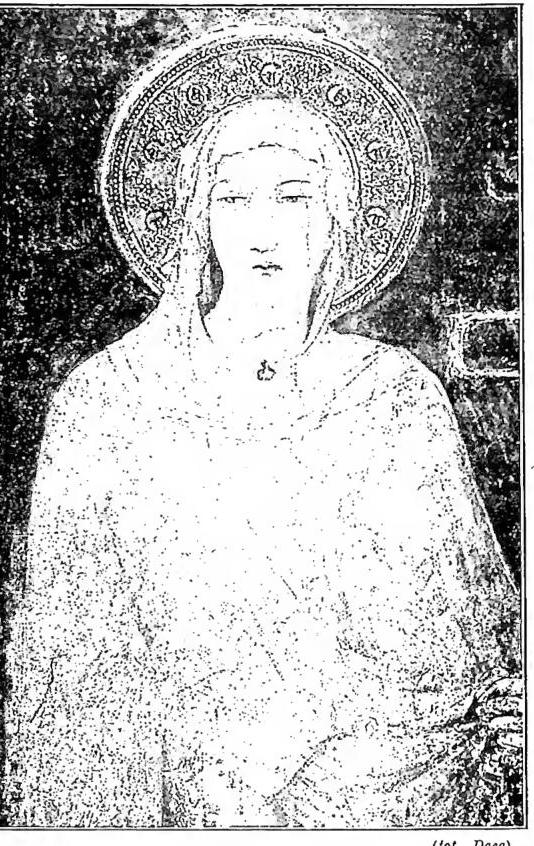
Later, s. C. was almost always depicted holding up the Monstrance, recalling the courageous gesture by which she had managed to confront and drive from S. Damiano the troops of Vitale d'Aversa, who were besieging Assisi. — Vedi Tav. LXXXVII.