
PALME, DOMENICA delle. — The Sunday preceding Easter has been called, since the time of Isidore of Seville (d. 636), D. delle p. (dies palmarum). Earlier, the Latin Fathers called it de passione Domini; other names were Capitilavium (from the custom in Spain of catechumens washing their heads and entire bodies in preparation for Baptism), Pascha competentium (from the custom of the Gallican Church of giving the traditio symboli on this day to the competentes, or candidates for Baptism), or dominica indulgentia (from the reconciliation of penitents; the Würzburg Lectionary and the Prague Sacramentary, of Isen). Today it has three distinctive features: a) the blessing of the p.; b) the procession with them; c) the commemoration of Christ’s Passion in the Holy Mass.
I. THE BLESSING OF PALMS
It takes place before the principal Mass; branches of palms or olive trees are blessed, and in the northern countries (from as early as the ninth century) also branches of other trees, such as willow, boxwood, yew, and even flowers (dies florum, Pascha floridum; V. Alcuino), both for the procession that follows and for the use of the blessed branches as sacramentals. At first, the blessing was not given to the branches but to those who carried them.The blessing of palms is found for the first time in the eighth century in the Gallican and Mozarabic Sacramentaries (e.g., Bobbio, no. 558), and in the ninth century in the Bavarian Sacramentaries (e.g., that of Isen, or Cod. of Prague, no. 85; that of Salzburg, ed. Dold, p. 79). The formulas multiplied in the following centuries. Two usages are distinguished (Hallinger): in the Romano-Frankish regions (e.g., Pseudo Alcuino, Cluny), formulas consisting solely of prayers were used in the principal church itself, whereas in the Germanic regions, in a church distinct from the principal one, a richer rite was conducted, consisting of lessons and prayers, in a form similar to that of an Ordo Missae, with the Canon excluded. This rite, however, is not the remnant of a separate Mass, or of a Mass celebrated in the church from which the procession departed, but, as Callewaert writes, an artificial construction intended to arrange the ceremonies—that is, the lessons and prayers—in a logical order. In fact, the blessing begins after the Gospel with a preface like that of the blessing of the baptismal font.
(phot. Felici)
The Roman rite of today consists of a Missa catechumenorum, that is, an Introit antiphon (Mt. 21:9; without psalm), the prayer « Deus, quem diligere », the lesson from Ex. 15:27 and 16:1–7, the responsory Collegium (Jo. 11:47; 49, 50, 53) or In monte Oliveti (Mt. 26:39 and 41), and the Gospel Cum appropinquasset (ibid. 21:1–9; in ancient times also Mc. 11:1 ff. or Jo. 12:12 ff.). Then follows the solemn blessing, with many reminiscences of the prayers of the Greek rite. The Preface, taken from a Gallican Mass for apostles or martyrs and adapted to the Roman rite no earlier than the fifteenth century, is followed by the Sanctus, because it contains the Osanna and the Benedictus of this day. The palms, blessed with holy water and incense, are distributed while the antiphons Pueri Hebraeorum are sung. After a prayer, the procession follows.
II. THE PROCESSION
It is older than the blessing of the palms and is performed on the model of that of Jerusalem, described by Egeria in the fourth century, in imitation of Christ’s triumphal entry. It first appears in Spain and Gaul; Amalarius already mentions it as a general custom. From a church outside the city (in an elevated place, representing Bethany or the Mount of Olives), where the branches were blessed, the procession moved toward the city. The person of the Lord was represented by the book of the Holy Gospels or by a large, uncovered and garlanded Crucifix; in England the Most Holy Eucharist was also carried in procession; in Germany the so-called “ass of the p.” was in use: a wooden ass equipped with a pulley, bearing the figure of the Savior. At the city gate, solemn homage was paid to the Redeemer: the schola, having spread their capes and sacred vestments on the ground and laid the branches before the Cross, adored it on their knees (to the singing of Theodulf’s hymn “Gloria, laus et honor”); the people came in small groups and laid their flowers before the Cross; then came the bishop with the clergy. At the words of the antiphon Percutiam pastorem, a cleric struck the bishop on the shoulders with his hand or with a palm, leu ictu. The procession then entered the city. Upon reaching the Cathedral, the Benedictus was intoned, and the bishop concluded the procession with a prayer. This ancient rite, described by Pseudo-Alcuin and in an Ordo of Besançon, is still observed today in the various dioceses of Germany. In the present Roman Rite, the procession must leave the church. On its return it finds the door closed. The hymn of Theodulf is sung alternately with the singers who have remained inside; at its conclusion, the subdeacon carrying the cross strikes the door with the tip of the processional cross. All reenter to the singing of the responsory Ingrediente. The ceremony of striking the door, already contained in the Roman Pontifical of the twelfth century, was introduced into the Roman Missal in 1604, under Clement VIII.III. THE HOLY MASS
It is consecrated to the memory of the Passion of Christ (v. Ps. 21: Deus, Deus meus, of the Introit and the Tract); the Epistle deals with humiliation. Already in the time of Pope Leo I (Serm. de Pass. D., I, 5), the Passion written by s. Matteo was read. Around the year 1000, in the churches of the north, the practice was introduced of having the Passion performed by three cantors; in Italy, from as early as the 15th century, the singing of the words of the people (turba) was entrusted to a choir of cantors, sometimes performed in figured music. The special signs in the Passio (T = tacite, or trahe or tene; C = cito, celeriter; S = iursum or sonoriter), which served to indicate the melody, now designate the persons who perform or sing: T, or (from the Middle Ages) the cross, the part of Christ; C, the part of the chronicler; S, the part of the various persons. At the words emisii spiritum the narrative is interrupted, everyone kneels, and meditates for some time: a custom of certain Benedictine monasteries already in the time of s. Luigi, king of France (d. in 1270), who introduced it into his private chapel, and which was accepted in Rome at the end of the 14th century.IV. FOLKLORE
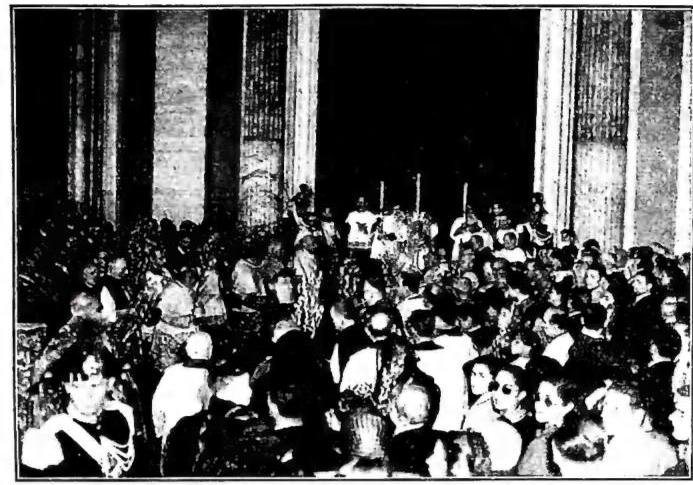
Palm Sunday opens the cycle of traditional customs of Holy Week, which ends on Easter Monday. It is also called Flowering Easter, because of the use made of flowers or flowering branches in its various ceremonies.Popular worship faithfully follows the official liturgy, merely enlivening it with expressions of innate artistic taste and intense faith. Its focal point is formed by the blessed palms, which are distributed in church during the services and which each member of the faithful takes home and preserves, since miraculous virtues are attributed to them, especially protection against thunderstorms. In homes the palms are generally placed above the bed, beside some sacred image. They are often adorned with ribbons or gilded with powdered pigment and interwoven so as to take on original and pleasing forms. Of particular importance throughout the Catholic world is the distribution of palms that takes place in St Peter’s in Rome. By a concession of Pope Sixtus V, the prerogative of supplying them belongs to the descendants of the Bresca family of San Remo. Three hundred of the most beautiful palms from the Riviera are selected for this purpose, and bundles of sixty branches each are made from them; these are then taken over by the Vatican’s banderaro and skilfully interwoven: numerous crosses are made from the detached fronds and attached to the olive branches. Another three hundred palms are sent to Chapters and monasteries. But the large palm offered to the pope is fashioned by the Camaldolese nuns, by virtue of a privilege granted to them by Leo XII in 1829. It is in the form of a trophy: it rests on a small wooden base, is adorned with flowers, and bears at the top a sacred image on card surrounded by palms. Distribution in St Peter’s Square is also very extensive, involving not only olive branches but actual palms, which women and boys offer in exchange for a small alms. Depending on the climate of the various countries and their respective flora, these palms
take on numerous varieties. In France, laurel branches are used especially; in the canton of Aargau (Switzerland), the palm consists of a small pine tree decorated with ribbons, fruit, and eggs. Artificial palms of gilded cardboard are also made, often adorned with appropriate sweets. In some regions of France, the principal cross in the cemetery is wrapped in blessed palms. The manner of distribution, too, displays variety and originality. Thus, at Sciacca (Sicily), it was customary for all the palm or olive branches first to be arranged so as to cover a large Cross and then, at a given signal, thrown to the people, who competed fiercely for them. Also in Sicily, the scene of Christ’s entry into Jerusalem is recalled in dramatic form: at Syracuse the representation, which is silent except for the singing of the chorus, takes place in the Carmine church; at the climactic moment, the temple door is flung open and Jesus, mounted on a little donkey and surrounded by the Apostles, enters while blessing. The collecting of eggs, which is generally carried out during the week, takes place in some areas on Palm Sunday: thus, at Alatri, groups of boys go about offering an olive branch and singing this couplet: «Here is the palm for whoever wishes to make peace – we are leaving, and you remain in peace». In Abruzzo, omens are drawn on this day as on New Year’s Day, and among the ritual foods people eat quajjato (curdled milk), with a meaning of purification.
Some scholars have wished to see in the palm ceremony a revival, in a Christian setting, of the festivals which among the Greeks were called Thargelia and Pyanepsia, during which olive branches decorated with braided wool were carried to the temple of Helios and later of Apollo; but closer examination has revealed the untenability of this hypothesis (v. the works of Harrison and Laisnel de la Salle, cited in the bibliography).