
SIRACUSA, ARCIDIOCESI. — City and archdiocese of eastern Sicily. It has an area of 1,200 sq km and 224,000 inhabitants, almost all Catholic, distributed among 42 parishes served by 124 diocesan priests and 60 religious priests; it has a seminary offering all courses, 12 religious houses for men and 33 for women (Ann. Pont. 1953, p. 403). It is a metropolitan see with the suffragan dioceses of Noto, Caltagirone, and Piazza Armerina; in 1950 CAUSA (v.) was united to it aeque principaliter.
I. HISTORY
Already inhabited by the Siculi, in 734 B.C. Archias of Corinth founded a colony there, occupying the small island of Ortygia. The city rapidly expanded and in turn founded the colonies of Acre, Casmene, and Camarina. The first oligarchic constitution caused incessant struggles between the wealthy, propertied Greek colonists and the poor indigenous plebs. In a revolt the former were expelled; they turned to Gelon, tyrant of Gela, who succeeded in bringing them back into the city, whose power he obtained (490 B.C.). The victory at Himera over the Carthaginians (480 B.C.) gave S. dominion over eastern Sicily. After the tyrant Thrasybulus, Gelon’s brother, was expelled in 466, a democratic regime was established, thanks to which S. extended its dominion over almost the entire island. This aroused the anger and jealousy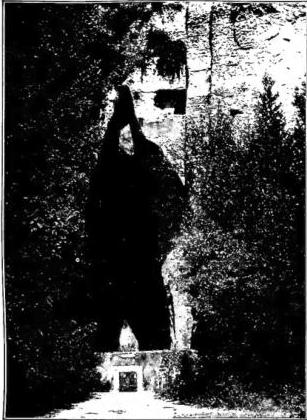
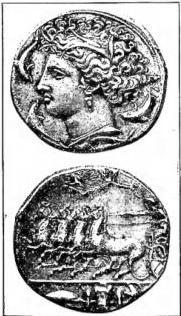
In 535 it was occupied by Belisarius, who wrested it from the Goths and celebrated a splendid triumph there. The emperor Constans II established his residence there during the last five years of his life (663–68). Shortly afterward S. suffered its first incursion by the Muslims, who returned several more times until they permanently occupied it in 878. In 1038 it was briefly occupied by the Byzantine commander George Maniakes, who built the castle there; in 1085 it was definitively liberated by the Normans and made a county under Jordan, son of Roger I. At the beginning of the thirteenth century, after being successively occupied by Pisa and Genoa, it took an active part in the revolt of the Sicilian Vespers and, having fallen under Aragonese rule, suffered the island’s unhappy vicissitudes.
II. CHRISTIANITY
When it was introduced there is unknown; St. Paul stopped there for three days in 61 (Act. 28:12), but there is no evidence that a constituted Church or faithful already existed. A writing of the eighth century states that the apostle Peter sent the first bishop, Marcian, there from Antioch, but the information is highly uncertain; the Church of Syracuse, however, was certainly established in the third century, when the question of the “lapsi” arose (CSEL, 3, 2, p. 553), as is clearly attested by its underground cemeteries, which date from that century and perhaps even from the preceding one. The first historically certain bishop is Cresto, who took part in the Council of Arles in 314 (Eusebius, Hist. eccl., X, 5). During the Diocletian persecution, however, S. LUCINA (v.); information concerning the other martyrs who fell in the various persecutions is uncertain or legendary. A catalogue of the Syracusan bishops said to date from the first century was published by C. Scobar in 1520, but it is no older than the twelfth century and contains many inaccuracies: it omits certain bishops known to have existed, such as Siracosio, attested by inscriptions; it includes many invented and duplicated names, which greatly undermine its value. One must reach the end of the fifth century to encounter another certain bishop, Eulalius, founder of a monastery that welcomed St. Fulgentius of Ruspe (PL 65, 128), and participant in the Roman Council of 502 (MGH, Auct. antiq., XII, pp. 447, 451). At the end of the sixth century the bishop of S. was Maximian, formerly abbot of the monastery of St. Andrew in Rome when St. Gregory the Great was there; the Pontiff, who held him dear, wrote him several letters, entrusted him with jurisdiction over all the Churches of Sicily in matters of lesser importance, and bitterly mourned his death (St. Gregory, Reg. Epist.: ed. P. Ewald - L. M. Hartmann, in MGH, Epist., I-II, V. index). He was succeeded by John, archdeacon of the Church of Catania, who was also highly esteemed by St. Gregory, who granted him the use of the pallium, as he had to his predecessor. In 640 the bishop was St. Zosimus, formerly abbot of a monastery in the city, and in 840 the famous Gregory Asbestas, involved in the Photian schism. In the Dispositio attributed to the Byzantine emperor Leo the Wise (886-911), the bishop of Syracuse has metropolitan jurisdiction over all the bishops of Sicily, Malta, and Lipari (G. S. Assemani, Italicae hist. script., III, Rome 1752, p. 495 ff.); but perhaps the privilege was older and dated from the time of the emperor Leo the Isaurian (717-741), who, as is known, transferred jurisdiction over the Sicilian Churches to the patriarch of Constantinople. When the city was occupied by the Saracens (878), the bishop was Sophronius, who was taken prisoner to Palermo. The first bishop after the Norman occupation of the island was Roger, elected by Urban II (1093); he devoted himself to the reconstruction of the diocese, which at that time was very extensive, embracing the entire southeastern corner of Sicily and also including the territory of the ancient diocese of Lentini (Lanzoni, pp. 629-31). Pope Alexander III granted the bishop of S. the perpetual use of the pallium and declared him immediately subject to the Holy See (1169), but Clement III abolished both privileges in 1188 and declared S. a suffragan of Monreale. In 1317 Bishop Pietro Moncada restored the Cathedral; the Benedictine Tommaso da Catania celebrated the first Synod in 1388, and in 1393, while visiting the diocese at Terranova (Gela), he was taken prisoner during a Saracen raid and carried off to Africa. The Syracusan Ruggero Bellomo built the episcopal palace, and Paolo Santafede distinguished himself through charity and self-sacrifice during the plague of 1455; in 1529 Ludovico Platamone received the Knights of Malta, expelled from Rhodes. In 1543 the cult of St. Conrad, already approved for the diocese in 1515, was extended to all Sicily; in 1553 Bishop Girolamo Bologna promulgated the decrees of the Council of Trent, while his successor Giovanni Orosco introduced the Roman rite, abandoning the Gallican rite already in use since the time of the Normans, and in 1570 began the construction of the diocesan seminary. Bishop Giovanni Torres enlarged the episcopal palace; in 1646 a famine devastated the city, and, in memory of its deliverance, a procession in honor of St. Lucia was instituted, which is still held on the first Sunday of May. The terrible earthquake of 1693 completely destroyed 22 cities of the diocese and more or less damaged 12 others, killing 38,000 people; Bishop Annibale Termini oversaw the reconstruction, beginning with the Cathedral and the Seminary, and promoted devotion to the Eucharist. Bishop Marini (d. 1730) began construction of the façade of the Cathedral, which was completed under Bishop Testa and adorned with statues by Marabitti. Bishop Alagona (d. 1801) built the chapel of the Seminary and established the library, now transferred to the Seminary.In 1816 the diocese was divided through the erection of that of Caltagirone, while the canons of the Cathedral were granted the use of the mitre and cappa magna; another division took place in 1844 with the erection of the diocese of Noto; on this occasion S. was declared an archiepiscopal and metropolitan see. Among the last archbishops, the Franciscan Benedetto la Vecchia (d. 1896) distinguished himself for holiness of life and learning. After the erection of the new diocese of Ragusa (1950), the archdiocese of Syracuse comprises the cities of Augusta, Buccheri, Buscemi, Canicattini, Carlentini, Cassaro, Ferla, Floridia, Francofonte, Lentini, Melilli, Palazzolo Acreide, Solarino, Sortino, and the hamlets of Belvedere, Brucoli, Cassibile, Pedagaggi, Priolo, Rizzolo, and Villasmundo.
III. MONUMENTS
Of the ancient Sicilian civilization there remain, in addition to the important collection of objects gathered by Paolo Orsi in the city’s Archaeological Museum, the famous necropolis of Pantalica, dating from the 12th to the 8th century B.C., and that of Buscemi. More important are the Greek and Roman monuments, such as the temple of Apollo, dating from the 6th century B.C., recently freed from the superstructures that obscured it; the altar of Jerone; the Greek theatre; the so-called Ear of Dionysius, famous for its acoustics; the Castello Eurialo; the imposing latomie transformed into luxuriant gardens; and the Roman amphitheatre and gymnasium. The Cathedral, formerly the temple of Athena, dating from the 5th century B.C. and, according to tradition, adapted as a Christian temple by Bishop Zosimo in the 7th century, has a fine trussed roof dating from 1518, a ciborium by Vanvitelli, a painting by Antonello da Messina, and several sculptures by Gaggini. Important are the churches of S. Pietro, Byzantine but remodelled in 1300; the Norman churches of S. Niccolò (11th century), S. Giovanni alle Catacombe (11th–12th centuries), and S. Tommaso (12th century), though the latter was subsequently remodelled. The Norman basilica of S. Lucia al sepolcro contains a crucifix dating from 1200 and a magnificent painting by Caravaggio depicting the Burial of the Syracusan Martyr; a fine portal dating from 1501 adorns the little church of the Madonna dei Miracoli. Among the noteworthy secular or civic monuments are: the Castello(phot. Alinari)
IV. ILLUSTRIOUS FIGURES
Among the personalities of S. who should be remembered for their antiquity are Giuseppe Innografo (8th century); St. Metodio, elected patriarch of Constantinople (843); St. Simeone the hermit, who died at Trier (1031), the first saint canonized by a papal bull, by Benedetto IX (1041). In the 13th century, the notaries Giacomo and Arrigo Testa, both from Lentini, poets of the Sicilian school at the court of Federico II. In the 17th century, the Jesuit Ottavio Gaetani (d. 1620), a diligent though not always reliable collector of Sicily’s hagiographic records, and his brother Costantino (d. 1630), a Benedictine, philosopher, theologian, and historian, friend of Cardinal Baronio and librarian of the Vatican Library; Vincenzo Mirabella (d. 1624), an archaeologist, mathematician, and historian who left a work on the monuments of S., the fruit of patient and costly research; Mario Minniti (d. 1640), a painter and disciple of Caravaggio, by whom a fine S. Benedetto is preserved; the Jesuit Ortensio Scammacca of Lentini (d. 1648), a prolific tragedian; Domenico Bottone of Lentini (d. 1696), an illustrious physician, author of the work Pyrologia topographica, which earned him a reputation as a scholar and scientist. In the 18th century, the founding of the two literary Academies of the Aretusei and the Anapei and the establishment of the Alagonian Library gave a great impetus to culture in S.; distinguished figures included Emanuele de Astorga (d. 1755) of Augusta, an eminent musician whose opera Dafni was successfully performed in Genoa in 1709; the architect Pompeo Picherali (d. 1746), who directed the reconstruction of the city after the earthquake of 1693 with an eclectic spirit and versatility; Saverio Landolina, man of letters and archaeologist, initiator of the Archaeological Museum adjoining the Alagonian Library; and the priest Giuseppe Logoteta (d. 1809), historian, founder of the Giornale ecclesiastico di Sicilia and of an Academy of agricultural and ecclesiastical studies. In the 19th century, the priest Giuseppe Capodieci (d. 1828), a shrewd and patient collector of the records of his homeland, which he left in manuscript in 50 volumes, in addition to those published, in the Alagonian Library; Tommaso Gargallo (d. 1843), an eminent poet, classicist, and historian; Alessandro Rizzo (d. 1867), an esteemed naturalist, founder of an Academy and a scientific cabinet; Raffaele Politi (d. 1870), painter and archaeologist, illustrator of the monuments of Agrigento; Gaetano Italia Nicastro (d. 1896) of Palazzolo Acreide, a successful researcher and illustrator of the archaeological monuments of his homeland; Gregorio Zappalà (d. 1908), sculptor, who worked for Piazza Navona in Rome; G. Aurelio Costanzo (d. 1913) of Melilli, an illustrious poet and follower of Romanticism; Orso Mario Corbino (d. 1937), an eminent physicist from Augusta.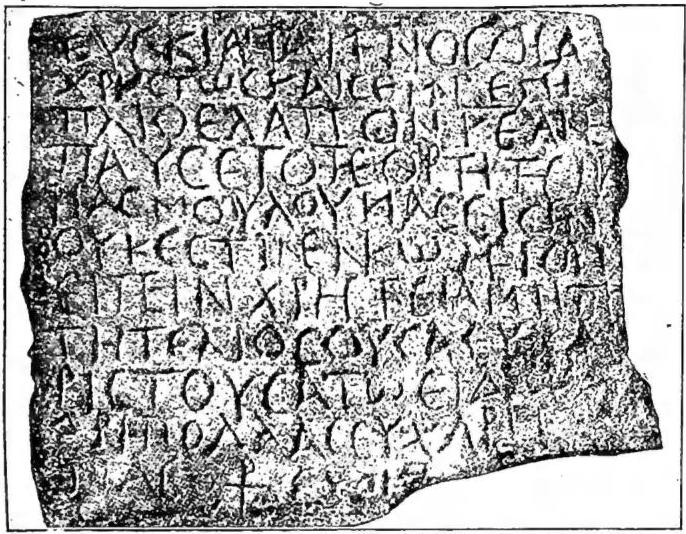
V. ARCHEOLOGIA CRISTIANA
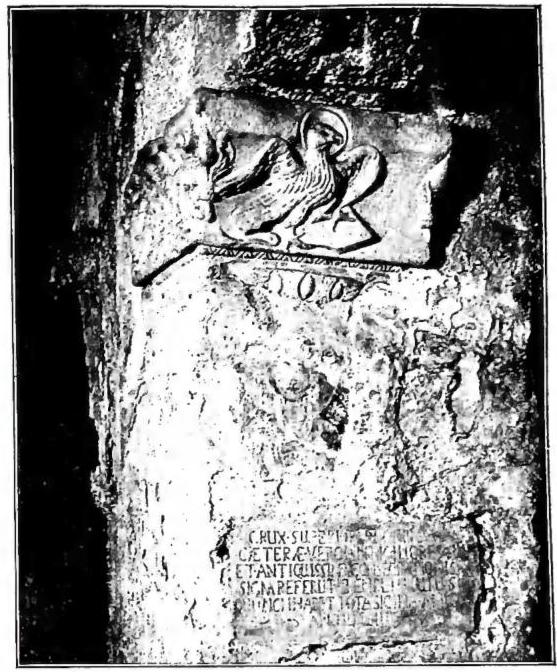
The early Christian monuments of S. are all located in the Acradina, one of the five regions that formed the ancient Greek city; they constitute a grandiose complex, inferior only to Rome in extent, architectural magnificence, and richness of inscriptions and furnishings. Unfortunately, the numerous ancient and recent devastations have caused considerable damage and dispersed much valuable material. Among large and small cemeteries, the region of Syracuse possesses approximately one hundred underground hypogea; most date from the time of the Constantinian peace, but nuclei certainly dating to the 3rd century and even earlier can clearly be identified, especially in the larger cemeteries.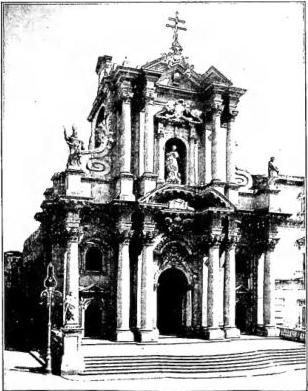
large sections were discovered in 1942 and 1950, but have not yet been scientifically described. The few paintings preserved there reproduce the familiar themes of the Good Shepherd, Jonah, Daniel in the lions’ den, and the Orans. Of particular importance is a Byzantine underground oratory from the 8th–9th centuries, with paintings among which the ss. Marciano, Cosma and Damiano are noteworthy. Elena and, on the vault, the martyrdom of the forty martyrs of Sebastia.
The cemeteries of S. Maria di Gesù and Vigna Cassia, originally independent, today constitute a single extensive complex; the former consists of a double cross-shaped gallery flanked by loculi, while the latter resulted from the fusion of about ten hypogea excavated at different levels and subsequently incorporated into one another. The architectural similarities between these two cemeteries and that of S. Lucia are so evident as to leave no doubt concerning their chronology. The extreme northwestern extension of the Vigna Cassia cemetery dates from a later period and resulted from successive enlargements. Few inscriptions and paintings have been found there, among which those of the arcosolium of Marcia are important; it must nevertheless be said that the two cemeteries have not been exhaustively explored.
The largest, best known, and at the same time most recent of the underground cemeteries of Syracuse is that of S. Giovanni. Broad galleries with polysomic arcosolia and spacious cubicula with grandiose tombs give it a truly imposing appearance, sufficient to justify the enthusiastic wonder of its first explorers and visitors. Its excavation made use of an old Greek aqueduct and of several cisterns transformed into cubicula. The paintings are sparse, among which those of the arcosolium of Deodata and a Madonna in the principal gallery stand out; the famous 4th-century sarcophagus of Adelfia, of Roman origin, was found there. Rich
SIRACUSA, ARCIDIOCESI di « Facade of the Cathedral, a work of the 18th century by P. Picherali (1728–57).
BYZANTINE, but it underwent transformations in later periods. Here a tradition, moreover a very recent one, sought to identify the tomb of s. Marciano, the city’s first bishop.
A dense series of hypogea rises on the eastern rocky slope of Acradina, extending from the small harbor to near the Capuchin convent. Their exploration yielded furnishings whose evidence for the Christianity of their users is rather ambiguous, since they retained Jewish or pagan traditions. The chronology of these hypogea can be placed between the 4th and 5th centuries. Also worthy of mention are the sub divo necropolises of Grotticelli and Fusco.
In the suburb, north of S., important underground cemeteries are found at Manomozza and Riuzzo near Priolo, and at Molinello near Augusta: all three display marked similarities with the oldest cemeteries of S., to whose chronology they must be linked. Traces of hypogea are found at Lentini, while more important are those at Floridia, Canicattini, Ferla, and especially those at Palazzolo Acreide (Grotta di Senebardo, Intagliata, Intagliasella).
After Rome, S. is the richest city in Italy in inscriptions. These have been published in various journals and works as they have come to light during the successive explorations of the cemeteries; there is, however, a need for a scientifically modern Corpus to collect them all. For several years p. Ferrua S. J. has been working on this, and has already published excellent specimens and preliminary studies. Among the minor arts, the collection of terracotta lamps is important, but here too an overall scientific study is still lacking.
The Byzantine period also left important monuments for the archaeology of Syracuse, especially in religious buildings. In addition to the hypogean oratories of S. Marciano and S. Lucia already mentioned, worthy of note are the church of S. Foca near Priolo, that of Zitone near Lentini, S. Teresa near S., and S. Lucia di Mendola near Palazzolo; the troglodytic oratories of S. Marco near Palazzolo, S. Nicolicchio and S. Micidiario near Pantalica, S. Pietro near Buscemi, etc. - Vedi tavv. XLIV-XLV.
BIBL. - Sicily (v.) it naturally also applies to S. In particular, history: S. Privitera, Storia di S. ant. e moderna, 2 vols., Naples 1879; B. Lupus, Die Stadt Syrahus im Alterthum, Strasbourg 1887; F. H. Chase, Syracuse and its environs, 3 vols., New York 1924; L. Giuliano, Storia di S. ant., 3rd ed., Milan 1936. Christianity: R. Pirri, Sicilia sacra, I, Palermo 1733, pp. 598-600; Lanzoni, pp. 532-39; A. Amore, De primor-
instead, it was the epigraphic harvest that yielded about 500 inscriptions (among which the important one referring to the cult of s. Lucia), for the most part Greek. The cemetery was in use between the 4th and 6th centuries; shortly afterward the overlying ground was also exploited. Not far from S. Giovanni and independent of it is a hypogeum of the 4th century transformed into an oratory in the Byz-
diti relig. christ. in Sicilia, Rome 1945, pp. 17-43; L. Narciso, La personalità storica del veci. Siracuso, in Atti del I Congr. di arch. crist., there 1952, pp. 217-23. Monuments: G. M. Capodieci, Antichi monum. di S., there 1816; F. S. Cavallari - A. Holm, Topogr. archeol. di S., Palermo 1883; id., Append. alla topogr., Turin 1891. Christian archaeology: besides the archaeological bibliography of S., the most important may be recalled: I. Carini, Iscriz. rinvenute nelle catac. di S., in Arch. stor. sicil., 1873, pp. 260-63, 505-523; 1874, pp. 508-14; 1875, pp. 121-25, 492-507; G. B. De Rossi, Arcosolio dipinto di singolare importanza, in Bull. di arch. crist., 3rd series, 2 (1787), pp. 149-59; V. Schultze, Die Katahomben von Syrahus, Vienna 1880; C. Cavallari, S. Giovanni fuori le mura di S. e i monum. annessi, in La Sicil. artist. e archeol., 1 (1887), pp. 21-24; G. Führer, Eine wichtige Grabstätte der Katahombe von S. Giovanni bei Syrahus, Munich 1896; id., Zur Grahschrift auf Deodata, there 1896; G. Agnello, La basilica dei SS. Giovanni e Marziano in S., in Boll. d'arte del Min. pubbl. istruz., 9 (1929), pp. 3-24; C. Barrecca, Le catac. di S., 3rd ed., Rome 1934; the complete bibliography of Paolo Orsi, the meritorious illustrator of Christian S., in Paolo Orsi, Rome 1935; A. Ferrua, Note di epigraf. crist. siracus., in Arch. stor. per la Sicil., 4 (1938), pp. 19-37; id., Nuovi studi nelle catac. di S., in Riv. di arch. crist., 17 (1940), pp. 43-81; id., Epigraf. ticula pagana e crist., ibid., 18 (1941), pp. 151-243; id., Florilegio d'iscrizione paleocrist. di S., in Rendic. Pont. accad. rom. arch. crist., 22 (1948-47), pp. 227-230; G. Cultrera, Il Temeno delle Θεομογόριοι e la cripta di S. Marziano, ibid., 23 (1950), pp. 45-56; L. Bernabò-Brea, Ipogei pagani e crist. nella regione adiacente alle catac. di S. Gioe., in Not. degli scavi, 1947, p. 172 ff.; id., S., ibid., pp. 208-14; G. Agnello, L'oratorio ipogeico di Costelluccio, in Nuovo Didashaleion, 2 (1948), pp. 36-50; C. Amato, Di alcune iscriz. funerarie per bambini rinvenute recentem. nelle catac. siracus., in Pastor Bonus, 1 (1950), pp. 2-9; id., Le scoperte più recenti nelle catac. di S., ibid., pp. 13-23; G. Agnello, La chiesa paleocrist. di S. Pietro a S., in Arte crist., 38 (1951), pp. 25-30; id., La necropoli e la chiesa rupestre di Bibinello, in Atti del I Congr. naz. di arch. crist., Rome 1952, pp. 31-47; S. L. Agnello, Scavi e scoperte a S. Lucia di Mendola, ibid., pp. 49-58; L. Bonanno, Le catac. Banuisto e la sua suppellettile, ibid., pp. 93-100; C. Cecchelli, Sapiestia Dei. La figuraz. sapienziale del sarcofago di Adolfa, ibid., pp. 111-12; L. Puma, Contributo allo studio degli ipogei crist. minori di S., ibid., pp. 251-57. V. Wilpert, Sarcofagi, pl. 92, II, p. 102; pl. 93, I-II, p. 102. Agostino Amore