
RAGUSA, DIOCESE OF. — Erected on 6 May 1950, by taking seven communes from the archdiocese of Syracuse and one from the diocese of Noto. It is united «aeque principaliter» with Syracuse. It comprises a territory of 1,000 sq. km., with a population of 135,000, of whom 133,000 are Catholics; it has 110 diocesan priests and 22 regular priests, 6 male and 24 female religious communities (Ann. Pont., 1952, p. 381). From 1952 onwards, the «Little Seminary of St John the Baptist» was established, limited to the three middle-school classes, dependent on the director of the archiepiscopal seminary of Syracuse.
The territory of the diocese of Ragusa was inhabited in prehistoric times by the Sicels, with necropolises carved into the rocky walls of the valleys; the indigenous name of Ibla probably belongs to the city of Ragusa. In the Greek period, the territory was Hellenized by the colony of Camarina. In Roman times, several small cities arose there, near which are found the principal testimonies of early Christianity: catacombs and hypogea, generally of Constantinian date, but with some older elements. Churches of Byzantine date are documented at Caucana, Acrilla, and Comiso. At the anchorage of Caucana, in 533, Belisarius gathered his fleet to sail for Malta and Africa.
The importance of Ragusa in the Norman period — it had been conquered by the Arabs in 856 — is attested by the geography of Edrisi, who celebrated its buildings and squares, its arable land, the frequency of commerce, its nobility, and its ancient civilization. In this period, it was enfeoffed by Count Roger to one of his comrades-in-arms, and perhaps his natural son, Goffredo, who took the name of Ragusa; he contributed to the endowment of the Church of Syracuse and in Ragusa built the abbey of Santa Maria la Nuova and donated the mother church of San Giorgio.
The development of Ragusa was influenced by the particular forms of the Sicilian feudal regime, which, where personal initiatives, fertile lands, and lively trade converged, allowed the formation of a bourgeois and noble class that culminated in the establishment of communal institutions. Ragusa counted 7,827 inhabitants in 1583, rising to 8,863 in 1714 and to 23,500 at the close of the 18th century.
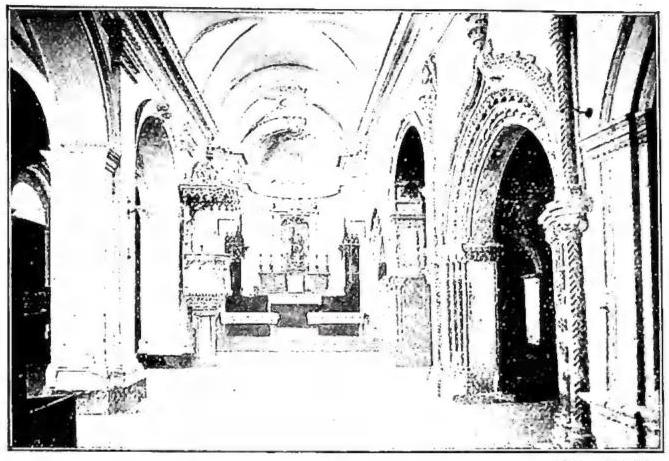
In Ragusa, the surviving portal of the ancient church of San Giorgio, dating from around the mid-15th century, is considered one of the most elegant examples of Sicilian architecture of the time, blending Castilian volumes; the stylized flower with which the arch terminates is accompanied by a series of figurative sculptures assigned to the architectural office. At Chiaramonte, the oldest part of the sanctuary of Gulfi dates from the same period, while two marble statues of the Saviour and the Madonna belong to the Renaissance; at Comiso, the structures of the Castello, the church of San Francesco, the work of an inventive craftsman who combined with exceptional skill various architectural experiences, are testimonies to the architectural nobility that marked the capital and the major centres before the earthquake of 1693, which gravely damaged them. Rising from the destruction, Ragusa was enriched by a new quarter, which, drawing from the slope the motifs of a suitable urban arrangement attributed to the animator of the rebirth, Baron Mario Leggio, became the new urban centre. The church of San Giorgio Nuovo, in the old quarter, begun in 1739 (architect R. Gagliardi) and enriched internally with paintings and decorations, including the remains of a tribune in the grotesque style of the previous church, is the largest building in the old city, surrounded by about thirty smaller churches (about forty no longer exist), as well as palaces, among which should be mentioned the Sortino palace, with its rich Baroque balustrade, and the Donnafugata palace, which houses a notable collection of paintings and ceramics. In the new city, the cathedral of San Giovanni, in Baroque style, built between 1706 and 1778, contains notable works of art (paintings by Manno, Vaccaro, and Paolo Vetri), while the church of the Ecce Homo (1808) is remarkable for its scenographic arrangement, and that of the College represents one of the most correct examples of Sicilian 18th-century architecture. To these works has been added an entire complex of new buildings, following the elevation of Ragusa to the capital of the homonymous province in 1926.
In the field of religious institutions, Ragusa boasts a constant tradition of civic generosity. Charitable works and confraternities have arisen at all times through the initiative of individuals and families; among these are the Sammito Hospital, the Messa dell’Alba, the Paternò-Arezzò Hospital, and, more recently, the donations of Sozzi and Cartia, which provided the basis for the erection of the diocese.
Among the notable figures of Ragusa are the Jesuit Niccolò Urso, praised by Aguilera for his exemplary virtues; G. B. Odierna (1597–1660), the famous astronomer; the theologian Carlo Bellio of the second half of the 15th century; Ascenzo Guerrieri, tutor of Pope Urban VIII, who appointed him bishop of Castellaneta in Apulia; the polyglot and orientalist Vincenzo Laurefice, who in 1623 was named bishop of Monreale; Giuseppe Miceli Marquez, author of a Latin-Spanish ecclesiastical lexicon; the bibliophile Alessandro Gaspano, abbot of Santa Maria Latina in Messina, who in 1667 donated his library to the Capuchin convent in Ragusa. One should also recall Fr. Anselmo of Ragusa, apostolic prefect of Bengal; in more recent times, G. di Stefano, founder (1781) of a substantial charitable work; G. B. Marini, creator (1774) of a children’s asylum; and Sister Maria Schininà, foundress of the flourishing religious Order of the Sacred Heart.
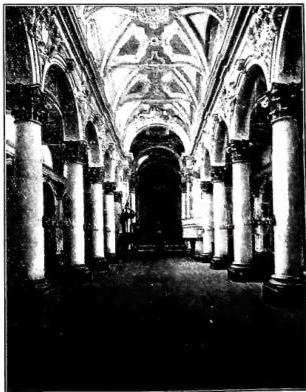
chapel of the oldest Chapter of the diocese, established in a church of Norman age, modified after the earthquake of 1693, in a unified complex by the architect G. B. Cascione, is, for the harmony of its lines and the refinement of its decorations, a masterpiece of the late 18th century. Among the other churches (10, of which 5 parish; another 15 transformed or destroyed) the sanctuary of St Blaise with its elegant 17th-century façade deserves mention. Once home to 7 religious families and a College of Mary, all now abolished, Comiso now has an orphanage and a rest home run by the Sisters of the Sacred Heart, a kindergarten run by the Ursuline Sisters, and numerous other institutions of education, assistance, and charity. Among the notable figures born here are Fr Pietro Palazzo (16th century) and Fr Mansueto Cocigra. — See pl. XIX.
RAGUSA (DUBROVNIK), DIOCESE OF. — A city and diocese in Dalmatia whose territory coincides entirely with that of the former Republic of Ragusa (including the islands). Until 1828 Ragusa was one of the four metropolitan sees of Dalmatia.
Covering an area of 1,315 km², it has 74,000 inhabitants, of whom 72,000 are Catholic; it comprises 59 parishes served by 46 diocesan priests and 40 regular clergy; within the diocese there are 12 male and 18 female religious communities (Annuarium Pontificium, 1952, p. 333).
The city was founded in the 7th century by refugees from ancient Epidaurus (see EPIDAURUS). The new settlement, Ragusium, became part of the Byzantine theme of Dalmatia. In the 13th century a Slavic suburb, Dubrovnik, was annexed to Ragusa; the city, encircled by fine walls, thereafter bore both names (Ragusa and Dubrovnik). The Slavic element gradually infiltrated the city so that by the 13th century some patrician families were of Slavic origin.
The first historical mention of Ragusa occurs around the year 850. Byzantine sovereignty, interrupted in the 11th century by that of the Normans, was for a brief period replaced by Venetian protection, under which it again passed in 1205 and remained until 1358. From the 12th century onward Ragusa became, through its trade with Western and Eastern countries, an important commercial centre in the Adriatic. In the 13th–14th centuries the boundaries of Ragusan territory were fixed; it extended from the mouth of the Neretva to the Bay of Kotor, embracing the islands of Mljet (Italian Meleda) and Lastovo (Italian Lagosta) and the Pelješac Peninsula (Italian Sabbioncello) with Ston (Italian Stagno). Its aristocratic constitution had its legislative organs in the Great Council (Consilium Maius) of 100 members and the Senate (Consilium Rogatorum or dei Pregadi) of 30 members, with an executive body, the Minor Council (Consilium Minus) of 12 members, including the count.
The sovereignty of the kings of Hungary was in fact merely nominal and consisted in the payment of a tribute. The count, originally always a Venetian noble, was later replaced by a Council of Three and subsequently by a single rector. Enriched by trade with many European countries, the city gradually embellished itself and assumed its definitive urban and artistic physiognomy. Ragusa was at this time engaged in numerous struggles to protect its possessions and newly acquired territories. With the death of the last Hungarian king, Louis (at Mohács in 1526), Ragusa placed itself under the sovereignty and protection of the Sultan, paying an annual tribute; thus the Republic of Ragusa, while maintaining its traditional autonomy—little short of true independence—and its neutrality in the conflicts between Venice and the Porte, succeeded in preserving its old markets in the Balkan hinterland (Bosnia, Serbia, etc.) and in deepening commercial relations with other parts of Europe and the Mediterranean, retaining the monopoly of trade with the hinterland under Ottoman sovereignty. This monopoly, however, gradually declined as the discovery of new lands redirected the course of world trade. Moreover, within the Ottoman Empire the symptoms of political and economic decline became more pronounced in the 17th century. In 1806 French troops dealt the final blow to the Republic of Ragusa, which at the Congress of Vienna (1815) was united with Austrian Dalmatia; after the dissolution of the Austro-Hungarian Empire (1918), Ragusa became part of the new Kingdom of Serbs, Croats, and Slovenes (later Yugoslavia).
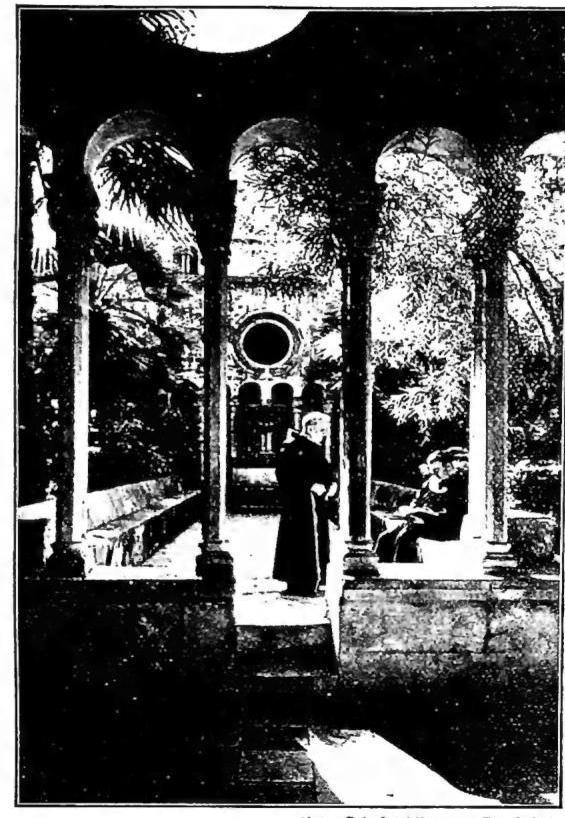
Ragusa, known as the “Athens of Croatia,” was the birthplace of many illustrious men, among whom the playwright Marin Držić and the celebrated poet Ivan Gundulić (Gondola) stand out. Ragusa also produced the famous Jesuit mathematician and astronomer Roger Boscovich (see s.V. 18th century). Also well known is the painter Nicholas of Ragusa (N. Božidarević). The city possesses considerable historical and artistic monuments, foremost among them the walls with their towers, the magnificent Rector’s Palace, the Customs House (Divona), the Franciscan and Dominican convents, the churches of St Saviour and St Blaise (Sv. Vlaho, patron of the city), the Cathedral dedicated to the Blessed Virgin, and the two fine fountains attributed to the Neapolitan architect Onofrio de la Cava. In Ragusa’s churches are paintings by Titian (or at least from his school), Andrea del Sarto, Pordenone, and Palma the Elder. Among its very ancient institutions are the pharmacy at the Franciscan convent, founded in 1317, and an orphanage for illegitimate children (1432).
The diocese of Ragusa appears to have been created at the same time as the new city in the 7th century. Indeed, the bishops of Ragusa always considered themselves successors of those of Epidaurus. The first explicit mention, however, occurs in the acts of the provincial synods of Split in 925 and 928; at that time, as a suffragan of Split, the new diocese of Kotor (Croatian Cattaro) was also erected. In 1022, by concession of Benedict VIII, Ragusa became a metropolitan see, but owing to protests from the metropolitan of Split, in 1060 Ragusa reverted to being a suffragan of Split; it was not definitively made a metropolitan see until 1120, under Pope Callistus II, when it had ten suffragans, including Bosnia. The protests and conflicts continued until, under Innocent III, the metropolitan see of Kotor was reconstituted, and Dalmatia thus had four archbishoprics: Split, Ragusa, Zadar, and Kotor. In 1828 Leo XII created a single metropolitan see at Zadar but united with Ragusa the ancient dioceses of Ston (Croatian Ston) and Korčula (Italian Curzola). In 1932 the island of Lastovo was placed under the archbishop of Zadar.
Among the best-known and most meritorious archbishops of Ragusa are Giovanni Dominici (1408–19), Gianangelo Medici (1545–49, later Pope Pius IV), and the noted papal scholar and diplomat Lodovico Beccadelli (1555–64).
At present the diocese of Ragusa lies entirely within the Federal Republic of Croatia. In the city are the diocesan seminary and two philosophical-theological schools, one Franciscan and one Dominican. — See pl. XX.
Atanasio Matanić.-