
MALTA. –
I. GEOGRAPHY
The M. Archipelago, which rises on a submarine platform joined to Sicily, from which it is 90 km distant, consists of the island of the same name (246 sq km) and those of Gozo (67 sq km), Comino, Cominotto and Filfola, as well as a certain number of rocks; 316 sq km in all.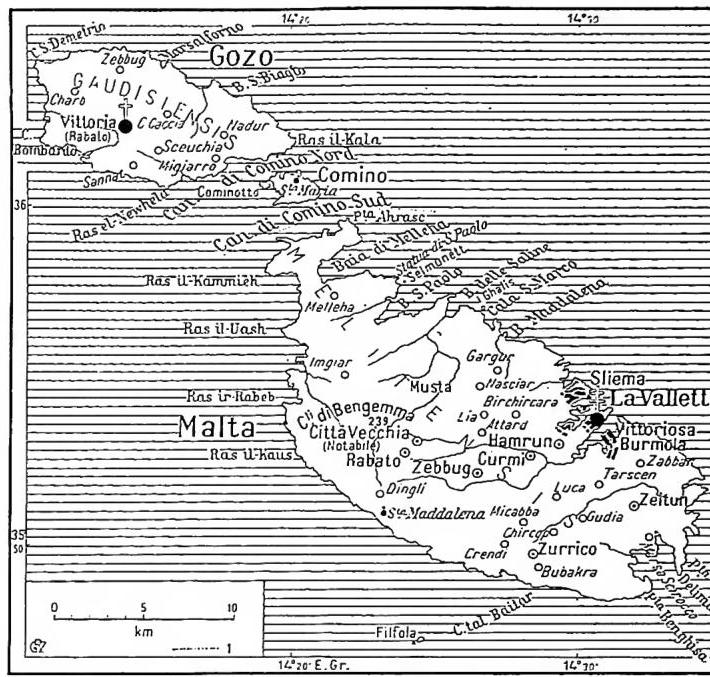
MALTA - 1) Ecclesiastical jurisdictional boundary. (properly, Enc. Catt.)
but production does not suffice for domestic consumption, since the population, having almost tripled over the past century (307,000 inhabitants in 1948), reaches an exceptionally high density (971 per sq. km.). Thus, for centuries, the archipelago has given rise to emigration directed particularly toward the Mediterranean coasts (where there are now more than 150,000 Maltese). The English number little more than 5,000, and foreigners about a thousand (including the Italians). The official languages are English and Maltese (the latter, which is a mixed Italo-Arabic dialect, introduced in 1934 in place of Italian). The only notable urban centre is the capital La Valletta (64,000 inhabitants with its suburbs).
The Archipelago lies halfway between Gibraltar and Suez and possesses a large and secure natural harbour: hence its military importance and the long British occupation (since 1798). M. is a colony governed by a governor, assisted by a council and an elected assembly of 40 members.
II. CIVIL HISTORY
Definitively wrested from the Carthaginians by the Romans in 218 B.C., M. was incorporated into the province of Sicily. In the 4th century it passed to the Eastern Empire, was possessed for brief periods by the Vandals and the Goths, and returned to the Empire in 533. In the 9th century it was conquered by the Arabs, who held it until 1091, when the Norman Ruggiero occupied II. Arab rule left significant traces in the language, toponymy, and art, and strong Muslim communities remained on the island until they were expelled by Federico II. In 1266 M. became, together with Sicily, Angevin territory; but after the defeat inflicted by Ruggero di Lauria on the fleet of the King of Naples in the waters of M., it passed to the Aragonese. In the 13th century the strong influx of Italian elements profoundly altered the dialect of M. During Norman and Swabian rule M. was often granted in fief to Sicilian families; the Aragonese, on the other hand, incorporated it into the royal domain, and in 1428 granted its community the same privileges enjoyed by Palermo, Messina, and Catania. The municipal organization encouraged the vigorous development of all civil institutions. In 1530 Carlo V ceded M. to the Order of St. John, which since 1522 had lost the island of Rhodes. The cession was made in full sovereignty, save for the symbolic annual tribute of a falcon. The Knights embellished the island and fortified it, transforming it into a powerful naval base that enabled them to withstand the unceasing attacks of the Turkish and Barbary fleets.In 1565 M. was besieged by the Turks: the stubborn resistance of the Knights and the entire population enabled a fleet sent from Sicily, Naples, and Tuscany to arrive promptly to their aid, and the Turks were forced to lift the siege. The Order’s relations with Sicily were, despite occasional conflicts, always cordial. But in the 17th century, and even more so in the following one, the Order gradually suppressed the municipal institutions, concentrating all powers in its own hands, and the loss of the traditional franchises aroused growing discontent among the population, which gave rise to conspiracies and revolts, suppressed with harsh severity. Toward the end of the eighteenth century, when the Mediterranean too had become a field of struggle among the states aspiring to continental hegemony, the powers turned their eyes toward M., which, by virtue of its geographical position and military importance, could constitute a valuable strategic base for whoever possessed II. In 1798 the island was conquered by Bonaparte. A reason, or pretext, for justifying the attack was provided by the fact that in December 1797 Paolo I of Russia had proclaimed his protectorate over the Order (in November 1798 he was elected grand master). The French, initially favored by part of the population, which had been ill-disposed toward the Knights’ authoritarian regime, soon alienated all sympathy through their policy, which aimed to subvert the islanders’ traditions and customs and offended their religious sentiment. Thus, when news arrived of the French defeats of 1799, the discontent erupted into open revolt. The Maltese appealed for help to Naples, Portugal, and England. English troops landed on the island and, with the assistance of the people, who fought bravely at their side, forced the French to capitulate on 4 September 1800. Although the capitulation made no mention either of the rights of the Maltese or of the sovereignty of the King of Naples, Admiral Nelson had confirmed that the island belonged to the King of Naples, and in the King’s name the commander of the English forces, Alessandro Ball, assumed its government. But he immediately began a skilful and tenacious campaign of penetration, employing every kind of promise and inducement. The Treaty of Amiens, which had sanctioned the return of M. to the Order and its neutrality, was not implemented; the English remained on the island, and in May 1814, by the Treaty of Paris, obtained full sovereignty over II. From this moment, the British claim to possess M. by right of conquest would be opposed by the Maltese assertion that they had voluntarily placed themselves under England’s protection. For more than a century M. would struggle to preserve its constitutional liberties and the teaching and official use of the Italian language. As regards the constitution, after the government-appointed Council of 1835 came the Constitution of 1849 and the broader one of 1887, which made the majority of the Council of Government consist of elected members. As for language, from 1880 the English government began to uphold the principle of equality between the two languages, excluding any privilege for Italian. The Maltese nationalist party, led by Fortunato Mizzi, fought tenaciously against the restrictive laws inspired by Geraldo Strickland. Strickland’s removal from the island did not alter the direction of British policy. First, the Constitution of 1887 was repealed, and the narrower Constitution of 1849 restored. The nationalists’ great electoral victories compelled England to grant a new Constitution with elected institutions in 1921. But in 1933 the Constitution was suspended; the governor assumed full control of the administration and enacted increasingly stringent laws to abolish Italian from official use and education and to adopt Maltese and English. In 1936 the Constitution of 1921 was definitively abolished.
Roberto Palmarocchi
III. DIOCESE
The diocese has a population of 280,000 inhabitants, of whom 278,000 are Catholics; it has 50 parishes with 309 churches served by 402 diocesan priests and 384 religious priests, one seminary, 45 male and 76 female religious communities (Ann. Pontif., 1951, p. 261).In the bay of this island, in A.D. 58, the ship on which St. Paul, together with other prisoners, was being taken to Rome was shipwrecked (Act. 28:1). The inhabitants of the place, whom St. Luke calls “barbarians” because they were unfamiliar with the Greek and Roman languages, welcomed the shipwrecked men kindly and took Paul for a god, both because he remained unharmed by the bite of a viper that had fastened itself to his hands and because he had healed the father of Publius, the chief of the island (Act. 28:6–9).
On the northern coast of the island of M., facing eastward (the direction from which the ship had come), lies the inlet known as “St. Paul’s Bay”; on the northern side of the bay is the islet of Salmonetta, separated from the mainland by a channel, where the formation of sandy shallows was easy (the double sea: Act. 27:41), upon one of which the ship went to pieces. A statue erected near the channel and a chapel commemorate the dramatic landing of St. Paul, patron of the island, celebrated with the feast of 10 February.
Christianity in M. is traced back to St. Paul. But Adon confused the Publius of the Acts with Publius, bishop of Athens, mentioned in St. Jerome’s De viris illustribus, and made him the first bishop of Malta (H. Quentin, Le martyrologes historiques au moyen âge, Paris 1908, pp. 416 and 599). Iulianus or Lucianus is said to have subscribed to the “constitutum” of the three chapters of Pope Vigilius in 553 (Hefele-Leclercq, III, II, p. 94).
Lucillus was deposed by Pope Gregory I in 598 (Jaffé-Wattenbach, 1196, 1549). He was succeeded by Trajan, formerly abbot of a monastery in Syracuse (Jaffé-Wattenbach, 1549, 1887).
Pope Pius XII, by the apostolic constitution Melitensem Ecclesiam of 1 January 1944, raised the church of M. to the rank and dignity of a metropolitan church, assigning to it the diocese of Gozo as suffragan (AAS, 36 [1944], pp. 161-163). The same Pontiff, by an Apostolic Letter of 18 January 1950, raised to the dignity of a minor basilica the church of S. Elena, situated in Birchicara (AAS, 42 [1950], p. 716).
Among the bishops of M., the following deserve mention: Cardinal Corrado Caracciolo (appointed in 1408), Cardinal Pietro di Foix, nephew of Louis XI (appointed in 1489), and Cardinal Giovanni Borgia, nephew of Alexander VI (appointed in 1497). Subsequently appointed, but having renounced the office, were Cardinal Raffaele Riario and Cardinal Andrea della Valle.
When M. was ceded to the Order, Charles V reserved the appointment of the bishop, to be chosen from among three names proposed by the Knights. Around 1574, when the Order protested because the bishop had been empowered to conduct inquiries against the Knights, Gregory XIII established the tribunal of the Inquisition of M., which lasted until 1798. In 1584 the same Pope prohibited knightly members or brothers from holding the bishopric, which was to be reserved for the chaplain priests of the Order. Relations between the bishops and the Knights were often disturbed by jurisdictional conflicts. The most serious conflicts occurred during the episcopates of Tommaso Gargallo (17th century), Baldassarre Cagliares (17th century), and Carmine G. Pellerano (18th century). In 1746 Benedict XIV regulated the respective powers of the bishop and the Chapter in the administration of the diocese. In 1780 a bull of Pius VI united the archbishopric of Rhodes in partibus to the bishopric of M., while nevertheless confirming the latter as suffragan of Palermo. In 1798 the bishop of M. was Vincenzo Labini. Upon occupying the island, the French declared that they would guarantee the free exercise of the Catholic religion; but immediately afterward they suppressed the religious Orders and confiscated their property, abolished the tribunal of the Inquisition, and forbade the clergy and the people to appeal to the Pope or to the metropolitan in matters concerning the administration of worship. These decrees contributed greatly to arousing hostility against the conquerors. The English, too, promised complete religious freedom. During their occupation, the Kingdom of Naples did not renounce its ecclesiastical patronage over the diocese. In 1807 the King appointed the Maltese Mattei as bishop, and London gave its consent; but after the Treaty of Paris, when, upon Mattei’s death in 1829, the King of Naples claimed the right to choose his successor, England refused it to him. Yielding to English pressure, Gregory XVI abrogated Palermo’s metropolitan rights over M., placing it under the direct authority of the Holy See. In 1831 he appointed Francesco Saverio Caruana bishop of M. and archbishop of Rhodes. When the English demanded, as was customary in England for anyone holding civil or religious office, an oath recognizing the Hanoverian dynasty and undertaking to do nothing against the Anglican religion, the bishop refused, and the Holy See approved his conduct. The definitive severance of every bond with the Kingdom of Naples took place in 1834, when an exchange was arranged between the property which the bishopric of M. owned at Lentini and that of the Benedictines of Catania on the island. During the long conflict between the Maltese and the English, the Church of M. sided with the former, who defended, together with constitutional liberties and their language, their religion, which was continually threatened by the British rulers. The sharpest conflict was provoked by Strickland’s anti-Catholic policy. The Holy See ordered an inquiry, which in 1929 it entrusted to Monsignor Robinson, an English subject. The result was an unequivocal condemnation of Strickland’s actions, a condemnation disseminated through pastoral letters issued by the bishops of M. and Gozo (the bishopric of Gozo had been established in 1864).
Roberto Palmarocchi-Donato Baldi
IV. ARCHAEOLOGY
The first explorations of the Christian hypogea of M. were those of G. F. Abela in 1647; thereafter, one must descend chronologically to Caruana (1881–97), A. Mayr (1901), E. Becker (1909), and Fr. A. Ferrua (1949).The ancient Christian cemeteries of M. are all excavated in the island’s characteristic marly limestone, used as a building material and permitting the excavation of large chambers containing the typical tomb, either baldachin-shaped or set behind a window. The tomb known as a baldachin tomb consists of a large raised sarcophagus for two or more bodies, surrounded by four pillars upon which rests an arch with a flat roof, the whole being carved from the limestone. In a single chamber there may be as many as four such tombs; they are occasionally found in Sicily, with some examples in Naples and only one in the Roman cemetery inter duos lauros (v.). At times, however, there are tombs for one or two bodies, in the form of an arcosolium, set in a niche whose vault is pierced by a window, an exclusively M. type. In some cases, several window tombs are found in an apsidal space with a characteristic raised platform used for funeral banquets. Some hypogea were closed by massive stone doors with a single leaf. Jewish hypogea are found near some Christian hypogea; the most extensive Christian cemetery is the one known as that of S. Paolo, beneath the church of S. Agata.
The epigraphy is poor. In a hypogeum, beside an arcosolium, the following Latin inscription was read: «in nomine Domini Ieshus Christi surge et ambulus, + Domine salbum me fac» (A. Heron de Villefosse, Inscription latine chrétienne de M., in Comptes rendus de l'Acad. des inscriptions et belles lettres, 1908, pp. 140–42); three other Christian Latin inscriptions are reported in CIL, X, 7498–500. A Greek inscription uses the expression καυρητήριον for a tomb containing two bodies (Corpus Inscrip. Graec., IV, Berlin 1877, no. 9540); in another, also Greek, the deceased is called εὐμαδῆς, γραττανὸς καὶ ἱητρός (ibid., 9451). Recently, in the cemetery known as that of S. Paolo, Fr. A. Ferrua read the Greek funerary inscription of a Leonia, bearing the Christological monogram.
V. ARTE
Art flourished in M. especially in the buildings erected after the establishment of the Order of St. John. The Order’s conventual church, dedicated to St. John, was built by G. Cassar between 1573 and 1577. It has a single nave with side chapels belonging to the various langues of the Order; it is sumptuous in its decorations, marbles, and tapestries (based on designs by P. Rubens and N. Poussin). The vault and several chapels were painted by M. Preti; by Caravaggio are La decolazione and il S. Girolamo. The crypt contains the tombs of the Grand Masters; that of Villiers de l’Isle-Adam (1530–1534) is the work of A. Gagini. The church of Gesù is by F. Bonamici, with paintings by M. Preti, Caracciolo, and Romanelli; the church of S. Giacomo (1710), in the Borrominian style, is due to G. Barbara; there are also the churches of S. Caterina d’Italia (1576), S. Francesco (1681), with paintings by M. Preti, and della Vittoria (1752). The palace of the Grand Masters, now the seat of the Governor, was built by G. Cassar (1572–1581); the auberge of the langue of Provence dates from 1575; the Palace of the Italian Knights (now the National Museum); the Palace of the Knights of Castile and Portugal, the work of Cachia (1744); the Palace of the Knights of Auvergne is today the Palace of Justice; the treasury palace of the Order has been converted into the Casino Maltese.In the old city, or Notabile, the Cathedral was rebuilt in 1697 by Lorenzo Gafa; it contains works by M. Preti, as does the church of S. Paolo e Publio; the church of S. Maria di Gesù contains works by A. Gagin