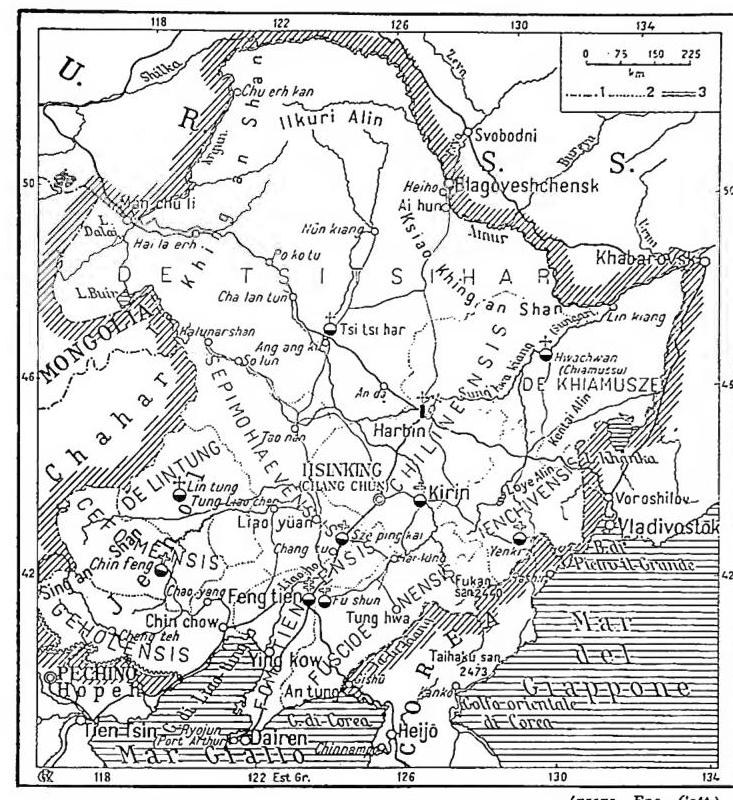
MANCIURIA. – It is the northeastern part of the Chinese domain, bounded by the Amur, the Ussuri, Korea, the province of Hopei, and Mongolia; a territory more than three times the size of Italy, extending between extreme latitudes comparable to those from Denmark to Calabria and facing the Yellow Sea along a short coastline (from the Gulf of Liaotung to that of Korea).
I. GEOGRAPHY
A long mountainous framework borders the vast plain on the W. (Hsing-an), N. (Hsiao Hsing-an), and E. (Chang-paik), across which flow the Zungari (2,400 km. in length) and the Liao (1,160 km.), whose tributaries together form an excellent network of internal communications. The climate is cold and continental, with abundant rainfall and marked differences between N. and S. In addition to its agricultural potential, deriving from the abundance and fertility of its alluvial soils, M. has considerable industrial prospects, owing to the presence of numerous mineral reserves, still, moreover, insufficiently known (coal, iron, copper, lead, manganese, oil shale, etc.), and to its no less significant forest resources (30% of the total area); exploitation of both may be said to be still in its infancy. Agriculture produces chiefly soybeans, wheat, rice, and sugar beet; livestock farming (5.4 million pigs, 2 million sheep, 1.7 million cattle) is still far from reaching its potential. Large-scale industry, although recently introduced, has already achieved notable successes in the iron and steel and chemical sectors (Ansham and Penhshin), as well as in hydroelectric power and textiles. Trade benefits from the two ports of Antung (the larger) and Dairen (formerly Port Arthur).The population (36.9 million inhabitants in 1946) consists overwhelmingly of Chinese; the Manchus proper probably constitute no more than one eighth of it, while the other minorities (Koreans, Japanese, Russians) are numerically insignificant. Population density is already high in southern M., where the climate is milder and economic activity more intense, especially in the lower basin of the Liao. There are numerous large population centers: one (Shenyang, formerly Mukden) exceeds one million inhabitants (1.1 million in 1946); two have more than 500,000 (the capital Changchun, formerly Hsinking, with 790,000, and Pinkiang, formerly Harbin, with 662,000), Kao-liang (a kind of borough), and about ten have 100,000 (among them Chilifeng with 430,000, and Fushun and Dairen with more than 300,000 each).
M., an independent republic in 1931, was transformed into an empire (Man-chu-Kwo) in 1934 by the Japanese, who in fact controlled it; after 1945 it was returned to China and divided into 9 provinces (Antung, Heilung-Kiang, Ho-Kiang, Hsing-an, Kirin, Liao-ning, Liaopehi, Nung-Kiang, and Sung-Kiang; Jehol is excluded). The Chinese Eastern Railway (Manchuli-Harbin-Suifenho-Pogranidnaja) and the South Manchurian Railway (Changchow-Mukden-Dairen) operate under joint Chinese-Soviet control.
II. EVANGELIZATION
In 1838 Gregory XVI separated from the Diocese of Beijing the Apostolic Vicariate of Leaotung, with jurisdiction over M. and Mongolia, entrusting it to the Seminary of the Foreign Missions of Paris. In 1840 Mongolia was established as an independent apostolic vicariate, entrusted to the Lazarists. Approximately 2,500 Chinese Christians lived in M., exiles or refugees who had escaped the persecutions toward the end of the eighteenth century and the beginning of the nineteenth. They had no permanent missionaries, but were visited by priests sent by the Bishop of Beijing, who since 1702 had also been the apostolic delegate for Chinese Tartary. The first apostolic vicar, Emmanuele Verrolles (1838–78), established several stations. The difficulties were considerable: the ethnic diversity of the population, the vastness of the territory, the severity of the climate, and the hostility of the pagans. Under Bishop Verrolles and his successors, however, the missionaries succeeded in organizing the existing Christian communities and founding new ones. In 1875 the mission received its first Sisters of Providence of Portieux. Genuine progress in conversions, however, occurred only after 1890.