
PIO VI, POPE. — Giannangelo Braschi, born in Cesena on 25 Dec. 1717 to Count Marc'Aurelio Tommaso and Anna Teresa Bandi. Educated by the Jesuits, he received his doctorate in utroque iure in 1735. He then completed his studies at the University of Ferrara under the guidance and protection of his uncle Giovanni Carlo Bandi, auditor of Cardinal Tommaso Ruffo, papal legate. Upon the death of Clement XII (1740), he followed the cardinal to Rome as a conclavist; after the election of Benedict XIV, when Ruffo became bishop of Ostia and Velletri, he administered his two dioceses. At Velletri he was caught up in the fighting of 11 Aug. 1744 between the Austrians and Neapolitans; the relief work he carried out on that occasion earned him the gratitude of Carlo II, and, taking advantage of this, he succeeded in 1746 in settling the disputes that had arisen between the Holy See and the court of Naples concerning the jurisdiction of the episcopal court. A participating secret chamberlain and study assistant to Benedict XIV, and canon of St Peter’s (1755), he received major orders three years later. Treasurer of the Apostolic Camera in 1766, he devoted himself to restoring financial administration and promoting the economic life of the Papal States. The investigations he initiated in the mines of Tolfa
(fot. Sanssini)
Pio V, pope, saint — Transfer of the body of St P. V to St Mary Major. Fresco in the Sistine Hall (1585–90) — Vatican Library.
improved their production and led to the discovery of silver-bearing veins.
On 26 Apr. 1773 he was created cardinal of the Order of Priests, with the title of St Onuphrius and the commendams of St Gregory on the Caelian and of the abbey of Subiaco (the latter he retained even during his pontificate). Upon the death of Clement XIV (22 Sept. 1774), after a conclave lasting more than four months, the votes converged upon him when it became known that he would continue his predecessor’s policy toward the Jesuits. He was elected on 15 Feb. 1775, consecrated bishop on 22 Feb., and crowned. His pontificate, one of the longest, was troubled by the intensification of doctrinal controversies, the revival of jurisdictionalism, the revolutionary schism in France, and the efforts of Enlightenment rationalism against the very foundations of the Christian faith. In Holland, the two dioceses of Haarlem and Utrecht, won over to Jansenism, exercised considerable influence upon Italian Jansenist currents and also found sympathy in Germany, where Febronian ideas had been received with enthusiasm. The propaganda of the French Jansenists, although reduced in numbers and opposed by the great majority of bishops, also spread into Italy through the University of Pavia, the work of the bishop of Pistoia, Scipione de' Ricci, and other minor circles. Vigorous action was necessary in Rome itself to suppress Jansenist infiltrations. In the Austrian States, Joseph II, supported and directed by the ministers Kaunitz and Cobenzl, sought by every means to reduce the Pope’s supremacy regarding the collation of ecclesiastical benefices to a merely honorary one and to separate the Austrian Church by prohibiting any dependence of religious orders upon foreign superiors, preventing appeals to Rome for matrimonial dispensations, subjecting the bishops to an oath, and obstructing the publication of papal acts. An attempt was even made to intervene in liturgical organization and in the selection of theology books for seminaries, whose administration the State sought to bring under its control. At the same time, efforts were made to restrict the activity of religious orders and suppress contemplative ones, secularizing them and dispensing the monks from their vows. The property of communities that were not dissolved was to be administered by the State. When every protest had proved fruitless, P. VI decided to travel to Vienna to negotiate directly with the Emperor. The Pontiff’s gesture, variously judged, made a profound impression in Europe, but the conversations, held from 23 March to 22 Apr. 1782, led to no agreement, since Cobenzl and Kaunitz had conspired to prevent one. The Pope managed to obtain only a few concessions concerning the royal placet for the publication of dogmatic definitions, the dissemination of Unigenitus, and the conferral of benefices in Lombardy.
Following Joseph II’s example, the king of Naples, who had already come into conflict with the Holy See in 1776 over the appointment of the archbishop of Naples, disavowed the traditional obligations of a vassal of the Church, among which was the homage owed to the Church. The Concordat of 1741 had fallen into disuse, and the king arrogated to himself the right to legislate in ecclesiastical matters. In 1775, when P. IV, immediately after his coronation, had proclaimed the jubilee, Ferdinand IV ordered his subjects, instead of making a pilgrimage to Rome, to visit the four principal churches of Naples. Numerous convents were suppressed, the freedom of action of the bishops was obstructed, and every appeal to Rome was prohibited, even in purely religious matters. Many episcopal sees remained vacant. In Tuscany there were the ecclesiastical reforms of Grand Duke Leopoldo, promoted and encouraged by Bishop Scipione de' Ricci. In Spain and Portugal, the struggle against the Church, which had continued since the beginning of the century, had greatly abated, but its consequences were still being felt. In Germany, the establishment of a nunciature in Munich provoked another serious conflict between the Holy See and the prince-elector archbishops of Trier, Mainz, and Cologne, to whom the archbishop of Salzburg had joined himself (v. EMESA, PUNTUAZIONE di). Jurisdictionalist claims were also advanced by Catherine II of Russia.
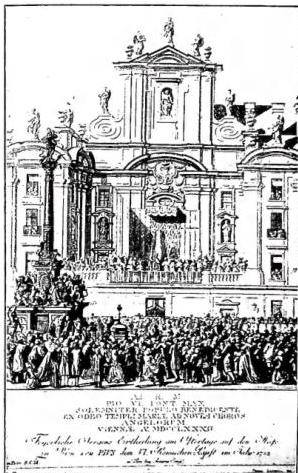
(fot. Bildarchiv d. Ö. Nationalbibliothek)
PIO VI, pope — Blessing imparted by P. VI in Vienna on Easter Sunday in 1782 from the loggia of the church of St Mary ad novem Choroa Angelorum V. Drawn from life and engraved by Carlo Schütz.
to forge what the legitimists would call the alliance of throne and altar, while in France the National Assembly, having abolished feudal rights, the privileges of the clergy, and tithes, decreed the secularization of Church property and the suppression of convents, and imposed the so-called Civil Constitution of the Clergy, which resulted in the persecution of the non-juring clergy and the formation of a schismatic hierarchy. After attempting not to aggravate the situation in the hope of reaching an agreement, P., in the briefs of 10 March and 13 Apr. 1791, condemned the decrees of the National Assembly.
As temporal sovereign, P. VI gave considerable impetus to public works; under his personal direction, the draining of the Pontine Marshes was undertaken, as was the reclamation of extensive marshy territories at Città della Pieve, Perugia, Spoleto, and Terni. The ports of Anzio and Terracina were repaired, while the restoration of the Via Appia was undertaken and a canal was planned that would have connected Rome with Terracina. P. VI restored St John Lateran and built the monumental sacristy of St Peter’s Basilica (1784). He also had the obelisks in Piazza Montecitorio and at Trinità dei Monti erected, and completed the construction, begun by his predecessor, of the Museum that accordingly took the name Pio-Clementino. The archaeological discoveries encouraged by the Pope, the splendor of the ceremonies, and the protection granted to the arts attracted artists and distinguished visitors to Rome.
The financing of this vast complex of works helped to aggravate the State’s economic disorder,
and the resurgence of nepotism also played a role. For his nephew Luigi Onesti, to whom he had given ten thousand gold doubloons on the occasion of his marriage to Costanza Falconieri, P. VI raised the Palazzo Braschi and facilitated the purchase of the Duchy of Nemi; another nephew, Romualdo Onesti, was created a cardinal; Braschi (v.) to their own. The public debt, which at the beginning of the pontificate amounted to forty-two million scudi, increased enormously, also as a result of the heavy military expenditures arising from the threats posed by France; nor did the increase in taxes, the reorganization of the customs service, or the impetus given to agriculture and the textile industry, protected from foreign competition by heavy duties, suffice to improve the situation. P. was consequently compelled to issue increasing quantities of paper money (notes) and to mint coins of inferior alloy. In 1797, following the French invasion, he was forced to resort to the sale of one-fifth of the rural properties belonging to the clergy and charitable institutions.
After the condemnation of the civil constitution of the clergy, relations between the Holy See and France became even more strained. Cardinal de Bernis, ambassador of Louis XVI, was recalled, while the nuncio, Monsignor Dugnani, departed from Paris. P. VI, for his part, rejected all the ambassadors subsequently proposed to him by France. The hospitality granted to the aunts of Louis XVI, Adelaide and Victoria, and to more than four thousand refractory priests, Bassville (v.), the French chargé d’affaires in Rome, and the Jacobin propaganda, which was also infiltrating the Papal States, aggravated the tension. With Bonaparte’s descent into Italy, the Papal States were about to disappear, but, contrary to the orders of the Directory, the general preferred to delay. The Armistice of Bologna (21 Aug. 1796) and the Treaty of Tolentino (19 Feb. 1797) imposed the cession of the Legations and Ancona, together with the renunciation of Avignon and the Comtat Venaissin; P. VI also had to hand over to the French thirty-one million lire and numerous works of art. DUPHOT, LÉONARD (v.), in a riot provoked by the revolutionaries (28 Dec. 1798), provided the pretext for the occupation of the entire territory. After the Republic was proclaimed in Rome, the French, having attempted to force him to renounce the State, compelled P. VI to move to Siena and, three months later, to the Charterhouse of S. Casciano near Florence. The Directory intended to confine him in Sardinia, but the Pope’s grievous state of health prevented this. When war broke out between France and the Kingdom of Naples at the end of 1798, the French invaded Tuscany, while the Russian and Austrian armies prepared to descend into Italy. P., compelled to leave Florence on 28 March 1799, was taken through Parma and Turin to Briançon and from there to Valence. The hardships of the long journey aggravated his illnesses and hastened his death (29 Aug. 1799). His body, initially buried in the chapel of the citadel and later in the cemetery of S. Caterina in Valence, was solemnly transferred to Rome in 1803. The serene fortitude with which P. VI endured deportation and imprisonment aroused the admiration even of his adversaries. - Vedi tav. CIII.