
RUFFO. — I. TOMMASO, cardinal, b. in Napoli in 1663, d. in Roma on 16 February 1753.
He completed his education at the Collegio Clementino, demonstrating a passion for the study of law; in order to devote himself to it, he declined the position of internuncio in Bruxelles, offered to him by Innocenzo XI. Vice-legate in Ravenna, nuncio in Toscana, and maestro di camera to Innocenzo XII and Clemente XI, who created him cardinal (17 May 1706). He governed as legate Ravenna, Ferrara, Bologna, and Ferrara again, of which he was bishop from 1717 and which, on his account, was raised to an archbishopric. Bishop of Ostia and Velletri, in 1740 he was appointed vice-chancellor of the Holy Church and secretary of the Holy Office. In the Conclave of 1740, his candidacy, which enjoyed considerable support, was opposed by Austria and France.
II. FABRIZIO, cardinal, b. at S. Lucido (Cosenza) on 16 September 1744, d. in Napoli on 13 December 1827.
His uncle, Cardinal Tommaso, entrusted his early education to Giovanni Angelo Braschi, the future Pio VI. He completed his studies at the Collegio Clementino. Having entered the prelature, he was admitted by Pio VI among the referendaries of the two Segnature and appointed cleric of the Apostolic Camera (1781). General treasurer of the Apostolic Camera at the beginning of 1785, he applied himself to implementing the reforming policy of the Pontiff; he therefore undertook to abolish the feudal barriers that obstructed internal commerce, regulated the customs offices on the borders of the State, protected manufactures through appropriate fiscal measures, and promoted the development of a merchant navy, the cultivation of hemp and cotton, the production of linen and earthenware, copper and iron works, and leather processing. Certain measures, such as the abolition of restrictions on production, the division into farms and the granting in emphyteusis to peasants of Camera property, and the limitation of the powers of cardinal legates, earned R. many self-interested enemies, whose hostility increased as the political and economic situation of the State worsened after the outbreak of the Revolution in France. In order to remove him, Pio VI created him a cardinal deacon on 21 February 1794 (in the Consistory of 26 September 1791 he had reserved him in pectore). Having returned to Napoli, he was appointed by the King intendant of Caserta, charged with supervising the manufactures of the agricultural-industrial colony of S. Leucio. Pio VI strongly disapproved of his acceptance of these offices and regarded as a usurpation the conferment upon R. of the abbey of S. Sofia di Benevento, arbitrarily declared to be under royal patronage.
After the invasion by the French, Ferdinando IV, who had taken refuge in Palermo, appointed him vicar general of the Kingdom on 25 January 1799, entrusting him with its reconquest. Landing in Calabria, near Punta del Pezzo (8 February 1799), almost alone and without money or weapons, he succeeded in assembling, if not disciplining, the masses of insurgents formed after the dispersal of the regular army.
Inclined toward moderation and clemency, despite the contrary urgings of Ferdinando and Maria Carolina, he strove to restrain the ferocity and rapacity of his bands, but was unable to prevent excesses such as those that occurred at Crotone (22 March) and Altamura (10 May). The R.’s prudent action to relieve the wretched condition of the common people contributed to the success of the undertaking, so that almost everywhere the advance of the army of the Santa Fede was accompanied by a popular uprising against the propertied classes, among which the Parthenopean Republic had found its greatest support. Having entered Napoli (15 June), R. negotiated with the defenders of the forts for an honorable capitulation, which the Sovereigns and Nelson refused to respect, thereby adding merciless repression to the bloody violence. R., who had never ceased recommending broad and generous forgiveness in order to establish a lasting restoration through the pacification of minds, by then fallen from favor, left Napoli in November for the Conclave of Venezia.
(phot. Enc. Catt.)
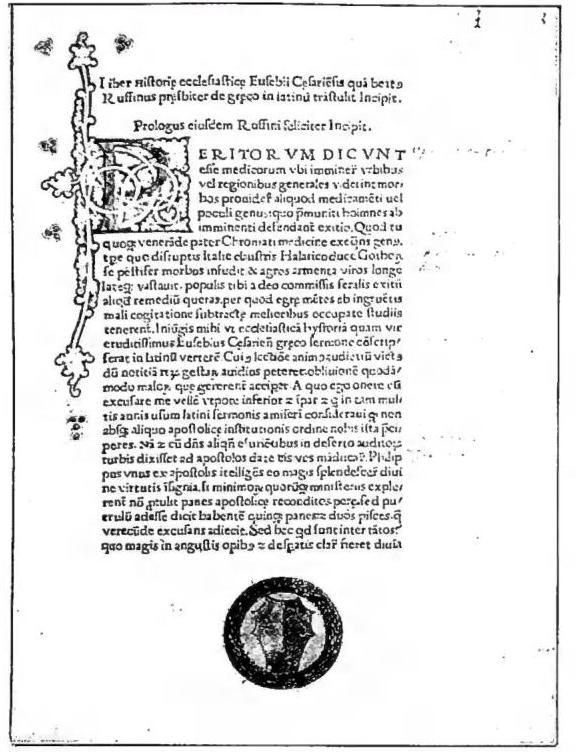
RUFINO TURANNIO — Incipit del Liber historiae ecclesiasticae by Eusebius, translated by R. T. Ed. G. F. de Lignamine (1476). Copy in the Vatican Library.
of the deputations of the Annona and the grascia and the prefecture of the Pontine reclamation works (1821). He spent his final years in Naples, devoted to his beloved studies of military art, economics, and agriculture.