
BRUXELLES. — In Flemish Brussel, capital of Belgium, it is ecclesiastically Malines (v.), which founded in B. and has directly under its authority the Institut St-Louis, comprising a Faculty of Philosophy and Letters, a school of philosophical and religious sciences, and the State-recognized Higher Institute of Commerce, with two sections, one French and the other Flemish. The College of Saint Michael in B., for secondary education, is run by the Jesuit fathers; it is also the present residence of the Bollandist fathers (v.) and their extremely rich library.
The State has in B. a free university founded by the Belgian liberals in 1834 in the former palace of Cardinal Granvelle, with faculties of philosophy, science, law, medicine, and applied sciences; in Leopold Park, the Physiological Institute (1895); in addition, the Institute of Hygiene, Bacteriology, and Therapeutics, an Anatomical Institute (1896–97), a Commercial Institute (1904), and an International Center for Contemporary World Literature (1907), with a very extensive library. Among the academies may be mentioned: the Royal Academy of B., for Sciences, Letters, and Arts (1772); the Royal Academy of Medicine (1841); the Royal Academy of Fine Arts; the Royal Archaeological Society of B. (1887); the Royal Geographical Society; the International Institute of Bibliography (1895), with its special Bulletin; the Royal Music Conservatory, with a rich library and many manuscripts; the Higher Women’s Institute of Commerce. B. is the seat of the International Academic Union (1918); the International Research Council (1918–19); the International Union of Cities (1913); the Belgian Society for Oriental Studies (1921); the Queen Elisabeth Egyptological Foundation (1923). It also has the following higher schools: of Political and Social Sciences, Commerce, Pedagogy, and Criminological Sciences; five institutes: of Oriental and Slavonic Philology and History, Urbanism, Aeronautical Structures, Telecommunications and Acoustics, and Solvay Sociology. Enrico Josi
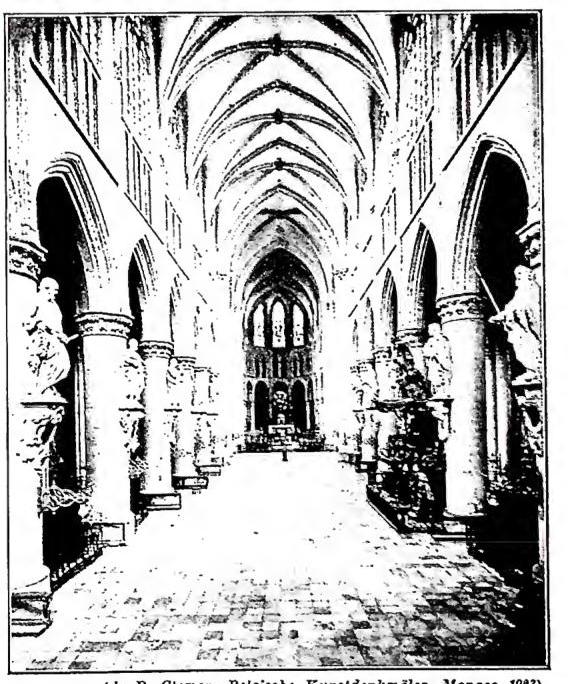
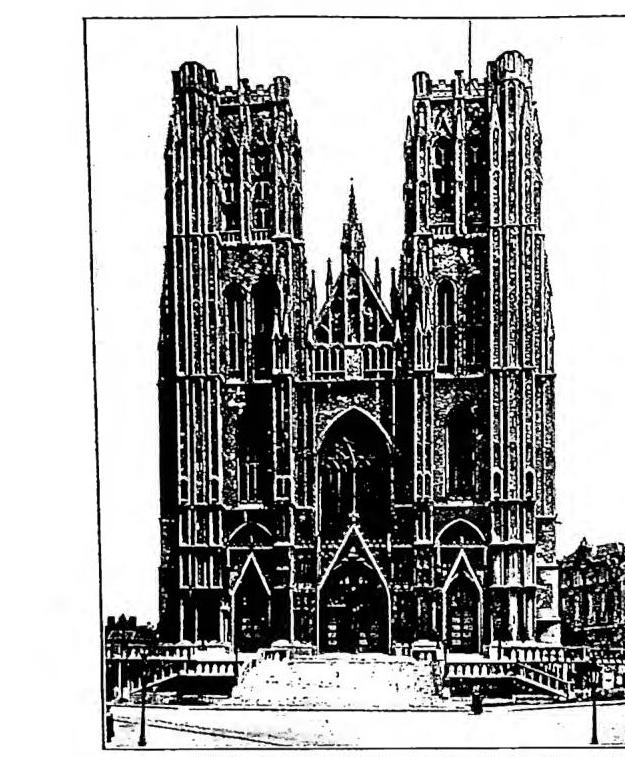
ART. – The oldest and most important monument is the collegiate church of SS. Michele and Gudula: begun in 1220 and completed only in the 16th century, it displays the evolution of the Gothic style: in the apse, in forms transitional between Romanesque and Gothic (1226–50); in the choir, in Early Gothic (1226–50–80); and in the grandiose central nave and right-hand aisle, in Flamboyant Gothic (14th century). In the 15th century Jean van der Eycken designed the left-hand aisle and collaborated with Jean de Ruysbroeck on the square towers flanking the main portal. Notable features include the Chapel of the Blessed Sacrament by Pietro van Wyenhove (1534–39),
(from P. Clemen, Belgische Kunstdenkmäler, Munich 1957)
BRUXELLES — Interior of the church of S. Gudula (14th century), with the statues of the Apostles (ca. 1640).
Of all Flanders and Brabant, the most majestic Municipal Palace is this one of B., an example of picturesque and sumptuous Gothic: Jacques van Thienen erected the left wing in 1402; in 1444 Carlo the Bold laid the foundation stone for the right wing, which was begun in 1451, while the pyramidal tower was already under construction, remarkable for the lightness and elegance of its tracery, the work of Jean de Ruysbroeck (1449–54). The rear side of the palace (Louis XIV style) is the work of Corneille van Nerven (1706–17); the interior is rich in tapestries from B. dating from the 16th–18th centuries and in historical paintings by Jacques de Lalaing. The square of the Municipal Palace is noteworthy for the row of palaces that served as the seats of the old guilds, built in the sumptuous Brabant Baroque style, enriched with classical elements. Among them, the King’s House, partly rebuilt in the 19th century, is particularly important for its interesting museum, which includes, among other things, porcelain and maiolica from the 17th–19th centuries and a very rare gilded wooden altarpiece from 1520. Worthy of mention are the church of Notre-Dame-des-Victoires-au-Sablon in late Gothic style (choir of 1420–35, transept and principal nave of 1450, portal from the first half of the 16th century, sculptures from the 15th century, and Baroque chapels from the 17th century); the very ancient Notre-Dame-de-La-Chapelle (begun in 1134, Romanesque transept of 1150, nave of 1210–40), with figures of apostles sculpted (1646–55) by J. Duquesnoy and Luc Faid'herbe, surmounted by the elegant bell tower of Pastorana (1695–1708), itself raised over a Gothic tower (1504–1508); the church of the Trinity
is late Renaissance, with the facade of 1621, the work of Francart; outside the city, the church of S. Pietro d'Anderlecht repeats the forms of Flamboyant Gothic (15th–16th centuries) and contains, among its most notable features, a Romanesque crypt (1078), a triptych Adoration of the Magi by G. Bosch, and a funerary statue of Jean de Walcourt (14th century).
There are numerous modern buildings: the Royal Palace, externally very simple, was modified in 1904 by the architect Maquet. The interior is sumptuous, especially the grand staircase, a masterpiece by the architect Balat, who also designed the Palace of Fine Arts. The Palace of the Nations, which dates from the time of Maria Theresa, was rebuilt according to Beyaert’s plan in 1883, following a fire; the bas-relief on the pediment surmounting the eight fluted Ionic columns is the work of Cojdecharles.
Massive buildings include the Palace of Justice, the work of Poelaert (1866–83), the Théâtre de la Monnaie, and the much-discussed Stock Exchange, built according to Suys’s design.
The museums are deservedly celebrated: the Museum of Fine Arts is one of the foremost in Europe for its works by the Primitives and the Flemish; the Modern Museum contains works by Belgian painters from David to the present; the Cinquantenaire Museum has valuable Egyptian, Greek, and Roman antiquities, medieval goldwork, tapestries, and porcelain; the Arms Museum is housed in the old fortified gate of Hal. The sculpture gallery mainly contains works from the centuries between the 17th and 20th.
In the Royal Library, whose nucleus goes back to that of the dukes of Burgundy, are preserved the Gospel Book of S. Lorenzo of Liege (10th century), the Pontificale of Sens (15th century), and « Les très riches heures » of the duke of Berry.