
PONTIFICALE. – This is the liturgical book containing the description (rubrics) and the formularies of the functions normally reserved to the bishop (pontifex-p.). As a book in its own right, it does not appear before the eighth century, nor is its name constant. It was called Ordinale or Ordinalis liber (from the Ordinations, one of the principal functions described therein), Mitrale (Sicardo da Cremona, thirteenth century), Benedictionale, Pontificalis ordinis liber (Durando), Pontificalis liber (1485), and Pontificale Romanum (1596). Its history is relatively recent and, following the studies of P. Batiffol, P. De Puniet, and V. JALABERT, LOUIS, and the critical edition of the medieval P. by M. Andrieu, its stages can now be traced with certainty.
I. EARLIEST ELEMENTS (first–fourth centuries)
These belong to the prehistory of the p. and consist of the benedictional formularies scattered fragmentarily among the earliest Christian writers. For several centuries, at the beginning, worship revolved around a single rite, the Eucharistic celebration. Around it and connected with it, the various consecrations and blessings were performed in a linear form, including the most solemn ones reserved to the pontifex, invested with the fullness of priestly power, that is, the episcopus, head of the Christian community. Such were Confirmation, Ordination, episcopal consecration, and the solemn blessings of persons and things. Traces of these rites are found in the New Testament writings or in those immediately following them, such as the works of Tertullian, Justin, Cyprian, Hippolytus, and Cyril of Jerusalem; in Book VIII of the Apostolic Constitutions; in the Euchologion of Serapion; and in the Testamentum Domini. Eusebius speaks of the dedication of churches. The blessing of the holy Oils dates from the same period. In 450, Marcian was crowned emperor by the Patriarch of Constantinople. The blessing of abbots and abbesses, however, is later (sixth century).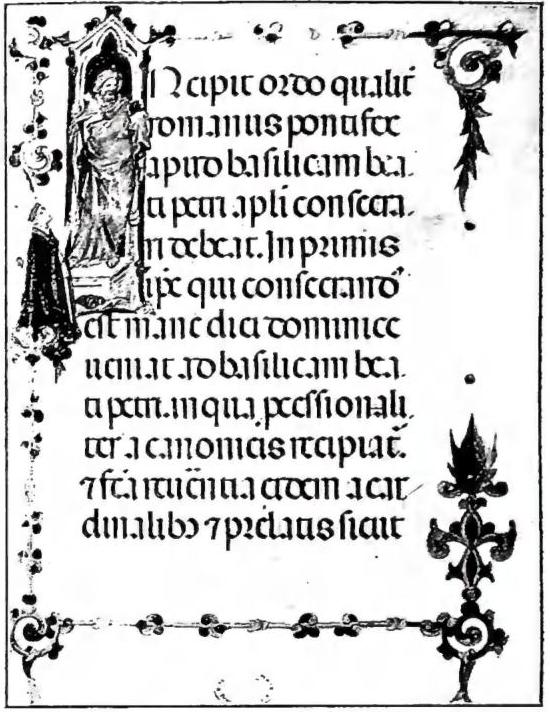
II. SOURCES (fifth–eighth centuries)
A genuine written tradition, especially for the formularies, began in the fifth and sixth centuries with the earliest Western euchological collections. Naturally, the formularies most commonly used were fixed in the codex or on the rotulus. For the Latin liturgy, the earliest documents of importance are represented by the Sacramentaries, in which the formularies reserved to the celebrant are collected. The so-called Leonine Sacramentary, the oldest type, contains the formulary for the Mass of dedication, the consecration of bishops, the ordination of deacons and priests, the consecration of virgins (ad virgines sacras), and the solemn blessing of spouses (velatio nuptialis). This list becomes even longer in the Gelasian Sacramentary, the official liber Missae of the Roman Church. Gregory the Great (d. 604) reformed this Sacramentary, multa subrohens, pauca convertens, nonnulla superadiciens (Vita Gregorii, II, 17: PL 75, 94). The Sacramentary gre-(from V. JALABERT, LOUIS, Les Pontificaux mss. des Bibl. publ. de France, Paris 1927, plate 59)
PONTIFICALE - Roman Pontifical of the 14th century - Boulogne sur Mer, Municipal Library, MS 86, fol. 2.
Gororianum, sent between 784 and 791 by Hadrian I to Charlemagne, had inherited from the Gelasianum also the formularies for episcopal functions, which subsequently underwent exceptional development in Frankish territory. The same addition that Alcuin made to the Hadrianic exemplar in order to adapt it to the churches beyond the Alps already included a certain number of formulas relating to the consecration of virgins, the dedication of churches, the coronation of kings, and exorcisms. But the sacramentaries contained only the formulas. The directive norms (rubrics and ceremonies) were lacking. These were supplied abundantly by that series of booklets of Roman origin, but flourishing luxuriantly from the 8th to the 14th century in Gaul, known as the Ordines Romani (v.), which contain a detailed description of the ceremonies and sometimes also the texts of the solemn pontifical functions. Progressively—in the 8th century under the pressure of external factors—the Church organized its liturgy. There emerged a tendency to separate the rites reserved to the pontiff and the bishops, gathering them into special collections. The Liber sacramentorum became more properly the Liber missalis, while for sacramental rites and blessings a new, more practical and manageable book was devised: the Pontifical. This process of disintegration and the consequent reorganization began in Gaul in the 9th century.
III. ORIGINS OF THE PONTIFICAL (9th–16th centuries)
The earliest attempts lacked a distinct character of their own. The liturgical books brought from Rome to Gaul first had to adapt themselves to their new environment, at times merging with pre-existing books, especially with the old Gelasian Sacramentary, thereby creating a mixed sacramentary (Gelasian of the 8th century), or assimilating local usages. To the strictly liturgical elements were added an infinity of other documents, giving rise to a kind of manuals of sacred science, which a century later became extensive and voluminous compilations. One type of these archaic Pontificals, destined to enjoy extraordinary success, was compiled at Mainz, in the Rhineland, in the Benedictine abbey of St. Alban, shortly after 950. The original has been lost, but copies remain in Germany, Italy, and France. The elements composing it are extremely heterogeneous. At times the two sources merge, and the Roman rubrics are found inserted and intermingled in a pompous ceremonial displaying the symbolism so dear to the medieval Gallican liturgists. The monk who compiled it left it without a title. M. Andrieu proposed calling it the Roman-German Pontifical of the 10th century, a name that aptly indicates its composite nature, country of origin, and date. The same scholar is now preparing its critical edition. The Mainz Pontifical spread rapidly, favored by the political conditions of the time. After the restoration of the Empire (962), many German prelates, accompanying the imperial court or placed at the head of Italian and French dioceses, carried copies of the Pontifical with them. Rome too adopted it around 1000, replacing its own liturgical books with it and thus bringing about an irreparable breach with its pure and venerable tradition. Throughout the 11th century German influence was very great. The four German popes of that period certainly used the Mainz Pontifical. Other copies were made in Germany and in Rome. The common foundation remained, but the particular features varied. Roman ecclesiastics therefore came to know several different editions of this book. With Gregory VII (1073–85) the period during which Teutonicis concessum est regimen nostrae Ecclesiae (M. Andrieu, Les Ordines Romani, I, pp. 526–45) came to an end. The influx of liturgical books from the north also ceased, but those already in existence were not banned; they were merely adapted more closely to local usages. Thus there arose an entire Roman family of Pontificals, in which the Mainz Pontifical remained the foundation, but with a whole range of particular features according to the character of the copyists and bishops for whom each copy was made. The criteria according to which these particular features were introduced can be reduced to two: a) the desire to abridge and to include only what was useful (the ancient Roman Ordines, the coronation of a king, the didactic treatises, the rituals of excommunication, the exorcisms and Masses for demoniacs, the series of Masses for the dead, the long series of blessings, and the rituals for ordeals were therefore eliminated); b) the Ordines that were retained were reproduced not as they had originally been written, but according to the abridgements made when they entered Rome. This applied, for example, to episcopal election and consecration, which in Rome had a character of its own because of the pope’s presence, and to Ordinations, performed by the pontiff himself. As for the pontifical functions celebrated on the various solemnities of the year, the Roman copyists took local color into account (stations, basilicas, and usages of the papal court). Thus, in the 12th century, the Pontifical of Rome was essentially an episcopal Pontifical, but with such modifications as to give it a pronounced papal character.At the beginning of the 13th century another Pontifical appeared, whose archetype was composed under the pontificate of Innocent III (1198–1216). Andrieu calls it, by analogy with the Missal of the Curia, which was disseminated during the same period, P. secundum consuetudinem et usum romanae Curiae. It is known in a threefold recension: the first (called recension α by Andrieu) is the basic recension; the second (recension γ) appears in the middle of the 13th century and is the work of a Roman liturgist who made substantial additions to recension α, developing above all the description of papal ceremonies; the third (recension β) is still the first recension, in which the copyists inserted the necessary updates, first in the margin as postscripts, and later, in more developed form, into the text. The three families existed simultaneously throughout the 13th century. But the longest recension (γ) decisively prevailed over the other two in the 14th century. Precisely then, however, a competitor blocked its advance: the Pontifical of dominus Gulielmus Durandus. Guglielmo Durand, bishop of Mende (d. 1296; v.), had composed a Pontifical between 1293 and 1295 for his own use, but his intention to make it useful also to other churches and to Rome itself is clear; in fact, he had introduced rites and ceremonies proper to metropolitans and to the Supreme Pontiff. Durand had therefore conceived a Pontifical for universal use.
In substance, Durand’s Pontifical was the Pontifical of the
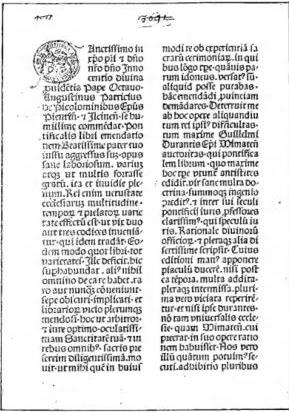
Curia (long recension), which underwent a twofold operation: the rites that could not be used outside Rome were removed, and others were added to make it a convenient and complete directory for episcopal functions. Some chapters were revised, others introduced anew. The material was divided into three books (a practice common among the theologians and canonists of the thirteenth century) and grouped according to subject: I. De personarum benedictionibus et consecratione; II. Consecrationes et benedictiones rerum; III. Quaedam ecclesiastica officia (cf. the complete description of these parts in P. De Puniet [bibl.], I, pp. 52–54). This division and various particular features were subsequently adopted in the P. and still remain there today. Durand’s P. enjoyed great success. It was the Liber Pontificalis par excellence, soon adorned with the title of authentic (= official). The expression Patrum Pontificale, found in Durand’s funerary inscription, shows how faithful he had remained to tradition. For this reason his work was also highly esteemed in Rome, where Clement V (1305–14) cited it as an authority. Innocent VIII (1484–92) wished to extend it as the official book to the entire Latin Church and commissioned the bishop of Pienza, Agostino Patrizi Piccolomini (d. 1496), formerly master of ceremonies to Paul II, to revise it and prepare a correct text for printing. The rubric section was entrusted to the papal master of ceremonies Giovanni Burckard (d. 1506), author of the Ordo servandus in celebratione Missiarum. The P., thus revised, appeared in 1485, preceded by a letter from Patrizi to Innocent VIII, in which the reasons for and the method of the edition are set forth (text in De Puniet, I, pp. 67–68; cf. also pp. 56–58). A second, improved edition was published in 1497 under the care of Giacomo de Lutis and Burckard. Other editions appeared at Venice and Lyons in 1511, perpulchris characteribus diligentissime annotatum. This is the so-called P. of Julius II. The Dominican Alberto Castellani republished it, with revisions and additions, in 1520. It was the most popular edition in the sixteenth century. Reprinted several times, it served as the basis for the P. which, under the title of Pontificale romanum, was officially extended to the universal Church in 1596.
IV. THE «PONTIFICALE ROMANUM» (sixteenth–twentieth centuries). It was promulgated by Clement VIII in the apostolic constitution Ex quo in Ecclesia Dei of 10 February 1596, which thereby abrogated all other P. in use: «Motu proprio omnia et singula Pontificalia in hunc usque diem in quibuscumque terrarum orbis partibus impressa et approbata... per praesentes supprimimus et abolemus». Even very ancient rites that preserved their own particular features in the Mass and the Office accepted the P. Such were the Ambrosian rite (cf. G. Mercati, Antiche reliquie liturgiche ambrosione e romane [Studi e testi, 7, Roma 1902, p. 7]), and the Bracarense rite, which had the so-called P. of St. Coraldo (cf. A. de Vasconcelos, Notas liturgico-bracarenses, in Opus Dei, 5 [1930–31], pp. 21–28, 46–54; cf. also Jahrbuch für Liturgiewissenschaft, 10 [1930], p. 237). Christians of the Syro-Malabar rite use the p. translated into the Syriac language (J. Vosté, Projet d'édition du Pontifical des Syriens Orientaux, in Ephemerides liturgicae, analecta, 53 [1939], p. 3). The P. was republished by Urban VIII on 17 June 1644, with the constitution Quamvis alias. Typographical errors were naturally eliminated, but the text remained unchanged and has remained so ever since. Benedict XIII, in order to facilitate the performance of the more difficult ceremonies of the P., arranged for a new edition, adding various illustrations but leaving the text unchanged to such an extent that, when he wished to introduce the imposition of hands into the rite of Confirmation, he added a special rubric in an appendix. Benedict XIV, by the apostolic letter Quam ardenti studio of 25 March 1752, promulgated the new edition of the P., the Rituale, and the Cerimoniale dei vescovi. The last typical edition, produced in 1888 by order of Leo XIII at Regensburg, altered the chant, corrected the orthography, and added accents. Pius XI intended to reform the P. in 1931. For this purpose he appointed a commission presided over by the Benedictine abbot H. Quentin, but various difficulties, above all the lack of critical editions of the early P., which Andrieu was then preparing, caused the undertaking to founder; consequently, since it was necessary
The P. is divided into three books. Book I contains everything concerning the Ordination, consecration, and blessing of persons (De personis); Book II contains the blessings and consecrations of churches and altars, and everything pertaining to the celebration of the Eucharist (De rebus); Book III contains the ceremonies of receptions, synods, visitations, and the various pontifical functions of the year. Clement VIII approved only these three parts. But since the P. gives the rites in the singular or plural and the numerical order often changes, it was necessary to introduce various rites with a change in numbering: Confirmation and ordinations in the singular; the consecration of bishops and altars in the plural. Moreover, certain functions of the Rituale are sometimes performed in solemn form, and it therefore seemed appropriate to prepare their description for when they are performed by a bishop. All these rites were included in a separate volume bearing the title Appendix and Supplementum ad appendicem. In the rites of Confirmation, ordination, and the consecration of bishops, some rubrics were also altered or newly composed. The various parts of the appendix do not have a common origin. The part concerning the Confirmation and Ordination of a single ordinand, or the consecration of several bishops, first appeared in the edition of Benedict XIII. The rite of the Baptism of adults was taken from the Ordo urvondus in Ecclesia Beneventana (Cesena 1683), published by Cardinal Orsini (later Benedict XIII). Other rites entered the appendix in the editions of the Apostolic Camera of 1848 and 1855, and a few others in the Ratisbon edition of 1888, in which the supplement to the appendix was also introduced. Although the P. is not a historical book, it nevertheless preserves rites no longer in use, namely: in the 2nd part, the rite of monastic profession, because in former times it was not unusual for non-professed clerics to be elected abbots, and they had to make religious profession before receiving the abbatial blessing (A. Paladini, De ritu professionis religiosae in P., in Ephemerides liturgicae, 49 [1935], pp. 385-89); the blessing of an abbot auctoritate Ordinarii, the coronation of a king and queen, and the blessing of a soldier. In the 2nd part: the solemn blessing of reliquaries, the blessing and imposition of the cross (for the Crusaders of the Holy Land), and of weapons. In the 3rd part, the following remain as historical reminders: the Ordo for the expulsion and reconciliation of penitents, the suspension and degradation of an ordained person, the Ordo of excommunication and absolution, the Ordo for the reconciliation of a schismatic or heretical apostate, the Ordo of the evening scrutiny (before the consecration of a suffragan bishop by the metropolitan), and finally, De barba tondenda (the initiation of a clericus) and De officio psalmistatus. Apart from these now obsolete rites, the P., like all the other liturgical books, requires a general revision. Some rites must be corrected and conformed in the text to the recent critical editions; others must be harmonized with similar rites found in the Rituale; still others must be simplified and abbreviated. An accurate revision of the rubrics of the P. is also necessary, and finally account must be taken of the problems—neither minor nor few—raised by pastoral liturgy, because the pontifical rites, among the most evocative and important elements of Christian worship, also form part of the living liturgy of the Church. - Vedi tav. CXVII.