
BLESSING OF VIRGINS, the. - An ancient and solemn ceremony of the Latin-Roman rite for blessing and consecrating religious women living in perpetual virginity.
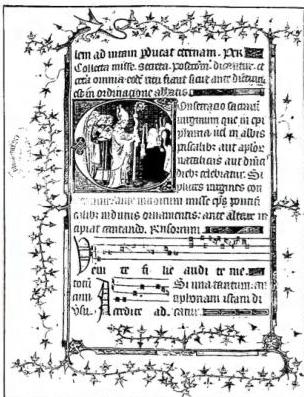
It is reserved to the bishop and is performed on the feasts of Epiphany, Easter and its octave, on the feasts of the Apostles and on Sundays (except those of Advent and Lent), during Solemn High Mass, with proper orations (Collect, Secret, Postcommunion) to be inserted under the same conclusion, after those of the day. By the late Middle Ages it had fallen into disuse; the religious of the mendicant orders (Dominicans, Franciscans, Carmelites, etc.) and the Cistercians did not use it, while the Benedictines, Carthusians and those of St Norbert retained it faithfully. Today it is in use in the Benedictine Congregations of Brazil, England, Solesmes, Beuron, and in the monastic Orders of St Bruno and St Norbert. Modern Congregations also make their profession in the manner of the blessing of virgins.
The first traces of a particular solemnity used for virgins are found in Tertullian, who speaks of a special head covering, called a “mitra” and “mitrella,” to be worn by virgins in imitation of that of widows, but without giving a ceremony of its imposition. Tertullian and St Cyprian refer to a special vow of virginity made by virgins in public. At Rome in the 3rd century hands were not imposed on virgins, as in the Apostolic Tradition of Hippolytus; the vow alone sufficed for the virgin; only her clothing was changed. St Ambrose’s sister, Marcellina, received the veil solemnly from Pope Liberius (325–66) in St Peter’s. This veil became the classic garment of virgins, called by St Jerome (Ep. ad Demet.: PL 22, 1108) the “flammeum virginale,” a sign of their consecration or rather of their espousal to Christ. The oldest formulas of consecration occur in the Sacramentary and in the Missale Francorum; those of the Gregorian Supplement appear in a more abbreviated form. The Gelasian contains, besides the preface or consecratory formula, the blessing of the vestments. The rite was later enriched with other elements: the German Pontifical and the Ordo Romanus vulgatus add, besides the blessing and imposition of the veil, ring and crown, solo chants (by the bishop, the virgin) and choral pieces. Carthusian nuns also receive the maniple and stole; these rites, through the Pontifical of Durandus, later entered the Roman Pontifical. The rite unfolds as follows:
1) The virgins, in secular bridal attire, always accompanied by two attendants and summoned by the archpriest, are presented to the bishop for consecration. To the bishop’s triple invitation “Venite,” they reply “Et nunc sequimur” and declare their vow of virginity. 2) The consecration begins with the Litany of the Saints and the Veni Creator, a very recent addition; the bishop blesses the monastic vestments together with the veil, ring and crown. This is followed (the virgins having meanwhile changed from secular to monastic dress) by the preface of the consecration. 3) The espousal takes place with the imposition of the veil, ring and crown, always accompanied by special antiphons sung by the virgin; at the end the so-called prayer of the Apostle Matthew, Deus plasmatos, is recited. The rite concludes with the presentation of the Breviary, the singing of the Te Deum, and the entrusting of the newly consecrated virgin to the abbess.
In Gaul, for the sacred v., one finds “puella” followed by the formulas: “sacra Deo” (E. Le Blant, Inscriptions chrét. de la Gaule, Paris 1856, pp. 188, 392); “sacrata Deo” (id., op. cit., pp. 44, 204); “Deo placita quae virginales actus omni honestate custodiens,” from the year 491 (id., op. cit., p. 388); “sanctimonialis” (id., op. cit., p. 259). In Spain there is “puella Christi” in an epitaph of 465. At Thabraca in Africa the well-known mosaic inscription reads: “Castula puella... properans castitatis sumere praemia dignam meruit immarcibilem coronam” (CIL, VIII, 17348). Damasus had a sister Irene “Sacrata Deo”; she “voverat haec sese Christo” (A. Ferrua, Epigrammata Damasiana, Vatican City 1942, no. 11). Later the same formula “virgo sacrata Deo” appears at Milan (CIL, V, 6240) or “Dei” at Gemona in the year 524 (CIL, V, 1822), “sacrata Devota XTO” at Rome (G. B. De Rossi, Inscr. Christ., II, 1, Rome 1888, p. 104);
“sacrata Domino” in 471 at Vercelli (L. Bruzza, Iscrizioni antiche vercellesi, Rome 1874, p. 268); “virgo sacrata” in Africa (Comptes rendus de l'Acad. des inscr. et belles-lettres, 9111, p. 569); in Spain in 588 there is a “virgo XPI” (E. Hübner, Inscr. Hispaniae Christ., Berlin 1871, no. 21).
Christian epigraphy has preserved many other inscriptions of sacred vv., those which the bishop of Carthage defines as: “Flos est ille ecclesiastici germinis... illustrior gregis Christi” (De habita virginum, 3: CSEL, III, 1, p. 189).
At Rome, among others, are known a “Praetextata virgo sacra” (G. B. De Rossi, Bull. arch. crist., 1 [1863], p. 73); an “Alexandra virgo sacra” d. 449 (id., Inscr. christ., I, p. 325, no. 745); a Lavinia “virgo Dei,” buried also at St. Lawrence outside the Walls, is styled “virgo Dei inimitabilis” (id., Bull. arch. christ., 1 [1863], pp. 68 and 72). In the Lateran Christian Museum there is a “Nigella virgo Dei” (O. Marucchi, Monumenti del Museo crist. Pio Later., Milan 1910, pl. 54, 1); Aurelia Agapetilla was “virgo Dei” as read on her sarcophagus (Wilpert, Die gottgew. [see bibl.], pl. IV, 1), and of a Juliana of the 4th or 5th cent. it is said: “hanc dum corporei premerent vicinis leti / sponsa diu nubit per sacra vela Deo” (G. B. De Rossi, Inscr. christ., II, 1, pp. 63, 92). At Aquileia an “Anicia Ulpina” is called “virgo devota Deo” (G. B. De Rossi, Bull. arch. crist., 1 [1863], p. 74).
Of 431 is Leucadia “Deo sacrata Puella” (E. Le Blant, Inscriptions chrétiennes de la Gaule, I, op. cit., no. 44, p. 89); at Trier of an Hilaritas “puella Dei” it is said that “omnibus diebus vitae suae Deum coluit et omni actu Salvatoris Domini praecepta servavit” (id., loc. cit., p. 366, no. 258). At Vercelli of a Maria it was written: “aeternos sortita thoros XPI que petivit” (CIL, V, 6734). In the hypogeum of St. Satyrus in St. Ambrose at Milan was interred “Manlia Daedalia clara genus censu pollens et mater egentium virgo sacrata Deo” (CIL, V, 6240).
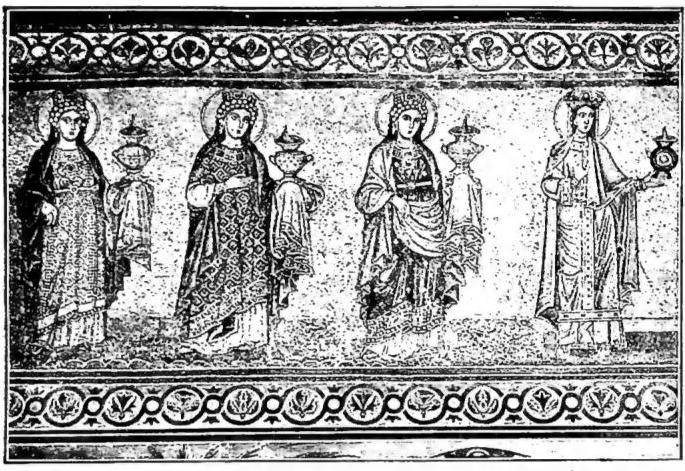
On the tomb of an abbess at Jouarre one reads: “Cenubii huius mater sacratas Do virtutes oleum cum lampadibus prudentes filias occurrere XPM” (E. Le Blant, Inscr. chrét. de la Gaule, I, Paris 1856, n. 199).
A cloth with the aforesaid scene was offered by Pope Paschal I (817-24) for the altar of the basilica of S. Prassede, which he restored (Lib. Pont., II, p. 55). Bishop Chrodegang of Metz had the scene of the wise virgins painted in the church of Gorze (Alcuin, Carmina, 117, 1). In later times the scene was painted in the apse of the chapel of Appiano Castle in Alto Adige (J. Gerber, Die romanische Wandmalerei Tirols, Vienna 1922) and in the grotto of S. Tommaso in Anagni; in relief it appears on the exterior of Strasbourg Cathedral.