
BRUNO (BRUNONE), saint. — Founder of the Carthusians, born at Cologne into the noble Hartefaust family (Latinized de duro pugno) around 1030, died at Serra S. Bruno (Catanzaro) on 6 October 1101, he is one of the great figures of the eleventh century. As a young man he was sent to the celebrated school of Reims, where he devoted himself ardently to his studies. Returning to Cologne, he was ordained a priest and obtained a canonry in the church of S. Cunibert. In 1057 Gervais, archbishop of Reims, appointed him to direct that school, an office which he held with distinction for about twenty years, contributing considerably to the renewal of the ecclesiastical spirit. Among his pupils were s. Ugo, later bishop of Grenoble, and the future Pope Urban II. The uncanonical and simoniacal conduct of the notorious Manasse de Gournay, Gervais’s successor, who had initially favored him by appointing him chancellor of the archbishopric, placed him in opposition and forced him to abandon both the school and the city of Reims. Only after the deposition of Manasse (1080) could B. return to Reims, where he also held a canonry. But the affair of Manasse had shown him all the misery of the world, and the disgust he felt at it led him to make a vow to withdraw and live solely for God. This was the true reason for his decision, not the alleged macabre miracle said to have taken place in Paris, where a canon, at the moment of his own funeral service, was supposed to have proclaimed his condemnation to hell—a tale that arose only in the thirteenth century.
At first B. withdrew with some companions to Sèche-Fontaine (diocese of Langres), under the direction of Roberto di Molesme, future founder of the Cistercians; but, finding that retreat insufficiently solitary, the saint, with six companions, among them Landuino da Lucca, set out for Grenoble, where he asked s. Ugo to assign him a place suitable for his purpose. The bishop granted him the Alpine valley called Cartusia, in the mountains of the Dauphiné northeast of Grenoble. There, in 1084, the first Charterhouse arose, later called the « Grande Chartreuse ». In 1091 Urban II summoned his former teacher at Reims to him as an adviser and ordered him to come to Rome. B. had to obey and, leaving Landuino as superior of the Charterhouse, set out for Rome with some companions. But in the Curia the hermits found themselves uncomfortable and, with the exception of B., obtained permission to return to their Charterhouse.
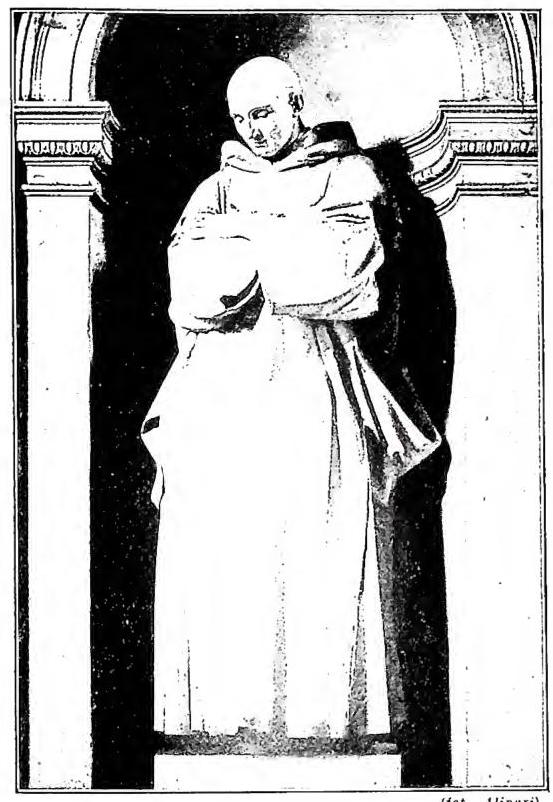
While he was with the Pontiff in southern Italy, and feeling irresistibly drawn toward solitude, B. obtained permission to withdraw to the Sila, in a place called La Torre, in the diocese of Squillace (province of Catanzaro). The count of Calabria, Ruggero, granted the land and endowed the hermitage that was being established; it was blessed by the archbishop of Palermo (1094). The influx of disciples was such that a second hermitage soon had to be built nearby, dedicated to S. Stefano, inaugurated in 1099 by the bishop of Squillace and governed by the prior of La Torre. The two places are today included within the municipality of Serra S. Bruno. The Saint died at La Torre and was buried at S. Stefano, which later became a Cistercian monastery, until Leo X returned it to the Carthusians in 1513. In 1514 the same Pope orally granted the Carthusians the divine office in honor of s. Bruno; this was later extended by Gregory XV (1623) to the whole Church and raised to the rite of double by Clement X. The feast is celebrated on 6 October.
There exist two works by the saint, dating from the period of his teaching at Reims, and two letters written at La Torre: Expositio in Psalmos (PL 152, 637-1420); Expositio in epistolas Pauli (PL 153, 11-566); letter to Rodolfo, provost at Reims, written after 1094 (PL 152, 420-23); Acta SS. Octobris, III, ed. Paris 1868, pp. 675-77); letter to the hermits of the Grande Chartreuse (ca. 1091: PL 152, 418 ff.; Acta SS. Octobris, III, Paris 1868, p. 674 ff.). One may add a Latin poem from his youth (PL 152, 38; Acta SS. Octobris, III, Paris 1868, p. 503 ff.). Other works attributed to the saint in editions of his works, Cologne 1509 and 1510, Paris 1524, are either by s. Bruno di Segni (v.), or by s. Bruno di Carintia (v.), two contemporary writers.