
MENDE, DIOCESI of. — Diocese and capital city of the department of Lozère (France), on the left bank of the Lot. It has an area of 5,000 sq km, with a population of 95,000, of whom 80,000 are Catholics. The diocese is divided into 4 archdeaconries, 28 deaneries, and 215 parishes served by 400 diocesan priests and 15 regular priests; it has a major and a minor seminary (Ann. Pont., 1951, p. 268). The diocese belonged to Aquitania I, and its original seat was Gabales, whose name was transformed into Javouls.
The church of Gabales was represented at the Council of Arles (314) by the deacon Genialis. Much later, the venerated tomb of the martyr bishop St. Privatus made M. the religious center of Gévaudan. As for the period in which Bishop Privatus lived, Gregory of Tours (Hist. Francorum, X, 29; Virtutes s. Iuliani, 30) places him in the age of Valerian and Gallienus and says that he was put to death by the Alamannic invader Crocus; Fredegar, on the other hand, in his Chronicle (II, 60), makes Crocus a Vandal king, and thus places the event around the year 407; L. Duchesne prefers to place Crocus’s invasion at the beginning of Constantine’s reign, perhaps before the Council of Arles (Pastes épiscopaux de l’ancienne Gaule, II, 2nd ed., Paris 1910, pp. 54-55 and 124-26); most recently, G. Bardy has held that it is preferable to follow Gregory of Tours (Recherches sur un cycle agiographique. Les Martyrs de Chrocus, in Rev. de l’hist. de l’Egl. de France, 21 [1935], pp. 5-29).
St. Privatus is commemorated in the Hieronymian Martyrology on 21 August; he is also mentioned by Fortunatus (Carm.
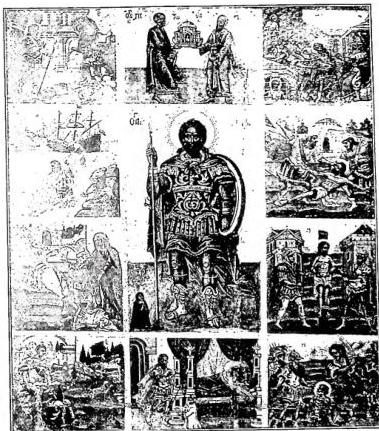
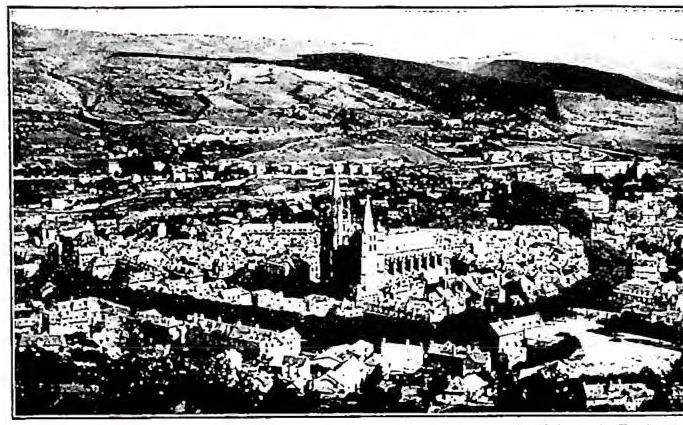
(courtesy of Prof. E. Josi)
The present Cathedral, dedicated to Notre-Dame and St. Privatus, was built largely at the expense of Pope Urban V (1362-70), whose bronze statue was erected (1874) in front of the façade, preceded by a portico built in 1900. Two bell towers rise on the right and left; the one on the left, which is higher, was commissioned by Bishop F. della Rovere (1504-24). It contained the great bell called the « non pareille », weighing 20 tons; broken in 1579, its enormous clapper, 2.15 m high, remains. The interior has three naves and no transept. The choir of 1692 was separated by a wooden « jubé », whose decorations now adorn part of the baptistery chapel. The choir stalls, with scenes from the Old and New Testaments, date from the same period. On the high altar is displayed the « Vierge Noire » or « Notre-Dame de M. », brought from Palestine by the Crusaders. Beneath the choir windows are eight Aubusson tapestries (1708) depicting scenes from the life of the Madonna. Beneath the central nave is the crypt, with the tomb of Bishop St. Privatus and remains of the primitive church. M. suffered greatly from the Huguenot sackings in 1562 and from the adventurer Merle between 1573 and 1581. Monsignor Claude de Rosseau restored the Cathedral in 1608. Among the sanctuaries that are centers of pilgrimage, besides the statue of the Black Madonna in the Cathedral, are the hermitage of St. Privatus; « Notre Dame de Quézac », documented since 1052; and « Notre-Dame de tout pouvoir » at Langogne.
M. was initially a suffragan diocese of Bourges; in 1678 Innocent XI placed it under Albi. The local « Société des lettres, sciences et arts de la Lozère » has established a museum with collections of geology, archaeology, and Gallo-Roman ceramics.