
MENDEL, GREGOR

MENDEL, GREGOR. — An Augustinian Hermit, born at Heinzendorf near Odrau (Czechoslovakia Silesia) on 22 July 1822, died at Brno on 6 January 1884.

In 1843 he became an Augustinian friar and entered the Convent of St Thomas in Brno, changing his baptismal name from Johann to Gregor; there, in 1847, he was ordained a priest. In 1851 he enrolled at the University of Vienna, where he attended courses in physics, mathematics and the natural sciences; he subsequently taught physics and the natural sciences at the Higher Technical School of Brno; in 1868 he was elected prior of the Convent of St Thomas.

His name is associated with the hybridization experiments he carried out on peas, beans and Hieracium, genetics (v.) and, more precisely, of that branch which, after his name, is called Mendelism. The results were published in the Verhandlungen des Naturforschenden Vereins in Brno, under the titles: Versuche über Pflanzenhybriden (4 [1865]) and Über einige aus künstlicher Befruchtung gewonnene Hieraciumbastarde (8 [1869]); but although he had also communicated them by letter to Nägeli, both because of the journal’s limited circulation and because the time was not yet ripe for their comprehension, they attracted little attention. He also conducted experiments in the hybridization of various breeds of bees, which he never published; several works on meteorology, however, did see the light. From 1868 onward, after being elected prior, he no longer had the time or opportunity to conduct experiments. In 1900 three botanists, De Vries, a Dutchman, E. Tschermak, an Austrian,
Article illustration
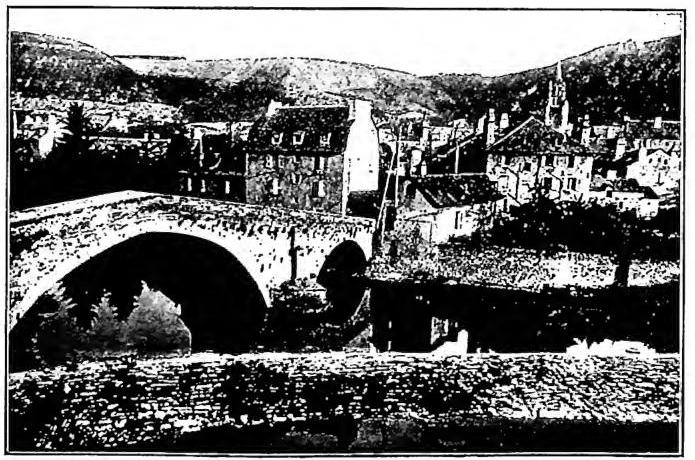
MENDE, DIOCESE OF — Notre-Dame Bridge (14th century).
(courtesy of Prof. E. Josi)
and K. E. Correns, a German, repeated his experiments independently and without knowledge of M.’s works, arriving at the same results. As soon as they learned of the work of their predecessor, however, they acknowledged his priority; indeed, in 1901 Tschermak republished his works in the collection Ostwald's Klassischer der exakten Wissenschaften (121, Leipzig), and in 1905 Correns published in Berlin the G. M. Briefe an Carol Nägeli (1866–73). Mendelism derives from the so-called “laws of M.,” which were deduced by later scholars on the basis of his research and are generally presented as follows: 2nd law, or law of dominance. When two individuals differing in one character are crossed, the hybrids are all alike, and only one of the characters is manifested. The two characters are called antagonistic or allelomorphic; one is “dominant,” the other “recessive.” 2nd law, or law of segregation. When the sexual elements are formed in an organism, the two bearers of each character (called “genes” or “factors”) separate and pass, one into one half and the other into the other half of the sexual elements. 3rd law, or law of independence. The different characters found in an individual are all independent of one another.

BIBL.: H. J. G. Iltis, M. Leben, Werk und Wirkung, Berlin 1924. genetics (v.) may also be consulted with benefit. Celso Guareschi
Cite this article

“MENDEL, GREGOR.” Enciclopedia Cattolica, vol. VIII (1952), p. 408. Azione Romana digital edition, https://azioneromana.com/article/mendel-gregor.