
BRNO (BRŮNN), DIOCESE OF. — Capital of Moravia (Czechoslovakia), area 10,370 sq. km, population 1,259,613, of whom 1,113,189 are Catholics; it comprises 449 parishes with 1,044 churches, 786 diocesan priests, and 160 religious priests. The diocese extends over the south-western part of Moravia. Its principal cities are: B., capital of Moravia, Jihlava, Trebic, and Znojmo. In this territory the Catholic faith was spread in the ninth century by the saints.
of Moravia remained Catholic; it nevertheless passed largely
to Lutheranism under the early Habsburgs; during the
period of the Counter-Reformation it returned to the Catholic faith.
B., a provostship since 1296, was raised to an episcopal see
by Pius VI, at the request of Empress
Maria Teresa, on 5 December 1777, through the division of the arch-
bishopric of Olomouc.
Among its bishops, the most distinguished were Matteo
Fr. Count Chorinský (1777–86), Cardinal Francesco Sal.
Bauer (1882–1904), and Giuseppe Kupka (1926–41). Among the
priests, the canons Francesco Sušil, professor of Sacred Scripture,
and Giuseppe Pospisil, professor of philosophy, distinguished
themselves as scholars and patriots. In addition to the Cathedral
Chapter of B., there is the collegiate church of Mikulov, founded
in 1625. B. has a fine tradition of scholarship. Worthy of mention are
the university library (about half a million vol-
umes) and that of the Theological Institute; there are also the
civic library, the library of the Augustinian monastery,
the archive of the church of S. James, founded in the fourteenth
century, with precious manuscripts and historical documents. Near
B. is the large and richly endowed Benedictine library
of Rajhrad (Raigern), the first monastery in Moravia, founded
in 1048. Among the cultural institutions may be mentioned the Theological
Institute; Masaryk University; the polytechnic; the important
cultural society Matice Moravska; and the higher school
of religious culture, a gymnasium, and a bishop’s lyceum. Mo-
nasteries are found in B. and in other places of the diocese: an Aug-
ustinian one at B., a Benedictine one at Rajhrad, a Premonstratensian one at
Nova Rise, and others belonging to various male religious orders.
The most noteworthy monuments in the Romanesque style in the
diocese are the church of S. Procopius at Trebic and the conventual
church of the Cistercian nuns of Porta coeli at Predklasteri. Among the
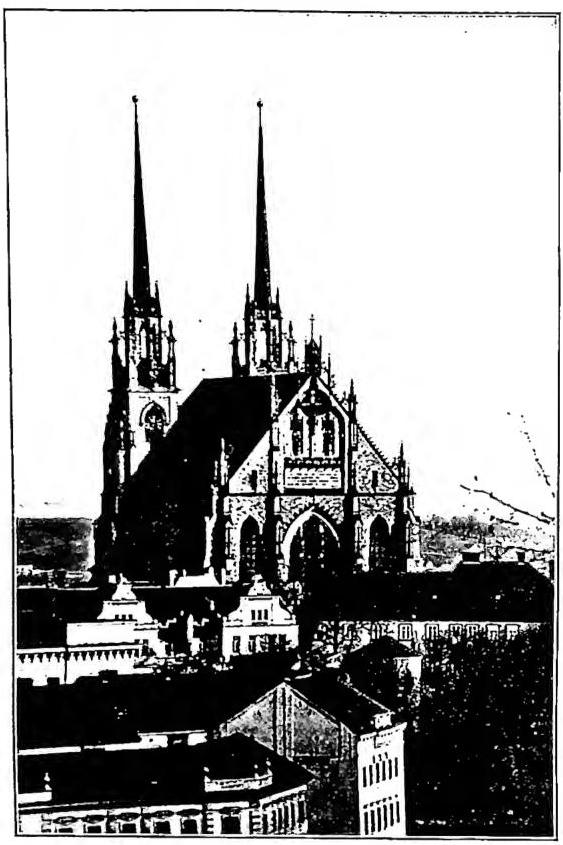
churches of B., the most important are the cathedral of SS. Peter
and Paul, Gothic, destroyed in 1645 and restored in 1748 and
1908; S. James, Gothic, from the fourteenth century; S. Thomas, Gothic
from the fourteenth century, rebuilt in the Baroque style in the seventeenth
century; and the Augustinian conventual church, Gothic from the fourteenth
century. The church of S. Mary at Krtiny near B., in the Baroque
style, has the largest and most monumental dome in Central Europe.