
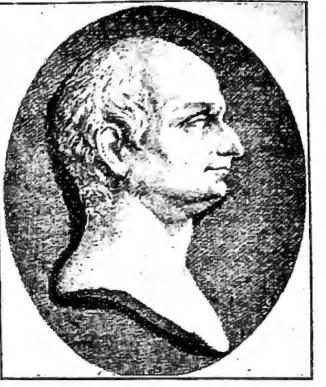
SPALLANZANI, LAZZARO. — Born on 12 September 1729 at Scandiano (Reggio Emilia), died on 12 February 1799 at Pavia. After studying grammar at Scandiano, he completed his studies of philosophy at Reggio, with the Jesuits; in 1747 he moved to Bologna to study law there, in accordance with his father’s wishes.
Meanwhile, he began frequenting the salon of the celebrated Laura Bassi, and, having fallen in love with scientific studies, succeeded in obtaining his father’s permission to follow his own inclination. He did not, however, neglect the Italian, Latin, and Greek languages, so much so that in 1755 (in the meantime he had donned the habit of the Priests of Mary; he also received major orders, though it is not known when) he went to teach logic, metaphysics, and Greek at the College of Reggio (the former Seminary); in the same city, two years later, he received the chair of physics and mathematics at the University (founded in 1753). In 1763 he moved to Modena, where he taught Greek and mathematics at the S. Carlo College and physics and philosophy at the University; in 1769 he was called to the chair of zoology at the University of Pavia, which he held until his death, declining invitations from other cities, including Padua and Paris.
His most important research concerns animal biology, including the famous Saggio di osservazioni microscopiche concernenti il sistema dei Signori di Needham e Buffon (Modena 1765), with which he entered decisively into opposition to the theory of spontaneous generation; he subsequently added new experiments and facts to this essay in the Lettere (1767) and the Prolusione (1770). In 1776, in vol. I of the Opuscoli di vita animale e vegetale, he resumed and coordinated the entire question, rebutting many opposing arguments. In the second of these booklets he presented a long
series of studies on the spermatozoa of humans and vertebrates, and in vol. II of the Dissertazioni he studied fertilization in many animals and the development of the egg, and presented fine experiments on artificial fertilization (which he also achieved in the dog). It is curious to note that, despite these experiments, with which he demonstrated the necessity of fertilizing sperm for the development of eggs, he was an ovist preformationist—that is, he held that the future organism was already preformed in the egg of animals. He also sought to study the question in plants, but without noteworthy results. Another field of study for him was regeneration. As early as 1768, at Modena, S. had published a Prodromo di un'opera da imprimersi sulle riproduzioni degli animali, but only in 1783 did the Risultati di esperienze sopra la riproduzione della testa nelle lumache terrestri appear; this did not yet represent the definitive conclusion of the research, which was never published. Nevertheless, his assertion that snails were capable of regenerating their heads caused a great stir and a whole flowering of criticisms and counter-criticisms, so much so that in 1768 the Academy of France appointed a special commission, which fully confirmed « this new miracle of natural history ». It was then that S. uttered the famous saying: « experimenting in any manner is everyone’s profession; experimenting properly was and will always be the profession of the few ». He also carried out research on circulation: he discovered capillary circulation both in cold-blooded and warm-blooded animals; demonstrated the contractility of the arterial bulb in the frog; demonstrated the absence of air bubbles in circulating blood; and also observed the white blood cells, though he did not interpret them correctly. Another scientific monument of his work was his research on digestion and respiration, the latter published posthumously by Jean Senebier, the Genevan librarian (Memorie sulla respirazione, Milan 1803), experimentally and brilliantly confirming Lagrange’s hypothesis and establishing the doctrine of the internal respiration of tissues.
Among his minor works, his accounts of scientific journeys should be mentioned: in 1781, 1782, and 1783 along the coasts of the Tyrrhenian and Adriatic Seas, with observations on the « plant-animals » or zoophytes (sea pens, madrepores, gorgonians, and corals, whose animal nature he upheld), as well as on geology and paleontology; in 1785 to Constantinople, with observations in the most varied branches of science, from mineralogy to meteorology and from zoology to the history of the customs of the peoples visited; in the Two Sicilies, with descriptions of ascents of Mount Etna and Mount Vesuvius and of volcanic phenomena (1788–89); and in the Modenese Apennines, where he described the salse of Reggio di Querzola, the fires of Barigazzo, and the petroleum of Monte Zirbio (1792). Also worth noting are the letters on the suspected presence of a new sense in bats (Turin 1794), in which he studied these animals’ faculty of orientation even in darkness and when deprived of various senses (sight and smell); his research on the electricity of torpedoes, whose falciform muscle and its nervous connections he described; his research on the reproduction of eels, a long-standing problem not completely solved; and his research on the revival, after desiccation, of the tiny animals found in mosses on roofs (Rotifers and Tardigrades).
S. was rightly called the « Galileo of biology », and his writings also reveal a rare grammatical sense and considerable stylistic grace, which make them magnificent examples of scientific research.