
LIFE. -
I. PHILOSOPHY
1. Notions. In contemporary philosophical language, life (v.) strictly denotes "a set of phenomena (particularly: nutrition and reproduction) characteristic of beings endowed with a certain degree of organization." By analogy, this term is applied to certain superindividual structures that, within the human plane of the "objective spirit" (objektive Geist), in the Hegelian sense or in the less systematic sense of the Geisteswissenschaften, manifest an activity of self-organization and irreversible transformation: growth and death. Thus, the "life" of artistic forms, civilizations, societies, and language. From a phenomenological standpoint, three levels of determination of the living are distinguished: a) the empirical-pragmatic level of common sense; b) the empirical-scientific level of the biological sciences; c) the properly philosophical level (v. II).Despite the difficulty of recovering the original aspect beneath the cultural evolution of concepts, and notwithstanding the confusion of empirical notions, the convergent data of ethnological investigation and the psychology of child perception lead to the assertion that man has an original tendency to consider all bodies as living and endowed with intentions (cf. Piaget, La représentation du monde chez l'enfant, Paris 1926, p. 160). Thus, animism and anthropomorphism would determine the two components of the primitive empirical concept of life: the spontaneity of movements and their intentional expression; as well as the "place" where we perceive them, the human world, which for some would be the first to be grasped (cf. L.-A. Feuerbach, Grundsätze der Philosophie der Zukunft, Leipzig 1846, § 32 p. 231). This assertion is taken up by some existential philosophers (e.g., M. Buber, who in Ich und Du, Fr. trans., Paris 1938, p. 50, distinguishes between a general "animation" of the world and the instinct of cosmic relation that makes things a "thou" opposed to an "it" of interested and scientific investigation). Therefore: human world, animal world, vegetable world, inorganic world, in the opposite sense of the ascending ontological hierarchy, which does not necessarily coincide with the phenomenological order (cf. H. Bergson, Essai sur les données immédiates de la conscience [Paris 1936, p. 108], for whom the idea of inertia, as negation of spontaneity, is genetically simpler than spontaneity itself).
The origin of this perception of life (a question intimately connected with that of the perception of the psyche of others) has been explained either by an "empathy" (Einfühlung) that projects our own "life" into things (on the theory of Einfühlung, cf. Th. Lipps, Ästhetik, p. 355, in Die Kultur der Gegenwart, VI, part 1°, Berlin 1907); or by an induction that, from the analogy of expressive movements, concludes with a similarity of animation; or, as Scheler would have it, who seems to admit it both for the application of "vital centers" (Vitalzentren) and for that of "spiritual centers" (Geistzentren; cf. Wesen und Formen der Sympathie, 5th ed., Frankfurt a. M. 1948, pp. 252-87, esp. p. 255 ff.), by an a priori of an almost emotional order (irreducible to an innate idea or to a properly said intuition) that immediately reveals, in an organic and expressive tonality, the vital sense of these movements. In conclusion, an "immediate" apprehension of the living, grasped as a "concrete significant totality" (St. Thomas attributes it to the "cogitative"; cf. in De Anima [ed. A. M. Pirotta, Turin 1925, n. 396]), seems more probable, where the central phenomenon is movere seipsum, according to the various functions of life. The specific concept of vegetative life is relatively late. Some ethnologists hold that attention to the life of plants developed particularly in matriarchal civilizations (v.).
2. History
a) Ancient philosophy. - In ancient philosophy, three main orientations are distinguished: a cosmic conception of life, an anthropological conception, and a more expressly biological representation. The first, represented especially by Heraclitus (and taken up by Stoicism), presents a "cyclic" becoming (ἐπὶ κύκλου; H. Diels, Vorsokratiker, 6th ed., Leipzig 1910; B. 103) animated by an "ever-living fire" (πῦρ ἀείζων; ibid., 30) with terms susceptible to reversible transformations according to a law of unity and return.For Stoicism, the entire world and its evolution form a living being; "the becoming of being is analogous to the evolution of the living" (cf. E. Bréhier, La théorie des incorporels dans l'ancien stoïcisme, 2nd ed., Paris 1928). Being is likened to a "seed," which, developing by virtue of an immanent causality, configures it into a defined structure (on the Stoic terminology relative to life, cf. G. Kittel, Ζάω, in Theol. Wörterb., II, pp. 838-39; on the classical usage, pp. 833-38). The anthropological conception is affirmed with Plato, for whom the world is also a "perfect animal" (Tim. 23 d), similar to its intelligible paradigm (ὅμοιον τῷ παντελεῖ ζῷω, ibid., 31 b). But the logos here is more manifestly likened to a nous that informs it (Phil. 30 d). And the world of immutable Ideas itself seems to him to be animated by a kind of internal dynamis, which has led some to think of a complete assimilation of Ideas into living thinking souls. Being is οὐκ ἄλλο τι πλὴν δύναμις (Sophista, 247). Conversely, A. Diès asserts (La définition de l'être et de la nature des Idées: le Sophiste de Platon, Paris 1932, chap. 2) that the tendency to define life by intelligence and not only on the human plane is already clear. But it is especially in Plotinus that every form of life is energeia (Enn., III, 11, 16, 17, 18, ed. E. Bréhier, Paris 1927); this "energy," however, is itself an obscure concept: πᾶσα ζωὴ νόησις τίς (Enn. III, VIII, 8-17). The degrees of life are thus the same as the degrees of thought, of an ever-clearer thought. Contemplation is life par excellence (Enn. III, VIII, 8, 26-30); and, truth be told, all beings are "contemplations": θεωρίας τὰ πάντα ὄντα (ibid. 26). But the Good from which life springs is not living (Enn., VI, VII, 15,
b) Christian philosophy. - In the writings of the New Testament (St. John and St. Paul), the philosophical elements concerning the conception of L. are as follows: a) affirmation of L. in God, whose perfect immanence, independent of the freely created cosmos, unfolds in the Trinity of Persons (Aristotle’s God is alone); b) intimate connection of L., lux, amor; ζωή, φῶς, ἀγάπη (this is absent in the classical conception of divinity); c) exercise of Christian L. through faith and charity; d) hierarchy of degrees of L.: the carnal man, the reasonable man, the spiritual man (guided by the spirit of God): σῶμα, ψυχή, πνεῦμα (I Thess. 5, 23); ψυχικὸς ἄνθρωπος, πνευματικὸς ἄνθρωπος (cf. F. Zorell ἄνθρωπος, in Lexicon graecum N. T., 2nd ed. Paris, 1931): a hierarchy taken up again by Maine de Biran (cf. Nouv. Essais d’Anthr., ed. P. Tisserand, Paris 1949, XIV, pp. 195-402). The merit of St. Thomas lies in having fused these elements in the Christian conception of L. with Aristotelian philosophy: a) phenomenological: the "salient" character of the living being is movere seipsum, which manifests itself immediately in the behavior of the animal through a concrete apprehension reserved to the "intentional" sense par excellence: the cogitativa (v. and cf. Sum. Theol., I q. 18, a. 1; q. 16, 2 in de An., ed. Pirotta, nn. 396-98); b) ontological: insofar as L. actualizes the immanence of action ordered ex se toward the perfection of the Agent; c) through this immanence intensified by an "interior fecundity," L. attains the sphere of perfections simpliciter simplices, susceptible of analogical modalities and applicable to God (Sum. Theol., I, q. 16, a. 2). Hence an ascent of L., ever more perfect, unfolding from vegetative immanence to the intimate L. of the Trinity (v. Contra Gent., IV, 11).
c) Renaissance philosophy returns to the Stoic conception that considers the world as "a great animal"; vital energy, according to a naturalistic mysticism (represented by the names of Paracelsus and Bruno [v.]), unfolds in all manifestations of the cosmos.
d) Modern philosophy reacts against this panvitalism with mechanism, which takes systematic form in Descartes: he substitutes "mind" for the soul of the ancients (Oeuvres, ed. A. Tannery, VII, Paris 1905, p. 356) and presents the paradoxical theory of "animal-machines" applied even to the human body (ibid., XI, 223 sgg.; Traité de l’homme, ibid., p. 120 sg.; Traité des Passions, ibid., pp. 330-31), a theory taken up again by Malebranche (Recherche de la vérité, V, ch. 3, cf. also H. Bousson, La religion des classiques, Paris 1948, ch. 7) and which found its radical expression in the theory of the "man-machine" dear to the materialist physicians and philosophers of the 18th century (La Mettrie). Leibniz attempts a compromise between Aristotle and Descartes. The world, without having a soul (cf. Leibniz, Textes inédits, ed. J. Grua, Paris 1910, p. 558), is full, in its smallest parts, of vital principles or entelechies (Considérations sur le principe vital, in Opere varie, tr. it., Bari 1912, pp. 75-83), immortal because indivisible, endowed with confused perception and appetition, without influence on the world of bodies: hence a new dualism in the dubious realm of final causes (world of L.) and efficient causes (world of bodies and mechanism), which preestablished harmony reconciles extrinsically. This psychic spontaneity, whose freedom is a special case (cf. Textes inédits, ed. J. Grua, p. 287 sg.), is closely linked to the thesis of substance-force, of conatus (cf. L. Jalabert, La théorie leibnizienne de la substance, Paris 1947, chs. 1-3). For Kant, the immanent finality of the living being, in opposition to aesthetic and hedonistic finality, is objective, that is, referred to things (Kritik der Urteilskraft, Leipzig 1948, p. 161); it is material or real and not merely formal like that of geometric figures (§ 62); it is intrinsic in opposition to the extrinsic finality of a means at the service of man: since organized beings are for themselves "ends of nature" (Naturzwecke, § 65), cause and effect of themselves (sich bildende Kraft), causa sui.
e) Modern philosophy. - Hegel tends to reconcile the two aspects of finalism and mechanism as the two aspects of necessity and freedom (cf. Logik, ed. G. Lasson, II, Leipzig 1945, p. 387). In the Hegelian conception, L. presents three aspects: a) theological-religious (in the Theologische Jugendschriften): L. implies interiority in opposition to the exteriority of the law and the master-slave dualism, which are characteristic of the Old Testament (ibid., pp. 4-16); interiority that expresses the law of love and the relation of the Father to the Son, proper to Christianity, through freedom. b) logical-dialectical: L. is the immediate form under which the Idea appears (Logik, ed. cit., vol. II, p. 412), as dynamic subjectivity: end and cause of itself. L. presents three moments: the living individual as constituting subjectivity and self-determining organizer of its matter; the constituted individual whose properties are sensitivity, irritability, reproduction, vital processes that unfold a relation with the external environment that the living being destroys by assimilating it, need and impulse (Bedürfniss and Trieb) that complement each other in appropriation; the genus (Gattung) that inserts the individual into a chronological series and makes it a member of a species to which it belongs (ibid., 426 sgg. and Encykl., § 369-70). c) phenomenological: L. as interiorization of its object is "reflection" upon itself and constitutes the first step toward Selbstbewusstsein in the form of self-desire, negative because destroyed by its object (Phaenomenologie des Geistes, ed. W. Hoffmeister, Leipzig 1948, p. 135 sgg). The Romantic conception of L. has as its principal representatives Schelling, Schopenhauer, and Nietzsche. Schelling conceives the living being as the foundation of itself, causa sui, due to the necessary relation of the parts in the whole and the whole in the parts, and thus presents itself as an immanent concept (inwohnender Begriff) in which matter and form are inseparable (Ideen zu einer Philosophie der Natur, in Schellings Werke, I, Leipzig 1907, p. 134 sg).
unità di natura e di libertà, di necessità e di contingenza, di meccanicismo e di finalismo. L'anima, principio della v., non può essere né una forza né una giustapposizione di forze poiché deve far armonizzare queste forze, ma uno spirito (Geist als Prinzip des Lebens gedacht heisst Seele, ibid., p. 147). Questo principio, comune a tutti gli individui viventi, non è proprio di nessuno di essi, come lo stesso spirito è infinito e assoluto e si limita, mediante la forza di un principio negativo di individuazione, nella varietà delle specie e degli individui (Von der Weltseele, ibid., p. 599). Di conseguenza si chiama: « Gemeinschaftliche Seele der Natur » (ibid., p. 665) e la stessa nel suo insieme è un « allgemeiner Organismus », un tutto dove i corpi inanimati sono « vite spente » (erleuthenes Leben). L'essenza di tutte le cose è dunque la V. (ibid., p. 596). E la V. stessa non è che la manifestazione di questo genio creatore, immanente (Ideen, p. 322) alla sua opera nell'universo e che noi possiamo riconoscere mediante una « intuizione » (Anschauung). Schopenhauer respinge la Weltseele perché implicante una coscienza ed una conoscenza che non convengono a tutti gli esseri (Die Welt als Wille und Vorstellung, in Schopenhauers sämtliche Werke, ed. J. Frauenstädt, III, Lipsia 1873, p. 398), la V. è insieme l'oggetto immediato e fondamentale della volontà del noumeno (Wille zum Leben, Draug und Trieb zum Dasein) e il nocciolo della realtà: da qui ha origine il mondo ed una delle oggettivazioni di questa volontà del noumeno il cui primo grado è il mondo inorganico (ibid., II, 1873, capp. 17-29). Il vivente si differenzia dall'inerte per il fatto che questo esaurisce in un colpo la legge che esprime (così la pietra che cade spiega adeguatamente la gravità; ibid., II, cap. 28, p. 185); invece la pianta o l'animale è insufficiente all'idea specifica che tende a spiegare e mentre la prima è sottomessa all'eguaglianza di azione e reazione che governa la causalità, il vivente manifesta una reazione assolutamente sproporzionata agli « stimuli » che la provocano (ibid., II, cap. 23, pp. 137-38; riguardo alla distinzione fra Ursache, Reiz e Motivation cf. anche Über die Freiheit des Willens, Sämtl. Werke, cit., IV, ivi 1874, p. 29 sgg.). Donde nel vivente una plasticità, una individualità, una spontaneità (Über den Willen in der Natur; Sämtl. Werke, IV, pp. 60-64) che si presta con più difficoltà alla rigidità delle leggi meccaniche e matematiche benché, nondimeno, ne sia presente la necessità. Ed. von Hartmann congiunge la volontà incosciente di Schopenhauer con l'idea incosciente in un unico principio che si chiama l'Inconscio (Philosophie des Unbewussten, tr. franc., I, Parigi 1877, p. 5) idea senza la quale questa volontà sarebbe vuota e senza oggetto (ibid., p. 33). Questo inconscio si manifesta nella V. del corpo come nello spirito umano: ma è soprattutto chiara nell'organismo sotto la forma di finalismo organico. Nietzsche nel suo saggio sulla « trasmutazione di tutti i valori » dà alla V. supremo. Lungi dal negarsi, come in Schopenhauer, la V. deve, sotto la forma di « volontà di potenza » (Wille zur Macht) affermarsi contro tutte le tendenze degeneratrici che egli attribuisce alla civiltà e al cristianesimo. Tale volontà di potenza si afferma già nel mondo inorganico sotto forma di conflitto di forze (Wille zur Macht, I, Parigi 1909, pp. 296-98); più nettamente nel mondo organico come lotta degli individui e delle specie; nel mondo umano sotto forma di scienza (ibid., pp. 274-275) e di potere, e sotto un aspetto più larvato nella morale stessa (ibid., pp. 339-50); V. e volontà di potenza sono sinonimi di energia intensa. Idealizzata come valore supremo, la volontà di potenza, ch'è la v., trova in Zarathustra il simbolo del « vivente perfetto », il « superuomo » (« Übermensch », cf. Also sprach Zarathustra, lib. III, Parigi 1946, p. 227 sg.). Nel positivismo, A. Comte intende liberare i fenomeni biologici dalle interpretazioni teologiche (mediante volontà arbitraria) e metafisiche (mediante una psiche individuale o cosmica) per sottometterli all'esigenza positiva della spiegazione mediante leggi. Così spiegato il fenomeno biologico si riassume nella correlazione di due elementi (Discours de philos. posit., III, Parigi 1908, p. 141 sg.). H. Spencer, preoccupato dai problemi della genesi e dominato dall'idea di evoluzione,
parte dal concetto di « forza » (come sostrato inconoscibile di tutti i fenomeni cosmici). Piante ed animali sono trasformazioni della forza per integrazione di materia e dispersione concomitante di movimento. L'evoluzione non è altro che « il cambiamento da una omogeneità incoerente in una eterogeneità coerente in seguito a tale integrazione e dispersione ». La dissoluzione segue il cammino inverso (cf. First Principles, tr. franc., J. Cazelles, Parigi 1871, c. 6).
Secondo Bergson l'essenza della V. è la « durata creatrice » che si può cogliere mediante una intuizione; la V. si presenta come un « tutto » irriducibile tanto a un finalismo estrinseco quanto a un finalismo intrinseco, limitato a un solo organismo (visto che in natura non c'è un individualismo assolutamente netto). Ma se il tutto è originale e non si riduce ad una integrazione di parti, come ha creduto Spencer, ciò che ci rimanda dal meccanismo al finalismo costruttore è uno slancio vitale (élan vital) originale, un movimento semplice la cui evoluzione non si compie nei gradi successivi di una medesima tendenza (vita vegetativa, inattiva, ragionevole), ma in tre divergenti direzioni. La pianta, l'animale e l'uomo sono le tre direzioni divergenti di una attività che si è scissa sviluppandosi (Évolution créatrice, Parigi 1946, pp. 1-7).
3. Discussione critica. - Si constata, particolarmente nelle filosofie contemporanee, uno spostamento d'accento dall'ontologico all'assiologico, in quanto la v., intesa come principio, tende sempre di più ad essere interpretata come valore. Di qui le risonanze affettivo-assiologiche del termine. Tali divergenze possono far dubitare dell'unità del concetto di v.: tuttavia, riportato alla sua caratteristica originaria, la V. ha suggerito alla speculazione filosofica i seguenti aspetti: a) anzitutto l'immanenza dell'agire (piuttosto che la spontaneità valida per ogni azione naturale, cf. le osservazioni di C. Fabro sull'opera di F. De Sarlo, Vita e Psiche, in Bollettino filosofico, 3 [1937], pp. 65-77), così ben messa in rilievo da s. Tommaso; b) poi, o di conseguenza, la causalità, il cui « schema » è l'organismo nella fase embrionale (sugli schemi biologici in Aristotele, cf. H. Donovan-Hantz, The biological Motivation in Aristotle, Nuova York 1937); c) la fecondità (mirabilmente sviluppata da s. Tommaso in Contra Gent., IV, 11); tale struttura del concetto di V. ricondotta al suo grado intelligibile non esclude affatto, anzi implica, i caratteri affettivo-assiologici chiariti dalle filosofie romantiche e dalle Lebensphilosophien contemporanee.
BIBLI: W. ROUX, Der Kampf der Theile im Organismus, Lipsia 1881, p. 351 sg.; J. B. Lamarck, Philosophie zoologique, Parigi 1907; F. Raffaele, Individuo e specie, Salerno 1910; R. Berthelot, Évolutionnisme et platonisme, Parigi 1912; A. Cournot, Essai sur les fondements de nos connaissances, ivi 1912, cap. 9; J. V. Uexkull, Clavell und Innenwelt der Tiere, 2ª ed., Berlino 1921; H. Rickert, Philosophie des Lebens, 2ª ed., Tübingen 1922, cap. 1; L. Klages, Vom kosmogonischen Eros, 2ª ed., Jena 1926; vari autori, Cahiers de philosophie de la nature, ivi 1929-35; Ed. Le Roy, L'existence idéoliste et le fait de l'évolution, Parigi 1929, Introduction; X. Manquat, Aristote naturaliste, ivi 1930; N. Hartmann, Das Problem des geistigen Seins, Berlino 1933, p. 90 sg.; G. Singer, Histoire de la biologie, trad. franc., Parigi 1934; F. Ravaisson, Testament philosophique, ivi 1935; J. Boyer, Essai d'une définition de la vie, ivi 1939; G. De Ruggiero, Filosofi del Novecento, Bari-Laterza 1946, p. 41; R. Ruyer, Éléments de psychobiologie, Parigi 1946; W. Dilthey, Le monde de l'esprit, I, ivi 1947, p. 130 sg.; F. Grégoire, Note sur la philosophie de l'organisme, in Revue philos. de Louvain, 1948, p. 278 sg.; H. Salman, La nature du vivant, Parigi 1948; R. Dalbiez, La méthode psychanalytique et la doctrine freudienne, I, Parigi 1949, p. 207; L. Lévy-Brühl, Carnets, ivi 1949; N. Hartmann, Philosophie der Natur, Berlino 1950, parte 3ª, cap. 45-64; A. Brunner, Der Stufenbau der Welt, Monaco 1950, p. 549 sg.; J. Ortega y Gasset, Obras completas, II, Madrid 1951, pp. 451 sg., 149 sg.; III, ivi 1951 pp. 270-80; A. Wenzl, Metaphysik der Biologie von Heute, 2ª ed., Amburgo 1951; E. Dupréel, Vers une théorie sociologique de la vie, in Revue philosophique, 1952, pp. 351-68. Stanislao Breton
II. ORIGIN OF LIFE
1. Characteristics of the Living. - There is unanimous agreement in recognizing that differences exist between inanimate bodies and living beings. These differences, however, do not concern the material elements of the one and the other, as it has now been demonstrated that organisms are composed of the same elementary substances that form a large part of the inorganic world: carbon, hydrogen, oxygen, nitrogen, sulfur, phosphorus, chlorine, calcium, sodium, potassium, magnesium, with traces (often of highly important function) of iron, iodine, zinc, copper, manganese, cobalt, rubidium, etc. Nor do the individual molecular aggregations that these atoms assume in living beings, although far more complex than those found in inorganic nature, seem to mark, in themselves, a characteristic of the living, as was once believed, since such compounds can, at least theoretically, be produced in the laboratory, as has already been achieved for some. Thus, Wöhler (1828), by heating cyanic acid and ammonia, obtained urea identical to that which Rouelle had found in mammalian urine nineteen years earlier; thus, a few decades later, Kolbe synthesized acetic acid, Berthelot synthesized fats; thus, at the beginning of the century, Fischer achieved the synthetic formation of polypeptides, and recently Betti succeeded in fabricating by synthesis those optically active compounds that nature presents as such, but which our syntheses had hitherto produced only as racemic products, that is, as a mixture of the two right- and left-handed compounds. We are, of course, very far from having achieved, by artificial means, the complexity of organic molecules; but, theoretically, nothing prevents us from reaching II. The radical differences arise from the fact that even the most elementary organisms nourish themselves, grow, reproduce, are irritable, age, and die, whereas nothing similar is found in the inorganic world. The organism nourishes itself by intussusception, drawing to itself heterogeneous material particles, transforming them through a lengthy process of molecular decomposition and recomposition, and imprinting upon them its own specific structure. By this means, it increases its volume, if it has not yet reached the adult stage, up to a limit characteristic of the various species; at the same time, it differentiates its individual parts with cytological and anatomical formations of highly diverse structure, and establishes an incessant material and energetic exchange with the surrounding world. Once adult, and sometimes even in juvenile stages, the unicellular organism, like the multicellular one, is always capable of giving rise to other individuals of the same species, dividing itself into two or more nearly equal fragments, or delegating this function to particular cells whose sole task is to transmit life.It is sometimes objected that crystals exhibit some analogous manifestations. Like living beings, crystals also originate from the mother liquor and grow by attracting other particles of the crystallizable substance dissolved therein; in this growth, the particles do not assume the indifferent and chaotic position of vitreous substances, but, just as the cells derived from the fertilized egg take fixed positions in the embryo for each species, so in the crystal atoms and molecules arrange themselves with admirable order, giving rise to geometric figures characteristic of the various substances. And other analogies. In reality, there is no real similarity between the two series of phenomena. The "birth," if one wishes to call it so, of a calcite crystal, for example, occurs when, in a solution of calcium carbonate, some molecules first assume the rhombohedral spatial arrangement. No chemical reaction takes place: it was calcium carbonate in the solution, and it remains calcium carbonate in the crystal; what is new is only the form, in the sense of the spatial arrangement of the molecules. And already at this moment, one is in the presence of a perfect calcite crystal, which increases its volume without limit by attracting along its edges and faces other identical elementary crystals of calcium carbonate, not derived or transformed by it, but formed in the mother solution. And as it grows, instead of acquiring heterogeneity or new form, it merely makes visible the submicroscopic form of the primitive lattice. Thus, it is not an individual that grows and constructs itself, as in the living being, but new identical elements that, without losing their nature or individuality and without gaining anything from the union, superimpose themselves one upon another according to well-defined laws, thereby increasing the volume of the whole.
Every organism, after a certain period of existence characteristic of the various species, ages and dies, whereas nothing similar occurs even in crystals, which nonetheless represent the highest manifestation of activity in inorganic matter. Nor do microscopic beings and the germinal cells of higher living beings constitute an exception to this law, since even in these cases the original individual perishes over time, although a part of its matter lives on in its offspring.
Another characteristic of the living is irritability, defined by Cl. Bernard as the property of the "living element to act according to its nature under external provocation" (Leçons sur les phénomènes de la vie communs aux animaux et aux végétaux, Paris 1878, p. 248). It encompasses all the phenomena by which living beings react to excitations from external factors such as light, gravity, electricity, contact with a mechanical body, air, water, humidity, chemical substances, etc., and differs from the activity of inorganic matter in that the reaction with which the living being responds to an external excitation is, from time to time, elaborated by the living being itself, and is therefore variable from organism to organism, from physiological moment to physiological moment; and if, for a stimulus to act, a minimum intensity is required, beyond a certain limit the organism either no longer reacts or reacts in a manner opposite to the stimulus.
3. Origin of Life
While there is universal agreement in recognizing that the aforementioned operations are characteristic of the living, there are great divergences among scholars in the way of interpreting them and, consequently, in the problem of the first origin of life.Some still consider plausible the hypothesis of coenazoans or interstellar panspermia, put forward by Richter (1865) and later endorsed by eminent scientists such as W. Thompson, Helmholtz, Van Tieghem, Bonnier, Arrhenius, and others, who also sought to resolve the serious physical and biological difficulties associated with II. In brief, the hypothesis holds that life became established on Earth through germs originating from other, already inhabited celestial bodies. It is superfluous to examine whether those difficulties are truly resolved by the explanations attempted by the various authors; the fact remains that the problem of the first origin of life is not solved but merely shifted from Earth to that or those celestial bodies from which it is supposed to derive.
In materialists assert that life originated on our Earth through spontaneous generation from inorganic matter, as it is improperly called. Already Empedocles, Democritus, Aristotle, and other Greek philosophers; Lucretius and Virgil among the Latins; and, in some way, even St. Thomas Aquinas and the ancient Scholastics upheld the same doctrine, and it is well known that, until the 17th century, it was peacefully accepted, believing that such autochthony continued to occur, at least for lower organisms. The materialists' assertion thus seemed proven. However, Francesco Redi (Esperienze intorno alla generazione degli insetti, Florence 1668) began to demonstrate that the worms developing in putrefying flesh do not originate spontaneously but from eggs laid there by flies; Antonio Vallisneri (Storia della generazione dell'uomo e degli animali, Venice 1715), together with Malpighi, showed that the larvae present in galls and fruit pulp also derive from insect eggs; Spallanzani (Osservazioni e sperimenti intorno agli animaletti delle infusioni, Modena 1765) extended the same demonstration to infusoria, discovered a century earlier by Leeuwenhoek; and finally, Pasteur proved (1860), against Pouchet, that even microscopic bacteria do not derive from inorganic matter but from preexisting bacteria.
With these observations, the demonstrative proof of spontaneous generation thus failed, and materialists, to support their thesis, resorted and still resort to attempts to fabricate life in the laboratory, to filterable viruses (v. VIRUS), and to other presumed organisms even simpler than these, which, at the origin of life, would have originated from inorganic matter. However, attempts to fabricate life have always and only led to the construction of inanimate toys; the primordial existence of organisms simpler than viruses is a mere presumption unsupported by any factual data, devised solely to salvage the thesis; regarding viruses, it is still debated whether they are living, whether they are authentic organisms or fragments of organisms, there is no proof of their spontaneous origin, while their strictly obligate parasitism in any case excludes that they could have been the first living beings. In conclusion, so-called spontaneous generation, the foundation of the materialist hypothesis, has no experimental proof, and all the evidence available contradicts II.
C. E. Guye (L'évolution physico-chimique, Paris 1922) and Lecomte du Noüy (L'homme devant la science, ibid. 1939) have also mathematically calculated the probability of the random formation of a single protein molecule, much simpler than those actually found in living beings, reaching the conclusion that it is theoretically so improbable as to be practically impossible, just as, for example, the spontaneous formation of a watch, which is far from having the complexity of a living being, is practically impossible.
Among mechanists, for whom organisms are to be likened to machines constructed by nature, some are materialists, and the observations made above and those to be made later apply to them; others are more or less openly theists and, while denying that in the living being there are principles different from the chemical-physical forces of their material constituents, admit, with Descartes, that the power of God intervened to form these most perfect machines, realizing those chemical combinations and physical aggregations that the chance of materialists cannot produce. All the difficulties raised by spontaneous generation disappear in this view. But while it avoids the difficulties regarding the origin of life, it fails to adequately explain the intrinsic unity proper to every organism, as manifested through its operations.
Vitalists also admit that, at the origin of life, there was a direct intervention by God, but not limited merely to forming some highly improbable chemical combinations, rather extended to endowing the first organism or organisms with principles different from and superior to the physico-chemical forces that alone operate in the inorganic world. A doctrine already upheld by ancient naturalists, such as Aristotle, taken up by Scholasticism, and revived in modern times, chiefly through the work of Driesch; a doctrine that, both in the origin of life and in the operations of living beings, does not deny the importance of matter; it denies that matter alone is sufficient to produce life or to explain its characteristic activities.
Great is the reluctance of scientists to accept that there exist in the living being principles and forces different from the physico-chemical ones that can be measured with appropriate instruments; yet, if one wishes to grasp the fundamental element that characterizes life, one is compelled to do so in the name of that logic from which not even the experimental scientist can prescind.
3. Essence of life - Whoever indeed considers with absolute objectivity the development and mode of operation of any organism must admit a coordination, subordination, and convergence of its most varied activities toward the good of the whole. Every organism, despite the countless number of cells that may compose it, presents itself as a natural unity, in which the individual parts, macro or microscopic, lose their autonomy, merging into the great harmony of the whole. To better clarify these concepts, it is appropriate to highlight some facts in a multicellular organism, where phenomena occur with greater evidence.
In fertilization, which marks the beginning of a new life, this new natural unity is constituted. While in the divisional process of a cell the chromosomes split longitudinally, migrate in double rows to opposite poles of the nucleus, and the membrane, constricting, divides cytoplasm and nucleus into two roughly equal halves; in fertilization, on the contrary, the paternal and maternal germ cells mix their cytoplasms in an inseparable way, pair their respective chromosomes two by two, which, as if in view of this fusion, had halved their number, clothe themselves in a single cellular and nuclear membrane, immediately giving the impression that from two elements derived from different organisms a single cell is constituted. Even more, it already contains, in potency, the entire future organism and that particular organism. To realize it, it must multiply itself innumerable times and gradually differentiate the parts that will form; but normally nothing will occur that is not already, in some way, contained within it, nothing that does not feel its influence. From the external environment, it will demand nourishment and oxygen to grow and produce the necessary chemical reactions, but above all that it not obstruct its path or slow its evolutionary momentum. This momentum is inherited by the first blastomeres derived from the fertilized egg. They too enlarge and, having reached a certain size, divide in turn, but always transmitting to the daughter cells the same drive to realize the complete future organism. Morula, blastula, gastrula, are successive stages of this incessant process in which the cells, ever more numerous, continue to cooperate for the attainment of the single end. And just as before each of them, so now every group has a very precise function to perform, and if one becomes incapable of it, its task is assumed by cells from another sector, so great is the common eagerness to fulfill the mission entrusted to them, as if jointly, by nature.
Every cell nourishes itself, and the assimilation of materials occurs through the membrane. Now, the permeability of the membrane is certainly conditioned at every moment by its physical state and by the chemical equilibria existing on its surfaces. But it is known that these conditions vary incessantly, and not randomly, so that the permeability of the membrane continuously changes both qualitatively and quantitatively. It now allows the entry of substances it previously did not permit to penetrate, and it does so to the extent that they are necessary or useful—not only to itself but to the entire cell. Indeed, this intrinsic selective power goes beyond the needs of the cell, addressing also the needs of nearby and distant cells, and even extending to the future requirements of the organism in formation.
The living being thus gradually actualizes itself through self-construction from within and a dominion extending in space and time over an ever-vaster matter, which assumes living properties and cooperates in producing those organo-formative substances that do not create life but are produced by life and used as means for new constructions. In this intense labor, of which every biologist is aware, one discerns, with the instruments, the employed matter and the succession of different structures; yet one cannot identify the element that coordinates and orients such disparate and numerous phenomena, now enhancing, now suppressing the activity of individual parts so that the whole may be progressively and harmoniously constructed. Nevertheless, this directing cause must exist, since its effect exists, and it must be intrinsic to the organism itself, unless one wishes to resort to a useless occasionalism with all the difficulties it entails.
This unity, in its various aspects of coordination, subordination of parts, and convergence of activities toward the good of the whole, is still found in the adult, despite the fact that its cells do not form a true material continuity. To mention just a few facts, one recalls how the different reactions composing a given metabolic cycle do not usually occur in the same location but, initiated in one organ, are then completed by others to which the intermediate products manufactured by the first—still unusable by the organism—are carried by the blood. One recalls how alterations that may affect even a very limited region are felt throughout the whole, and how it is still the entire organism that intervenes, with the activity of numerous parts, to restore equilibrium.
There is then a phenomenon that, while on the one hand
confirms the unity of the living being, on the other opens a glimpse into the intimate nature of this property, clearly revealing it as due to something that is not reducible to matter alone: the preservation of the individual as identical to itself, insofar as it is always the same organism, despite the incessant modifications of the physico-chemical state of its parts and the continuous material substitution of their constituents. All the matter present in it at a given moment transforms and is replaced by other matter: yet the individuality of the organism remains constant until its death, and man is fully conscious of this fact.
Finally, the unity of a living organism becomes, by contrast, clearer in the coordination and subordination of its parts when considering the phenomena that occur in in vitro cultures, by which a fragment of tissue removed from the same organism is kept alive. These cells, previously so interdependent in their operations and so sensitive to alterations affecting one of them, now become entirely independent and transform into as many individuals in which no conspiracy toward a single end, no mutual collaboration, is found. If one is pricked with a needle, only that one reacts in the total impassivity of its neighbors. Having lost the purpose of their function and differentiation, they lose both, often transforming into structurally indifferent cells. And as if to make the independence acquired through separation from the whole more manifest, they also move apart spatially, each migrating on its own toward the edges of the slide, where, without further restraint or precise purpose, they resume proliferating autonomously, exactly as a unicellular individual would.
Such is the biological reality that presents itself to anyone who confronts the problem of life. The researcher finds before him beings formed by one or billions of cells, themselves composed of an astronomical number of atoms and molecules such as are also found in the inorganic world, but here operating as parts of a whole that, through them, orderly and finalistically self-constructs, and, once adult, orderly and finalistically carries out its various functions. Hence the need for a real principle, different from the physico-chemical forces of the individual inorganic bodies of which the organism is formed, and of a higher order than those, since it is capable of regulating their activity, unifying their action, making of the organism a whole from which the multiple functions derive and toward whose well-being they unfold. It is precisely to this element that St. Thomas’s definition refers when he says that life is the intrinsic principle of immanent action.
It is the task of philosophy, not science, to investigate the nature of this principle and how its union with matter occurs; but it is the duty of the biologist to admit its existence, since it is an integral and principal part of that biological reality (living organisms) that forms the proper object of his studies.
Giuseppe Bosio
III. LIFE IN ART
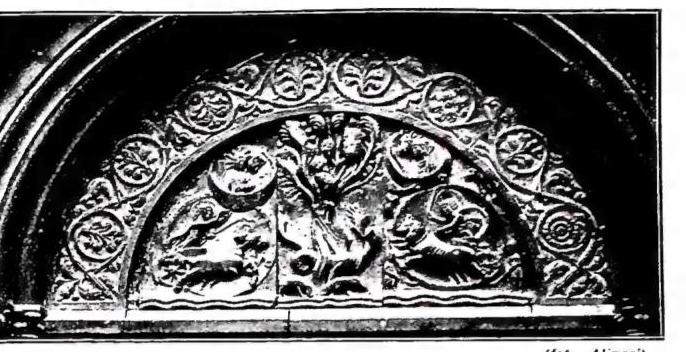
In medieval sacred art, allegorical representations of human life are frequently encountered, primarily intended to express in various figurative ways man's inevitable progression toward death.In the Cathedral of Torcello, a Byzantine-style marble bas-relief from the 11th century, embedded in the ambon's staircase, depicts a youth with winged wheels at his feet and a scale in his hand, symbolizing the fleeting nature Time (v.). A more complex depiction is found in the lunette of the southern door of the Baptistery of Parma, Antelami (v.) around 1200, illustrating the tree of life according to the IOSAPHAT (v.). Here, a youth reclines among the branches of a tree, savoring honey from a comb, unaware that at the tree's base two small animals (mice or moles?) gnaw at its roots, while a flame-spewing dragon awaits his fall. On either side, the Sun and the Moon, within disks bearing their respective chariots, represent the passage of time. A similar depiction, with slight variations, appears in the 13th-century bas-relief on a jamb of the door of the Chapel of S. Isidoro in S. Marco in Venice, and in a Gothic panel from the Museo dell'Opera del Duomo in Ferrara, where, alongside the usual symbolic elements, a unicorn also appears. Human life was also depicted through a series of representations of successive ages of an individual, connected in a kind of synoptic tableau. A fine example of this genre is found in a bas-relief of the Baptistery of Parma, also by Antelami. During the Renaissance, the concept of life was expressed in a manner entirely different from the medieval one. In this regard, one recalls the large panel by Lorenzo Costa in the church of S. Giacomo in Bologna, where the triumph of life is depicted as preceding the triumph of death.