
ALBERO della VITA. - Plant "in the midst" of the earthly paradise, upon which the Creator had conferred the power to preserve man's life and to protect him from death (Gen. 2, 9).
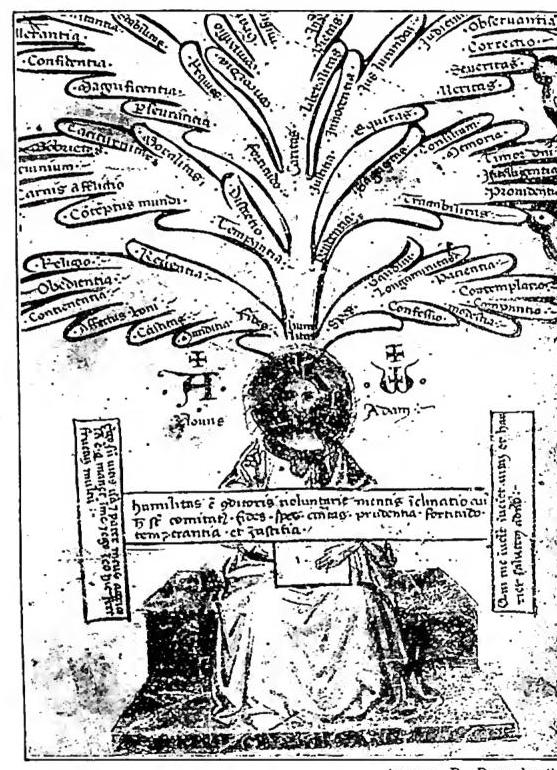
The historical reality is generally admitted in Catholic exegetical tradition, as it is for the "tree of the knowledge of good and evil" (v.), with which P. Mayrhofer (in Theologie und Glaube, 28 [1936], pp. 133-62) following others mistakenly identifies it, seeing in it the prohibition of the use of the procreative faculty; this interpretation was first proposed by Clement of Alexandria, according to whom the sin was against chastity (Strom., III, 14, 17; PG 8, 1193 sq. 1206), and J. Coppens renews it today. Various Catholics today, with J. Feldmann, H. Junker, J. Coppens, give an allegorical coloring to the two trees of paradise, or connect them to popular traditions; likewise modern Protestants (H. Th. Obbink).
In the Bible itself and in tradition, the tree of life has received symbolic meanings. In the book of Proverbs, wisdom is compared to the tree of life (3:18), and likewise the actions of the righteous (11:30), the fulfillment of a desire for life (13:12), and the peace-bringing tongue (15:4). In the Apocalypse, the "tree of life" is placed in the heavenly paradise: its fruits will be granted by the Spirit to the victor (2:7); in the midst of the heavenly Jerusalem "and on both sides of the river the tree of life bore fruit 12 times a year [perennially]" (preferable translation: 22:2, 14; Ezek. 47:7, 12).
Jewish apocalyptic writers transplant it to heaven (Apoc. Moses 28) or to the future world (Slavonic Enoch 8:3-5; 22:8-10) or to the messianic kingdom where the saints will eat its fruits (Ethiopic Enoch 25:4-7; 22:3-6; Testam. Levi 18:12 sq.; IV Ezra 8:52); referring to the messianic tree of Is. 11:1, they describe the future "plant of righteousness" (Ethiopic Enoch 10:16; 62:8; 84:6; 93:2-5). In rabbinical writings, the tree of life represents blessed immortality (Midrash on Cant. C. 6:9). The rabbis have fabulized about enormous dimensions of this plant (Talmud Jerus., Berachoth I, 1).
The Fathers often see in the "tree of life" a figure of the Cross upon which the new Adam restores to us the life lost by the old Adam, or a symbol of the Eucharist. In Ad Diognetum XII (conclusion by a later author) the two trees represent the true Christian (cf. Dante, Purg., XXXII, 37-60).
Among many peoples there are traditions concerning life-giving or "sacred" trees. P. Dhorme, J. Feldmann, A. Ungnad, along with others, see allusions to the two trees of paradise in Assyro-Babylonian documents. Babylonian parallels are mostly connected with the myth of Gilgamesh (v.). One of the prevailing themes in Assyro-Babylonian seals is the sacred tree flanked by two figures, animals or monsters, opposed symmetrically.
In Jewish art: Z. Ameisenova, The Tree of Life in Jewish Iconography, in Journal of Warburg Instit., 1939, pp. 326-45; H. G. May, The sacred Tree on Palestine Painted Pottery, in Journal of Amer. Oriental Soc., 59 (1939), pp. 251-59.
For the traditions of Eastern peoples: A. Deimel, Genesis 2-3 cum monumentis assyriis comparata, in Verbum Domini, 4 (1924), pp. 281-87, 312-15; A. Ungnad, Die Paradiesblume, in Zeitschr. d. deutsch. morgenl. Ges., 79 (1929), p. 111 ssg.; I. Plessis, Babylone et la Bible, in DBs, I, col. 757 sg.; Z. Mayani, L'arbre sacré et le rite de l'alliance chez les anciens Sémites, Paris 1935; N. Perrot, Les représentations de l'arbre sacré sur les monuments de la Mésopotamie et de l'Elam, Paris 1937; H. Danthine, Le Palmier dattier et les arbres sacrés dans l'iconographie de l'Asie ancienne, Paris 1937; S. N. Kramer, Gilgamesh and the Huluppu Tree, Chicago 1938. Antonino Romeo
ART. - Setting aside hypothetical connections with similar oriental conceptions, the tree of life, placed according to Gen. 2:9 in the middle of Paradise, was in patristic exegesis from the earliest times compared to, if not identified with, the cross of Christ. The omnipresence of this symbolism meant that the recent tendency to recognize the tree of life in certain signs discovered on early medieval baptismal fonts and grave slabs, as well as in the heraldic stylization of scepters, has remained rather problematic. On the other hand, there is no doubt that those forms of the crucifix that still display something of their arboreal origin go back to the idea of the lignum vitae
(v. CROCE, ALBERO della). While the crosses on the oriental ampullae of Bobbio (7th century) recall the bark of a palm tree, in Western types one finds depicted the cross with rudiments of branches (Astkreuz) or the "cruel" forked cross, favored by 14th-century German mysticism, or the anchored cross, or also the tree-cross (Baumkreuz).