
PROVERBI, LIBRO dei. — The third (after Job and the Psalms) of the didactic books of the Old Testament, and the first of the “sapiential” books. Ecclesiasticus (v.) drew upon it not infrequently, although there are very notable differences of form and content between the two books.
Alongside the name of P. (Παραγία, Proverbio), there is that of Parabole (Παραβολοί, Parabolae), which renders more literally the title prefixed to the book in its definitive recension: Millè (Sèbhnàh), Parabolae (Salomonis), in the Latin versions (Prov. 1, 1). In the Talmud the abbreviated title Millè is current, while Sèpher bohhnàh is rarer; corresponding to it is the title of Σοφία, used at times by the Fathers (Eusebius, Hist. eccl., IV, 28, 14; PG 20, 597; cf. ἡ πανάρετος σοφία in I Clem. 57, 3; PG 1, 324), and of Sapientia Salomonis (s. Cipriano, Testimon., II, 14; III, 56; PL 4, 768 [737], 781 [791]).
Màfal (v.), which is rendered only approximately by “proverb,” means a likeness, comparison, parable, or brief sententious saying, serving to inculcate a truth or a principle of moral and practical order: it is the parable in the strict sense (Ez. 17, 2; 24, 3), the likeness and the example, the saying in popular use (more precisely, proverb: I Reg. 5, 12; Job 13, 12; Prov. 1, 1.6; 10, 1; 25, 1; 26, 7.9), the witty and sarcastic quip (Ez. 12, 22 sqq.; 18, 2 sqq.; Mi. 2, 4; Hab. 2, 6), the words of mockery
The book of P. possesses only editorial unity. Its various collections are grouped around two principal ones. Even within the individual collections, it is difficult or impossible to discover unity and logical arrangement, since sayings follow sayings without any evident connection.
More positive indications of the multiplicity of the collections are, besides the diversity of style and doctrine, the repetition of very similar, or even identical, sayings, and the titles preserved at the beginning of the individual collections. After the extensive introduction of chaps. 1-9, the title of 1, 1 is repeated (10, 1), because at this point the first Solomonic collection begins (10, 1-22, 16). Two smaller collections of “sayings of the wise” follow (22, 17-24, 22; 24, 23-34): the first is introduced (22, 17) without a title, but presupposes one in the brief introduction of 24, 23. The second Solomonic collection (25-29) is the work of the “men of Hezekiah king of Judah” (25, 1). This is followed by the “sayings of Agur son of Jāqeh of Maššā” (30, 1), which seem to be limited to 30, 1-14, followed by the numerical proverbs (30, 15-33). Similarly, the “sayings of Lemuel, king of Maššā” (31, 1) amount to nine verses (31, 1-9: avoidance of evil women, who corrupt kings, and of the abuse of wine); the concluding poem on the virtuous woman (31, 10-31) is clearly distinguished by its acrostic form (twenty-two distichs corresponding to the letters of the alphabet): a vigorous portrait of the ideal wife and mother of a household.
The Fathers and the medieval interpreters attributed the entire book of P. to Solomon, misled by the title of 1, 1 and by the erroneous Agur (v.) and Lemuel (v. in 31, 1), which were not infrequently taken as pseudonyms or symbolic names of Solomon. The unity of authorship is no longer defended. The diversity of the historical and cultural setting is reflected too clearly in the individual collections listed above. There is no serious difficulty in maintaining the Solomonic origin of the content of the two collections 10, 1-22, 16 and 25-29. For this central nucleus, the entire book could be named after Solomon, just as the Psalter is named after David. The language of these two collections belongs to the finest period; the form of the mālāl is simple but effective; references to a monarchy passing through a period of splendor are frequent (16, 12-15; 20, 8.26.28), while national calamities are never mentioned. The content of these two collections may be regarded as a sample of the three thousand “proverbs” spoken by Solomon, according to I Reg. 5, 12 (Vulg. 4, 22). The second collection was made by the “men of Hezekiah” (25, 1); the first may be considerably earlier, without reaching back to the Solomonic age. It is difficult to determine when the smaller collections were joined to the two Solomonic collections, and when the book attained its definitive form, with the lengthy introduction of chaps. 1-9, which have the appearance of a brief treatise on the nature and usefulness of wisdom. To descend, for this latter part, as far as the Hellenistic age does not seem
(Ist. Esc. Cutt.)
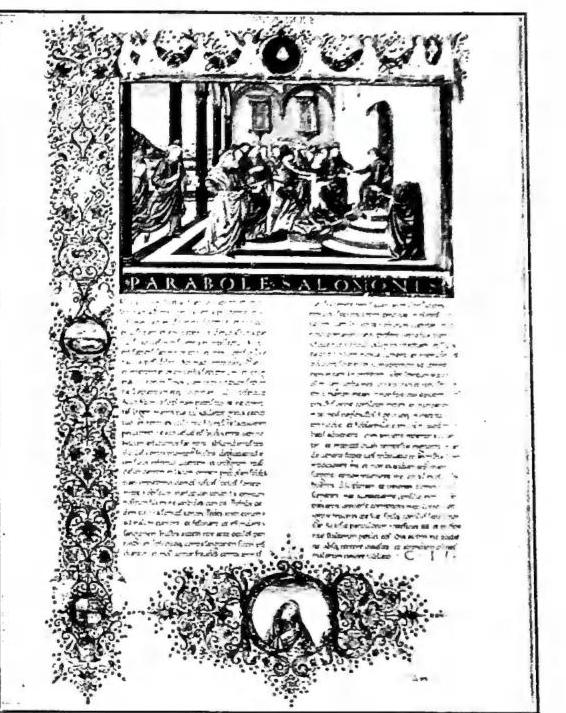
PROVERBI. Libro dei — Incipit of the book of P., or of the Proverbs of Solomon. The miniature represents the judgment of Solomon; in the roundel below, the young Solomon — Vatican Library, cod. Urb. lat. 2, f. 31 v (15th cent.).
justified: the way of conceiving wisdom is in fact different from that found in the books of Wisdom and Ecclesiasticus, influenced—especially the former—by Greek culture.
Chaps. 1-9, although predominantly characterized by a general exhortation to follow wisdom, also deal with avoiding evil companions (1, 8-19; 2, 10-22), especially evil women (5; 6, 20-35), with the duties owed to one’s neighbor (3, 17-33), prudence in undertaking commitments (6, 1-5), and avoidance of idleness (6, 6-11). The dominant theme is the invitation to follow wisdom (chap. 8), which invites one to her own table (9, 1-6), in contrast to the banquet of folly (9, 13-18).
The content of the two Solomonic collections is varied and disconnected. They move from the assertion that children, according as they are good or bad, bring joy or sorrow to their parents (10, 1), to the condemnation of ill-gotten wealth and the exaltation of justice (10, 2 sqq.), and then to the stigmatization of idleness (10, 4 sqq.), etc. Even where there is a certain unity of content, as in 10, 11-21 (wisdom in speech), maxims concerning wealth and poverty, and the different use made by the just and the wicked of their earnings, are interspersed (10, 15 sqq.). Every aspect of individual, family, and social life is considered. Particular prominence is given to the dignity and task of the king, whose model is delineated in 16, 10-15; 20, 26-21, 1. Cf. 25, 2-7; 29, 2-14.
The sayings of Agur (not identifiable) begin with
(courtesy of Senator G. Treccani)
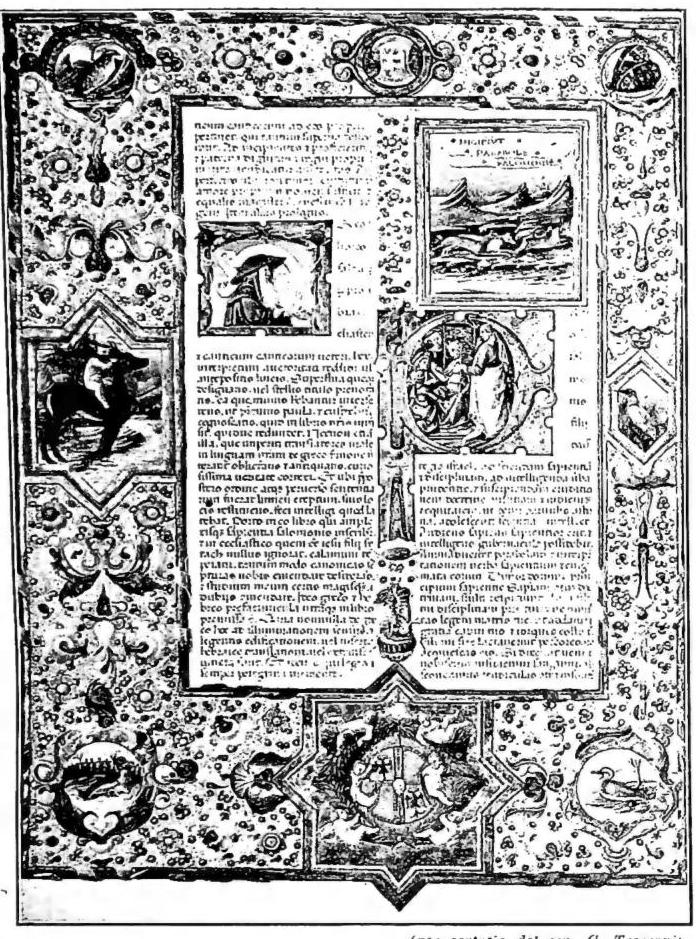
PROVERBI, Libro dei - Incipit of the book of P. or of the Parables of Solomon.
Bible of Borso d’Este, executed between 1455 and 1461, vol. I, f. 270 V. MODERATI, Biblioteca Estense.
a profession of the inaccessibility and transcendence of God (30, 1-4) and of the immutability of his word (30, 5 f.).
Agur loves the golden mean, and therefore desires neither poverty nor riches, which expose one equally to moral dangers, but only what is necessary for life (30, 7 ff.).
In the numerical mētālīm (30, 15-31) he too exalts the king (v. 29 ff). Lamuel (an unknown personage) portrays the figure of a good prince (31, 2-9). This is followed by the portrait of the virtuous woman (31, 10-31).
The book of P., like other sapiential books, offers notable analogies with the dogmatic and moral doctrine of the New Testament; thus 25, 21 (Rom. 12, 20) is cited with reference to certain acts of courtesy to be performed even toward one’s enemy, whose misfortune one must not enjoy (24, 17 f.). A free use of 25, 6 f. is found in Lk. 14, 8 ff. Prov. 20, 22 (cf. 24, 29) forbids repaying evil with evil: having gone beyond the law of retaliation, it draws near to the law of charity (cf. Rom. 12, 17; I Thess. 5, 15; I Pt. 3, 9). The reason for not repaying an enemy in kind is trust not in the intervention of God as avenger (Deut. 32, 35), but in his protection.
In its more recent and more doctrinal part, the book of P. distantly anticipates the Christian revelation of the Trinitarian mystery by presenting wisdom as something distinct from God
the creator: 8, 22-31; cf. 1, 20; 9, 1-6, etc. It must be acknowledged, however, that the mētālīm with directly dogmatic content are few. P. is an eminently practical book, concerned with the conduct of life. But underlying its practical directives are premises or principles that touch the very foundation of religion. The morality of P. rests on the fear of God (1, 7), that is, on a profound sense of dependence upon him, joined to an almost filial trust (3, 5-8).
P. displays undeniable similarities with the sapiential literature of the other peoples of the East. In particular, between 22, 17-24, 20 and Amen-em-ope (v.), the similarities are so numerous and precise that they cannot be considered accidental. The problem could theoretically be resolved either by P.’s dependence on the Egyptian, or by the latter’s dependence on P., or, finally, by the dependence of both on a common source. The first and second solutions have found fewer advocates than the third.
With regard to the text of P., the most notable fact is the very great divergence between the Masoretic text and the Septuagint. The Pēṣitto, the Targum, the Greek versions of Aquila, Symmachus, and Theodotion, and the Vulgate essentially agree with the former. The translation of St. Jerome, produced in great haste (in three days he translated Proverbs, Ecclesiastes, and the Song of Songs: cf. Proef. in libros Salomonic: PL 28, 1241), substantially reproduces a Hebrew text only slightly earlier than the age of the Masoretes. The Coptic, Syro-Hexaplar, and Old Latin versions agree with the Septuagint. The Septuagint version displays a character of excessive freedom. There are divergences in meaning (e.g., 13, 2-4 ff., 9 f.), texts translated twice (14, 22; 22, 8 f.; 25, 20), and numerous additions (either the preceding text is paraphrased or the same concept is expressed with some variation in the imagery); but the additions may sometimes (cf. 11, 16; 27, 20 f.) preserve traces of a Hebrew text older and better than the Masoretic one. The omissions are relatively few: 1, 16; 4, 52. 7; 7, 25b; 8, 29ab. 32b. 33; 11, 4; 13, 6; 15, 31; 16, 1-3. 6-9; 17, 19b; 18, 8-23 f.; 19, 1 f.; 20, 14-19; 21, 5. 18b; 22, 6; 23, 23; 25, 9a. 19b. Transpositions occur both of entire sections (the first part of the words of Agur, 30, 1-14, comes after 24, 22, that is, after the first collection of the sayings of the wise; the second part of the words of Agur, 30, 15-33, and the words of Lamuel, 31, 1-9, come after 24, 34, that is, after the second collection of the words of the wise), and of individual mētālīm, especially those of the first Solomonic collection (e.g.: 16, 7 after 15, 28; 20, 22 ff. after 20, 9). Compared with the Masoretic text and the Septuagint, the Vulgate has very few additions of its own: e.g., 14, 21c. On the other hand, one third of the additions in the Septuagint are common to the Vulgate. Rather than reflecting the influence of the Old Latin on the translator of the Vulgate, this seems to involve later interpolations. The Masoretic text and the Vulgate, purged of the interpolations, are considerably shorter than the Septuagint and largely agree with each other. Both represent a synagogue text freed, in the first centuries of the Christian era, from the additions preserved in the Septuagint.
Teodorico da Castel San Pietro