
PROTOEVANGELIUM. - This term is commonly used to designate Gen. 3,15, because it contains the "first good news" of salvation for humanity after the fall
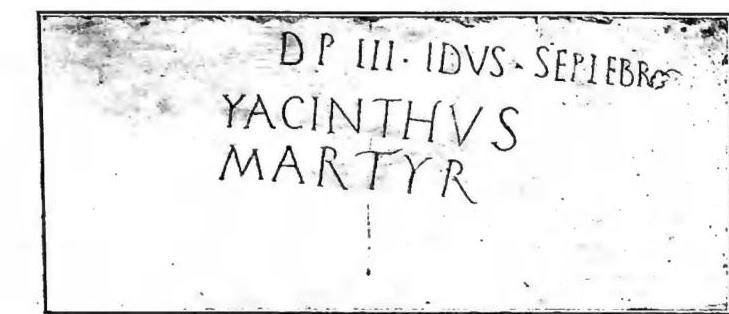
PROTO and HYACINTH, SS., Martyrs - Inscription of the martyr H. discovered on March 21, 1845, in the cemetery of Basilla, now in the chapel of the Collegio Urbano De Propaganda Fide - Rome.
(ibid. 3, 1-8). Eve, to exonerate herself from Adam's accusation, blames the serpent, which, without interrogation, is struck by the sentence (v. 14). Here is grafted the announcement of a relentless struggle between the two opposing groups: the serpent with its progeny, and the woman with her progeny. The second group will emerge victorious.
Here is the text of the protoevangelium according to the Hebrew: "And I will put hostility between you and the woman, and between your lineage and her lineage. It shall crush your head and you shall strike its heel". Where the Vulgate has the plural inimicitias, the Hebrew text has the singular 'ēbhāh, "hostility". The future "I will put" can indicate a fact that is already being implemented from the moment it is announced. "Crush" and "strike" are forms of the same Hebrew verb šīph, "to crush", "to smash", attenuated in the Septuagint with τηρέω in both cases. The Vulgate translates first conterere, then insidiari; the Old Latin, reproducing the Septuagint, servare. The difference in meaning seems also suggested by the context, which intends to contrast two actions of different efficacy. The classical variant is hū' ("it"), to be referred to zar'āh (the woman's "seed" or lineage), translated with the masculine αὐτός, instead of the neuter αὐτό, by the Septuagint (agreement ad sensum with σπέρμα) and by the Old Latin with ipse (referred to semen), while the Vulgate has ipsa. The versions, unlike the original, would thus suggest that an individual defeats the serpent. This, for the Vulgate, is "the woman".

The crushing victory over the serpent can only be attributed to a champion of humanity, who escapes every influence or power of the evil one. It is the Messiah. The mariological meaning of the text rests above all on tradition, which found its classical expression in the ipsa of the Vulgate.
The full meaning of the protoevangelium may not have been perceived by our first parents and by subsequent generations; but, however vague, it was a ray of hope in the gloomy picture of fallen humanity. In a completely different sense, the best-known "infancy gospel" is called the protoevangelium (v. GIACOMO, protoevangelo di).