
PROVENÇAL LANGUAGE AND LITERATURE. – Strictly speaking, there is no p. language today, but only a system of dialects of southern France, distinguished from that of the French dialects by a certain number of important characteristics, on the whole more conservative. It comprises all the dialects south of an imaginary line which, starting in the west from the Gironde estuary, follows the Dordogne for a stretch, rises in an arc around the Massif Central, including Limousin and Auvergne, then descends to the Rhône, crosses it between Vienne and Valence, traverses Dauphiné as far as the junction of the Cottian and Maritime Alps, and finally follows the latter, ending at the sea near Monaco. In the Middle Ages the domain of these dialects extended farther north, almost as far as the Loire, perhaps including Poitevin as well; and upon them there was elaborated, with the characteristics of a koiné, a literary language of importance no less than that of the others in the nascent Romance world. Dante designated it, after its affirmative particle, as lingua de oc, to distinguish it from its Italian sister, that of si, and its French sister, that of oil; but in usage the name p., strictly speaking an improper one, became established as early as the thirteenth century, referring to a linguistic area much larger than Provence properly so called, indeed larger than the Roman Provincia itself. This linguistic differentiation of the south from the north of France was fostered by the earlier and more intensive Romanization, the different pre-Latin substrate (Celtoligurian in the south, Gallic in the north), the different Germanic superstrate (Visigoths, later Burgundians in the south, Franks in the north), and finally all the historical and geographical conditions that allowed considerable independence in the Middle Ages to the Duchy of Aquitaine and, in general, to all southern life.
The earliest text of p. literature to have come down to us, in a manuscript from the abbey of Fleury-sur-Loire, now in Orléans, is a fragment of a didactic-hagiographic poem on Boethius, regarded as a martyr of Christianity: this poem, in laisses of decasyllables, must have been composed around the middle of the eleventh century by a Limousin who drew upon a Latin biography and directly upon the De consolatione philosophiae. A few decades later came another hagiographic poem, whose manuscript, now in Leiden, has the same provenance as the first, although the text instead belongs to the Narbonese region: the Song of Saint Faith, which recounts, in laisses of octosyllables, the life and martyrdom of the legendary Saint venerated at Agen and Conques, drawing upon the Latin accounts of her passion and translation, upon the miracles described by Bernardo d'Angers, and in part also upon Lactantius’s De morte persecutorum. Dating from the end of the eleventh century or the threshold of the twelfth are also some sacred lyrics (a Latin Christmas hymn interspersed with p., and a wholly Provençal prayer to the Virgin based on the pattern of well-known Latin hymns), in a manuscript of S. Marziale of Limoges, now in Paris. These elements alone suffice to show the weight that impulses of a genuinely religious nature had in the emergence of p. literature, as in that of the other Romance literatures.
Scholastic traditions and clerical culture certainly also played a major role in the emergence of troubadour lyric, which constitutes the largest and finest part of p. literature. It is no coincidence that the monastery of S. Marziale at Limoges, one of the most active workshops of Latin rhythmic poetry from the time of Abbot Odolrico (1023–40), lay within the domains of Guglielmo VII, Count of Poitiers and IX Duke of Aquitaine (1071–1126), the first troubadour whose poems have come down to us, and certainly one of the first to practise this art, which took its name from the tropus ecclesias and repeated verse patterns and historical structures from the medieval rhythmic tradition of tropes and hymns. And it was precisely in Guglielmo’s time and in his domains that the preacher Roberto d’Arbrissel (1101) founded the monastery of Fontevrault, whose singular organization, inspired by the glorification of the Mother of God, assigned authority over a mixed convent not to an abbot but to an abbess, not to a virgin but to a widow: a mystical exaltation of woman from which, according to Bezzola, Guglielmo would have drawn inspiration, reducing it to a secular intention, for that exaltation of woman which is the central theme of the troubadours’ love poetry.
Whether or not one accepts this hypothesis, it is certain that between the secular love of the troubadours and the mystical love of a St. Bernardo or of a
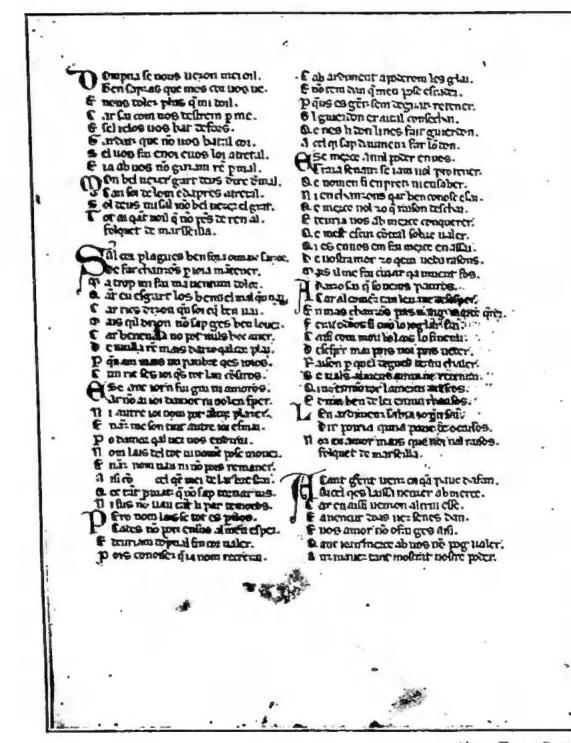
But in troubadour poetry, although modes and forms of religious culture persist, religious experience is no longer exclusive, nor dominant. From it there gradually become detached the values of a lay and aristocratic spirituality and literature, in which the relationship between lover and beloved is assimilated, in addition to religious devotion, also to the feudal relationship between vassal and lord; and love, even where it is not crudely sensual and seeks to spiritualize itself through gratuitous compassion, even where it is felt and exalted as a principle of moral elevation, even of chastity, is nevertheless essentially adulterous,
extramarital. The reference to Cathar heresy suggested by this conception to some critics (Péladan, Rahn, De Rougemont) is nevertheless excessive. The « ben celare », the designation of the lady by means of pseudonyms (senhals), are not precautions of heretical esotericism, but attitudes of practical discretion, often a mere pretext for freeing lyric poetry from a condition of overly immediate autobiographical expression; and the solote to which the troubadours aspire is worldly and literary delight, which may be idealized as the seal of courtesy, but remains far removed from the sacramental claims of the Cathar consolamentum.
Ultimately, this is a matter of custom, quite understandable in the milieu of the wealthy feudal castles, just as cicisbeism would be in eighteenth-century salons; and « contrasti » and « partimenti » and « questioni » and « corti d'amore », with their casuistical subtleties, are a form of social entertainment. Yet the importance of « courtly love » transcends these practical and contingent aspects, assuming, in the history of Western civilization, the significance of a discovery. Not only do social relations between the sexes become « established on a new plane which, in certain respects (the ideas of « courting », « cavalier », etc.), extends down to the present day; but in the experience of love a new tone of the spirit is discovered, unknown to classical eros, a more intimate and universal human value, by which love, this « discovery of the 12th century » (Seignobos), becomes the symbol of a civilization. Between the brute instinctiveness of the senses, a natural reality never denied, and the rigorism of the moral and religious law, always acknowledged as superior, a world of feeling is gradually carved out: risky in its ambiguity, subtly soft in its refinement, aristocratic and intellectually sophisticated in its manifestations, and virtually inexhaustible as a source of literary inspiration. The theorist—or, one might say, the Machiavelli—of this autonomy of sentimental life, governed by a meticulous etiquette inxta propria principia, was Andrea Cappellano with his treatise De Amore, composed around 1185 and later condemned in 1277 by Bishop Stefano Tempier; but he did no more than systematize a complex of attitudes that can be grasped in their native state in troubadour lyric poetry, which precisely finds its unity around this ideal axis.
This unity, on the other hand, should not be understood in an overly static sense. Gone are the days when, to a Diez, Provençal poetry could appear as uniform as the work of a single author. All recent criticism tends better to identify and define, within the unity of the tradition represented in the surviving songbooks by approximately 2,700 lyrics of more than 400 authors, their individual personalities and the various modes and differing force of their inspiration. Attention is focused on the initiators, who, in creating their poetry, founded a poetics; whereas monotony, conventionalism, and lack of inspiration are more readily defects of the epigones, who composed verse within the limits and according to the models of an already established tradition. Thus one can see how the exaltation of woman and sentimental love appears in Guglielmo IX alongside old yet still lively motifs of malicious antifeminine satire and exuberant, at times coarse sensuality (hence the definition « two-faced troubadour »). One can see, in opposition to the emerging courtly poetic school, whose leader is identified in the person of a vassal of Guglielmo, Ebolo viscount of Ventadorn, the indignant song of Marcabruno rising in forceful invectives and sarcastic parodies (texts datable to 1133–48). He redeems the humility of his social condition through an awareness of an art directed, in difficult language, toward proud formal trials, and through an almost prophetic sense of his own mission; hence his sirventes have biblical accents as they lash the corruption of morals and exhort to the crusade against the infidels of Spain. One feels the fascination of a dreamy and subtly contradictory inspiration in the theme—not, as some believed, a religious allegory—of distant love, sung by Giaufré Rudel, protoppe of Blaia (d. during the Second Crusade). In Bernardo di Ventadorn (active 1158–80), the finest representative of Ebolo’s school, one recognizes the clearest voice of troubadour poetry, pouring forth with spontaneous musicality in songs of ecstatic tenderness and gentle nostalgia for love,
sunny with radiant images and stirred by an eager readiness of insight. Opposed to his trobar leu, that is, easy and graceful, as was also practiced by the elegant Pietro Roger and the passionate Beatrice, countess of Dia (the most notable among the seventeen poetesses who mark women’s participation in the troubadour movement), stands the trobar clus, which today one would call hermetic, of Rambaldo d'Aurenga (1150–73), with its exasperated search for lexical asperities, phonetic and conceptual surprises, and new structures, mastered with aristocratic confidence; and, later, the trobar vic of Arnaldo Daniello (1180–1210), a fervent master of style and technique, a true “smith,” more than a craftsman in delicate chasing, of arduous formal experiments (one may recall the “sestina”) that aroused the admiration and imitation of Dante and Petrarch. Marcabrunian and courtly echoes intertwine in Cercamondo and Bernardo Martin, and with a more conscious eagerness for perfection in Pier d'Alvernia (1158–80); trobar clus and trobar leu succeed one another in Giraldo di Bornelh (1165–1200), whom Dante hailed as “poet of rectitude” and who was truly a sustained but not profound preacher, a severe moralist, though not to the point of rejecting courtly love, as Marcabruno did. Alongside amorous, satirical, and moral themes, others also resound: for example, in Berrando del Born (1181–94), the antibourgeois taste for arms and prowess, and the spectacular exaltation of war. Nor is the religious note absent from significant compositions: from the sorrowful penitential song that Guglielmo IX composed during an illness, in the thought of death, to Marcabruno’s and Pier d'Alvernia’s crusade songs, and to the latter’s prayer and profession of faith.
In the years straddling the two centuries, troubadour poetry is in full flower. The names become more numerous, but at the same time less significant, as distinctive features grow attenuated and tend to level out under the sway of fashion. Pietro Vidal, a Toulousan (1180–1206), finds felicitous accents in a lively, fantastical, and sentimental humor; Rambaldo di Vaqueiras (d. after 1205) takes pleasure in varying tones and genres, from the burlesque to the epic-like; in his youthful poetic activity (1180–95), Folchetto displays qualities of culture and discursive learning that would later lead him to become bishop of Marseille (though some religious poems already attributed to him probably belong to the homonymous Folchetto di Romans). And let us also recall: Gaucelmo di Cabestanh, with his accents of melancholy; Arnaldo di Marnoli, with his weary and somewhat prolix grace; Rigaldo di Berbezieux, with his curious comparisons drawn from the Bestiaries; Raimondo di Miraval, Gaucelmo Faidit, Peirol, the Monk of Montaudon, and others. Decline is approaching—not caused, but merely hastened, by the Albigensian War, the royal seizure of the great fiefs, and the consequent disappearance of that elegant life which had nourished “courtly” poetry. In the second half of the century, the most notable voice is that which the Toulousan Pietro Cardinal (1225–72) raises to cry out his horror at the violence committed against his land, and his violent reaction against the political and economic domination of the clergy; he does not, however, defend heresy, and indeed preserves a sincere and profound religious feeling: one of his finest songs is addressed to the Madonna. The weakening of the cult of Mary is, moreover, a characteristic of the period, and other troubadours also raised songs to the Virgin, from Perdigon and Amerigo di Belenoi in the first half of the century, to Folchetto di Lunel and Deodato di Pradas in the second. An attempt to reconcile the courtly ideal with the new spirit of religious devotion is found in Guglielmo di Montanhagol (1233–58), of whom it is debated whether, and to what extent, he should be regarded as a precursor of the stilnovisti.
(phot. Biblioteca Ambrosiana)
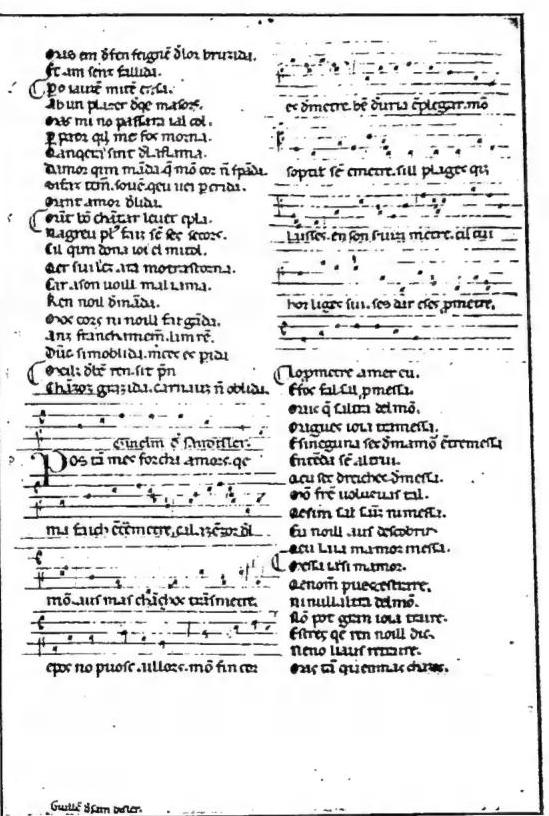
PROVENZALE, LINGUA E LETTERATURA - Song by Guglielmo di Saint-Leidier with melody. Provençal codex of the 14th century (G.) Milan, Ambrosian Library, cod. R. 71 Sup., f. 73r.
Giraldo Riquier (1254–82). Catalan poets arise in emulation, adopting Provençal as their literary language, from Guglielmo di Berguedan to his namesake of Cervera (called Cerveri); among them was the sovereign Alfonso II himself (1162–96). Thus in northern Italy, from the end of the 12th century to the beginning of the 14th, from Pier della Cavarana to Ferrarino da Ferrara, Provençal is the language of courtly lyric; and in Provençal the Bolognese Rambertino Buvalelli and the Mantuan Sordello write with mastery, as do the Genoese Lanfranco Cigala and Bonifacio Calvo, the Venetian Bartolomeo Zorzi, and even Tuscans such as Dante da Maiano and Terramagnino da Pisa. In geographically and linguistically more distant regions, such as Galicia, Sicily, and Germany, or in places where a glorious literary tradition already existed, as in northern France, poetic schools arise that reproduce Provençal forms in the mother tongue. The poetry of the troubadours thus stands as the point of departure for all European lyric poetry; and although today, following the discovery of the Mozarabic khargias, which takes us back as far as the middle of the 11th century, one can no longer repeat that the troubadours’ verses were the first lyric verses in a Romance language, one can certainly repeat that theirs was the first literary movement in which a high and complex artistic consciousness found expression—a movement decisive at the roots of all modern Western poetry.
The work of the troubadours is also noteworthy from the musical point of view: the 264 melodies that have survived reveal a technique closely connected with that of Gregorian chant, with narrower ranges but a more rigorous formal symmetry, a more pronounced tendency to consolidate rhythm into short periods and the tonal sense into modes closer to the present major and minor modes.
(phot. Enc. Catt.)
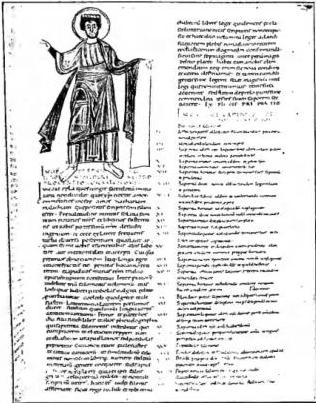
PROVERBI, Libro dei - Prologue by St. Jerome to the book of Proverbs, followed by the index of the chapters of the same book. The miniature depicts Solomon - Vatican Library, cod. Pal. lat. 4, f. 70 (9th century).
Provençal was nevertheless the language of the first poem on the Eastern Crusade, of which a reworked fragment remains (Chanso d'Antioche); and in the 14th century the Albigensian War and the war of Navarre gave rise to historical poems. Romance poetry produced a notable Arthurian romance, the Jaufré, and above all a delightful courtly romance, the Flamenca (first half of the 13th century); but little else, and that little of scant importance. Didactic poetry is represented by several ensenhamens and by the cumbersome Breviari d'Amor of Matfre Ermengau (d. 1322); drama by several mysteries from the end of the 13th century (Esposalizi de nostra Dona Santa Maria) or the 14th (Passion of the Didot ms.; Jeu de s. Agnès). In prose there are, for the most part arising from a fanciful interpretation of lyric texts, vidas and razos, that is, biographical and anecdotal accounts placed before the poems of individual troubadours in some songbooks; then edifying and didactic works, lives of saints, sermons, and translations of sacred texts: a production that, regardless of its slight intrinsic value, confirms the completeness of literary functions for which ancient Provençal was truly a “language.” Grammars were also compiled for this language, the first of a modern idiom: the Razos de trobar of the Catalan Raimondo Vidal, which is also a treatise on poetics; the Donat provençal by a certain Ugo Faidit, identifiable with Ugo di Saint-Circ, Jaidit meaning exiled in Italy: works, therefore, intended for foreigners.
But from the 14th century onward, in Provence itself the literary and linguistic tradition now required artificial support. In 1323 the Consistori del gai saber was founded at Toulouse, and this first modern academy instituted the “floral games,” annual poetic competitions (won the first time by Joan de Caselnou, with a song to the protecting Virgin); its chancellor, Guglielmo Molinier, composed an extensive treatise on grammar and poetics, the Leys d'amors. But laws, games, and consistory could not halt the decline, which was due to changed historical conditions. Long before the Edict of Villers-Cotterets (1539), French had established itself throughout the South as the language of high society and literature (one may think of G. Phebus, A. De la Sale, and C. Marot); while the increasingly fragmented dialects served only for a few minor popular works and for certain traditional genres, such as the Noëls sung in the Christmas octave.
Attempts at revival, such as those made at the end of the 16th century by the Gascon Du Bartas, in the 17th century by the Toulousain Pietro Goudelin (Goudoli), and in the early 19th century by the school of Marseille and the barber-poet Jasmin, did not lift Provençal beyond the dialectal sphere. It was instead raised by the movement founded in 1854 by seven young men, among whom were genuine poetic talents: Giuseppe Roumanillo, Teodoro Aubanel, Mistral (v.); but this was an ephemeral revival. The language of the Félibres (as these poets called themselves, adopting the obscure term by which a popular religious song designated the doctors who disputed with Jesus) was the Arlesian dialect transformed by subtle work of philological selection and aesthetic refinement; but it never achieved a truly complete range of literary functions, and the rapid evolution of spoken Arlesian itself, the resistance of other strongly characterized dialects, mutual unintelligibility among the less closely related varieties, and the consequent habitual recourse by all to the official language of the State, French, as the language of conversation and culture, mean that even Mistral’s masterpiece, Mircia, is no longer accessible today to the people for whom it was written. Contemporary Felibrism, having survived Mistral’s death and the two world wars, is and remains dialect literature.