
SAINT-BENOÎT-SUR-LOIRE. – The Abbey of St-Benoît-sur-Loire at Fleury (from the ancient name of a villa, Floriacum, belonging to a Florus or Florius) stands near the town of the same name in the Val de Loire, in the department of Loiret and the diocese of Orléans.
Its central position, at the intersection of the great communication routes, made this valley a center for the peoples of ancient Gaul; it contained the omphalan, the sacred navel: periodic assemblies were held there, and expiatory sacrifices were also performed there for the entire nation, in the temple of the god Radiobus, to which pilgrims came from every quarter under the guidance of the druids. This sacred character was preserved also in the Gallo-Roman period, as important archaeological remains demonstrate, and was subsequently passed on to the Germanic peoples who settled in Gaul.
Christianity encountered difficulties in this pagan center, where it triumphed in the 4th century, perhaps through the work of s. Martino, to whom several churches in the valley are dedicated. Probably the same period must be assigned to the first Christian traces at Fleury. It is known only that in the middle of the 6th century an oratory dedicated to the Virgin was attached to the villa, whose owner was King Clodoveo II. The King, who shared with his consort s. Batilde a concern for the propagation of monastic life, ceded the villa, in exchange for other estates, to the abbot of S. Pietro of Orléans, Leodebodo. Attracted by the fame of the Rule of s. Benedetto, he had decided to found a new monastery in order to introduce its observance there. He could now carry out his plan at Fleury, where the villa was soon transformed into an abbey, which he himself endowed with many possessions by a charter dated 27 June 651. The choice of the site, the favor shown by King Clodoveo, and the intention of transferring there the relics of s. Agnano, beloved by the people for having saved Orléans from Attila, reveal the purpose of creating in the valley a Christian sacred center capable of exerting a powerful attraction, no less than that exercised by the earlier center of pagan character, which had presumably not yet entirely disappeared. The development of the abbey of Fleury was therefore rapid: the translation of the body
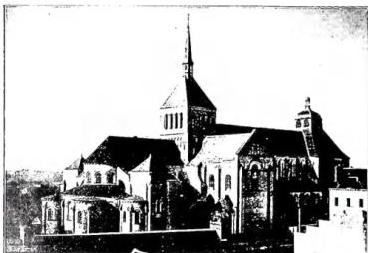
Following the Cluniac reform, Fleury became a model monastery, from which various colonies were sent to other houses, even outside France. At the same time, the school reached its apogee through the work of Abbot Abbo (v.), who governed the monastery from 998 to 1004. Serious fires suffered by the abbey in the years 974, 1002, and 1026 interrupted its fervor of life and study; the fire of 1026 destroyed all the buildings. The monks, led by Abbot Gauslinus (1004–30), soon undertook their reconstruction. While the crypts were restored shortly afterward and the altars of Our Lady and S. Benedict were rebuilt together with the choir with two transepts, the church, damaged by a new fire in 1184, was consecrated only in 1218. During this period and in the following century, the monastery’s spiritual life was as intense as its artistic activity; it did not diminish even because of material difficulties and the decline of the school. The influx of pilgrims also decreased. This state of affairs continued for a long time and grew steadily worse because of the raids that devastated the region, particularly during the Hundred Years’ War; moreover, upon the death of individual abbots, the tax officials attempted to seize the abbey’s temporal goods, and in 1363 it also suffered a two-year occupation by a Breton company. Further abuses and new intrigues in the abbatial elections brought persons who were for the most part unworthy to the government of the monastery, worsening the situation to the point that Fleury too had to submit to commendatory rule (1486). Regular discipline was by then also failing; the individualistic spirit had destroyed communal life, nor did the various attempts to restore observance succeed. The commendatory abbot De Coligny, who openly declared himself favorable to Calvinism, completed the impoverishment of the abbey by removing its finest treasures and abandoning it to the pillage of the Huguenots in 1562.
A few years later Fleury became part of the Gallican Congregation of the Exempts, but only with its
annexation to the Congregation of the Maurists in 1627 did it undergo a reform that restored to it a period of religious and cultural flourishing. In the following century, however, a new relaxation became apparent. In 1789 the monastery was sold; in 1806 it was demolished: only the church remained, which from 1865 was cared for by several monks from S. Maria de la Pierre-qui-vire. In 1944, with a group that had come from the same abbey, the monastic community was reestablished at Fleury.
The school of Fleury was distinguished not only by Theodulf, Alcuin’s collaborator in the Carolingian revival, but also by Abbo in the 10th century: the number of its students has been estimated at 5,000. From the 9th to the 12th century, various authors compiled the Miracula s. Benedicti. Writers worthy of remembrance include: Aimone, Ugo di S. Maria, Gauslinus, Andrea, Rodolfo, Teoderico. The most cultivated sciences were biblical, historical, and liturgical studies, as well as patristics, but classical literature also occupied an important place; there were numerous hagiographical works. Special mention is also due to the scriptorium, in which a type of writing developed that is known precisely by the name of Fleury script.
The Library was closely connected with the school. Its collections were destroyed or dispersed at the time of the Huguenot wars. A few remnants are now in Orléans, Bern, and the Vatican.