
ODDONE DI CLUNY, saint. — Second abbot of Cluny in 878–79, from a noble family of Maine, d. at St-Julien de Tours on 18 Nov. 942. Admitted in 898 among the Canons of S. Martino of Tours, he distinguished himself through his intelligence; having withdrawn to the monastery of Baume-les-Messieux, BENNONE (v.) to Cluny in 910, whom he succeeded in 927.
Under O., the Cluniac movement rapidly expanded, gaining the monasteries of Romainmoutier, St-Géraud d'Aurillac, St-Pierre of Tulle, St-Sauveur of Sarlat, St-Martial of Limoges, St-Jean-d'Angely, St-Allyre of Clermont, and, moreover, outside Burgundy and Aquitaine, where Bernon's influence had been limited, Fleury-sur-Loire, St-Pierre-le-Vif of Sens, and St-Julien of Tours. Italy, in turn, entered the orbit of Cluny. O. won for the reform the Roman monasteries of S. Paolo, S. Lorenzo, S. Agnese, and S. Maria on the Aventine. His influence also extended to Naples, Salerno, S. Pietro of Pavia, and S. Elia in the Suppentonice valley near Nepi.
It was not always without difficulty that the wandering monk propagated exact Benedictine observance. Fleury-sur-Loire dared to resist him even by force of arms. But O. benefited from solid support among bishops and princes, particularly the royal family of Burgundy, King Rodolfo I, Duchess Adelaide, King Ludovico IV, the counts of Périgord and Mâconais, Duke Alfredo of Aquitaine, the kings of Italy, Ugo and Lotario, and Alberico, prince of the Romans.
In March 931, Pope Giovanni XI officially confirmed O. in his mission as reformer, granting him, in return for an annual payment of 10 soldi, the power to aggregate monasteries to Cluny and to receive into them temporarily the monks attracted by his reform. The same bull sanctioned Cluniac independence, exempting it from every lay and ecclesiastical authority except that of the Holy See, as had already been established by the charter of donation of Guglielmo il Pio (910). The Pope thus laid the foundations of the Congregation of Cluny, centralizing in feudal fashion a group of monasteries without the protection and domination of a mother abbey (Jaffé-Wattenbach, 3584; PL 132, 1055; privilege renewed by Leone VII, Jaffé-Wattenbach, 3605; PL 132, 1074).
Although they are of later composition, the Cluniac Statutes (Ordo Cluniacensis) reflect O.'s influence, particularly in the traditions of hospitality and charity, discretion in penitential exercises, and the predominant place accorded to the liturgy.
A mediator and much-heeded counsellor of popes and great men, O. repeatedly restored peace between Alberico, master of Rome, and Ugo, king of Italy (936, 938–39). During a similar mission to Rome, in the summer of 942, he was stricken with malaria. But he still had sufficient strength
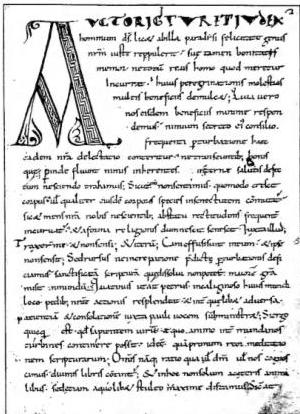
O.'s literary work is fairly considerable. A moralist, he left, besides some sermons, a compendium of the Moralia in Iob of S. Gregorio il Grande, an impersonal work. The Collationum libri tres are more interesting; the author committed to writing and developed the discussions he had had with Turpione of Limoges when, as a candidate for the priesthood (908–909), he made him aware of his apprehensions concerning his future responsibilities. The picture he draws of the period is rather gloomy. The Occupatio is of the same inspiration, an extensive poem of 7 books and 7000 hexameters. It consists of moral reflections on some salient event in sacred history. Allegorical exegesis is evident in II. The historical work, inspired by hagiographical concerns, includes a life of S. Geraldo, count of Aurillac and founder of the abbey of that place, and a brief biography of S. Martino of Tours. A reputed liturgist and musician, O. was finally the author of hymns and several antiphons in honor of S. Martino. Of the musical treatises attributed to him, modern criticism has recognized only a brief fragment, the tonora per ordinem. — Vedi tav. IV.
3. — CATHOLIC ENCYCLOPEDIA. — IX.
Acta Sanct. O. S. B., V, pp. 150–86; PL 133, 43–86; Bibliotheca Cluniacensis, pp. 13–56; Neues Archiv, 15 (1890), pp. 117–26. The monk Nalgod, in the 12th century, reworked and condensed the Vita by Giovanni da Salerno, leaving a more orderly and accurate text enriched with chronologies; ed.: Mabillon, loc. cit., pp. 186–199; PL loc. cit., 85–104. Cf. BHL, 6202–99. Literature: E. Sackur, Die Cluniacenser, I, Halle 1892–94, pp. 36–120; II, pp. 330–38; Dom Du Bourg, St-Odon, Paris 1905, literary and popularizing, cf. Anal. Balland., 24 (1905), pp. 408–409; L. Kolner, Odo, der erste Cluniacensermagister, Deggendorf 1913; A. Fliche, La réforme grégorienne, I, Louvain 1924, pp. 30–47; A. M. Zimmermann, Kalendarium Benedictinum, III, Metten 1937, pp. 324–27; Fliche-Martin, Hist. de l'Eglise, VII, Paris 1940, pp. 322–24; E. Ammann, s. V. in DThC, XI, cols. 937–39; G. Antonelli, L'opera di O. di Cluny in Italia, in Benedictina, 4 (1950), pp. 19–40; cf. also the bibliography of the entry CLUNY. Clemente Schmitt