
ODDONE di CAMBRAI, blessed. – Benedictine theologian and bishop, born at Orléans around the middle of the 11th century, died at the monastery of Anchin, near Douai, on 19 June 1113. Scholastic master of Toul and subsequently of Tournai (1087), he attracted a multitude of disciples, whom he taught exaggerated realism, combating nominalism as heretical. Having withdrawn with some disciples to the vicinity of Tournai (1092), he restored the ancient monastery of S. Martino from its ruins, where he lived as a regular cleric: in 1095 he accepted the Rule of s. Benedict with the Cluniac observances and became abbot. Elected bishop of Cambrai in 1105, replacing Gaucher, deposed at the Council of Clermont (1095), he was unable to remove the intruder until 1106. Having fallen out with Henry V, he settled at Anchin, from where he governed the diocese.
His philosophical writings—Sophistes, Liber complexionum, and De re et ente—are lost. Theological works: the Expositio in canonem Missae is important for Eucharistic theology (real presence, etc.); in De peccato originali, after asserting that this sin is more a privatio iustitiae debitae than a reality, he explains its transmission by drawing upon his exaggerated realism (which he calls doctrina orthodoxorum): the universal is a reality that exists wholly in individual beings; in Adam it was all the
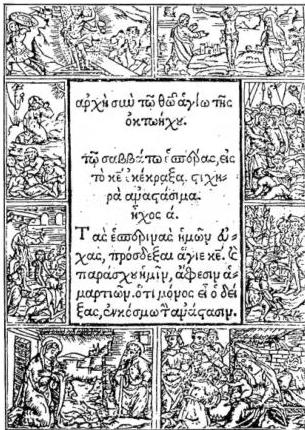
OCTOECHOS — Sixteenth-century edition (with neither place nor date of printing). Leaf IV² with the incipit and illustrations of scenes from the life of Christ. Copy preserved in the Vatican Library.
human nature, which expands into individual particularities in the individual creatures (PL 140, 1091). This treatise is an example of the earliest applications of philosophy to dogma, immediately following the Berengario di Tours (v.).
With the Disputatio contra Iudacum de adventu Christi Filii Dei, G. seeks to convince his opponent by logic alone, presenting a theory of Redemption centered on sacrifice. In the short treatise De blasphemia in Spiritum Sanctum, he demonstrates that this sin consists in final impenitence. In De canonis Evangeliorum, he applies the principles of Eusebius of Caesarea to determine the mutual relationship of the Gospels.
These works underwent various editions, the latest in PL 140, 1053–1160, where a homily on the Villicus iniquitatis is also published, though doubts have been raised concerning its authenticity. Other homilies have been lost.