Also known as:
German: Ottilia;
St. Odile, Odile of Alsace, Odilia of Alsace;
French: Odile
ODILIA, Saint. - Foundress and abbess of Hohenburg, patroness of Alsace. Daughter of Adalric, duke of Alsace, according to legend she was rejected by her father because she was born blind. Bereswinta, her mother, is said to have entrusted her to an old servant woman who lived at Scherwiller near Selestat, and later to the monastery of Baume-les-Dames, in the diocese of Besançon. O. is said to have recovered her sight at the Baptism conferred on her by St. Erhard, bishop of Ratisbon. Through the intervention of Hugh, her brother, she is said to have been received back by Adalric, who made her a gift of the castle of Hohenburg, on the present summit of Mount St. Odilia, so that she might transform it into a monastery (between 667 and 680), of which she was the first abbess and where she governed a community of about 130 nuns.
She is also credited with the foundation, at the foot of the Hohenburg, of the hospice and monastery of Niedermünster, of which her niece Gondelinda was the first abbess. She died around 717 and was buried in the chapel of St. John the Baptist that she herself had built at Hohenburg. Laid to rest at Ottrott during the French Revolution, her relics were definitively brought back on 6 October 1800 to the chapel of the convent on Mount St. Odilia, today the center of frequent and numerous pilgrimages.
Popular devotion spread rapidly after the 9th century in Alsace, Switzerland, southern Germany, and later throughout all of Europe. Feast day on 13 December. The saint is invoked against ailments of the eyes.
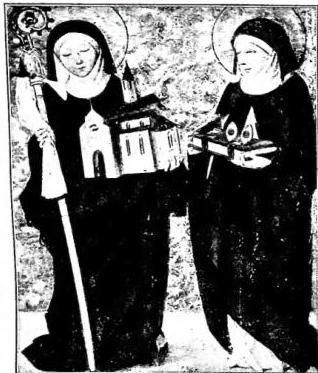
ODILIA, saint - The abbesses St. Erentrude and St. O. with her characteristic iconography: the two eyes. Painting on panel (ca. 1475). Salzburg, abbey church of Nonnberg.(from J. Braun, Tracht und Attribute der Heiligen in der deutschen Kunst, Stuttgart 1911, fig. 119)Bibliographyan ancient anonymous Vita, probably by a priest of the convent, late 9th century, ed. by W. Levison, in MGH, Script. rer. Meroc., VI, pp. 24
BIBL.: an ancient anonymous Vita, probably by a priest of the convent, late 9th century, ed. by W. Levison, in MGH, Script. rer. Meroc., VI, pp. 24-30. Abundant literature in the highly erudite study by the canon M. Barth, Die Hl. Odilia, ihr Kult in Volk u. Kirche (Forschungen u. Kirchengesch. d. Elsass. n. 5), Strasbourg 1938. The most recent work with critical apparatus, G. Lallemand-Simon, Odile, fille de la Lumière, Paris 1946, of a literary character.
Schmitt, Clemente. “Odilia, santa.” In Enciclopedia Cattolica, vol. IX, coll. 70–71. Città del Vaticano: Ente per l’Enciclopedia Cattolica e per il Libro Cattolico, 1952. https://azioneromana.com/article/odilia-santa.
MLA
Schmitt, Clemente. “Odilia, santa.” Enciclopedia Cattolica, vol. IX, Ente per l’Enciclopedia Cattolica e per il Libro Cattolico, 1952, coll. 70–71. Azione Romana, https://azioneromana.com/article/odilia-santa.
BibTeX
@incollection{ec9_odilia_santa,
  author    = {Schmitt, Clemente},
  title     = {Odilia, santa},
  booktitle = {Enciclopedia Cattolica},
  volume    = {IX},
  pages     = {70--71},
  note      = {Cited by column},
  publisher = {Ente per l’Enciclopedia Cattolica e per il Libro Cattolico},
  address   = {Città del Vaticano},
  year      = {1952},
  url       = {https://azioneromana.com/article/odilia-santa}
}
One of some 20,000 entries brought back from the twelve printed volumes (1948–54). Spotted something? Help us improve it.
Click or scroll to zoom · drag to pan · Esc to close