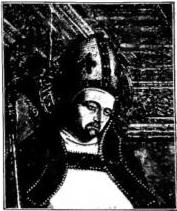
UGO, king of ITALY. — Crowned in Apr. 927, he held power until 947. Born between 880 and 881 to Count Tibaldo and Berta, daughter of Lotario II of Lorraine, he became Count of Vienne in 899 and governed the Kingdom of Provence when the emperor-king Ludovico returned there, blind and without prestige, after the disastrous Italian expedition of 905.
In 912 he attempted an expedition into Italy on his own account, but without success, and renewed the attempt with better fortune in 927, availing himself of the support of the marquess Giulio of Tuscany, his uterine brother, and of the support of Pope Giovanni X, who hoped to find in him an ally against the turbulent Roman nobility. He landed at Pisa in Apr. 927 and from there reached Pavia, where he was crowned king of Italy; but his understanding with Giovanni X, which seemed to foreshadow action in Rome and the Papal State and an imperial coronation, brought about a rupture with the house of Tuscany, and an agreement between the latter and that part of Marozia (v.). Marozia reached an agreement with Guido of Tuscany and married him, but when Guido died, she carried out an astute political diversion and, in order to preserve her own predominance and that of her family, offered U. the imperial crown and her hand. ALBERIGO (v.), Marozia’s son, forced U. to flee Rome, but his desire for revenge dominated all his subsequent policy.
There was no shortage of internal conspiracies and external attacks, which were forestalled or contained with great vigor until 945, when Berengario d'Ivrea (v.), having taken refuge in Germany, returned at the head of an army and, after entering Milan, received the homage of the magnates. U. temporarily abandoned power, while his son Lotario, who had been associated with him since 931, retained the royal title, leaving the exercise of power to Berengario.