
AIMONE (Latin: Haymo, Haimo, Aimo, Hemmo), bishop of HALBERSTADT. — Born around 778, died on 26 or 27 March 853.
According to some, his place of birth was in Englan-
IN OKTYMVIDPOSITVSESTKORPVS BONEMERIEFAVSTIIE
QUIFVITSVISAMABILISP
OKASSIOSINELANÇVENŞB
DEOKSEKVIŞSVBQIEXXVI
REQUIEMETERNADETILLO
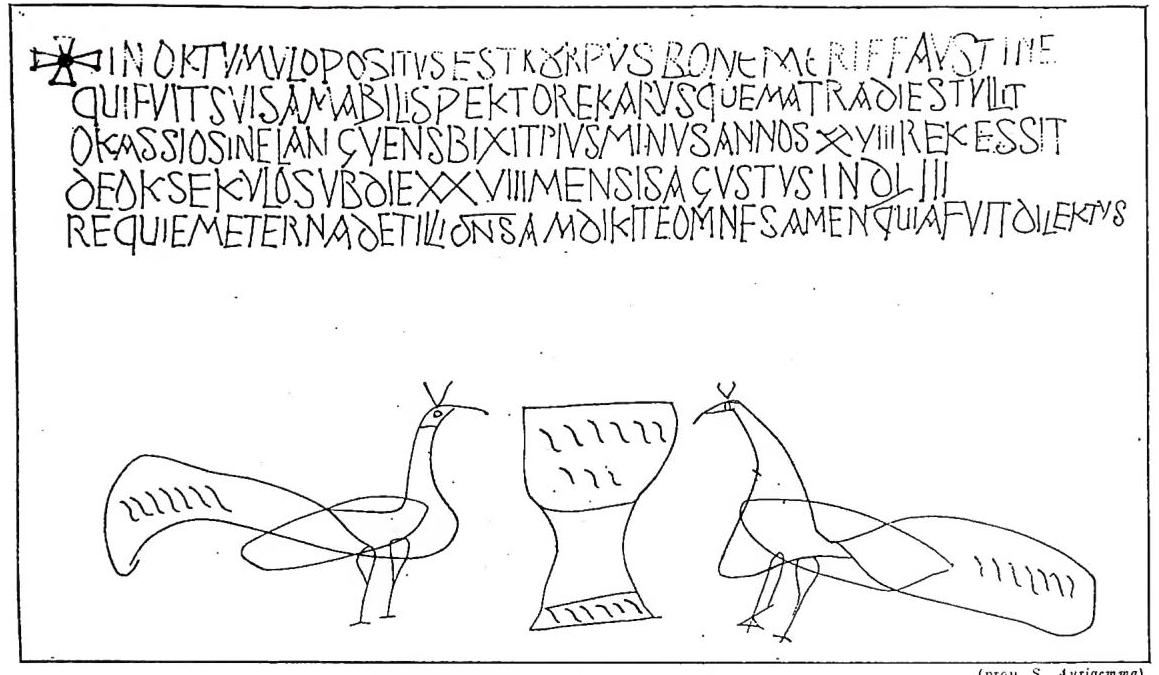
(prop. S. Aurigemma)
In 839 he was appointed (the 3rd) abbot of Hersfeld and in 841 (the 3rd) bishop of Halberstadt in Saxony. On that occasion, or shortly thereafter, Rabano Mauro dedicated his encyclopedia De universo to him, advising him not to meddle in secular affairs but to devote himself entirely to the instruction and sanctification of the people (PL 111, 11–14).
A. was faithful to this rule. Devoted to study and pastoral duties, he rarely left his diocese: he went to Mainz (847) to attend the first provincial council, and then (852 or 851) to take part in the national council of Germany.
Rabano Mauro celebrates him as « iustitiae cultor et pietatis amator... decus Ecclesiae, plebis laus, gloria cleri »: indeed, the four poems by Rabano ad praeclarum episcopum (PL 112, 1591–96) seem to be addressed to him. In some early editions he bears the title of saint.
Works. – « Vir undecunque doctissimus », writes Trithemius, A. was above all « divinarum Scripturarum interpres » (PL 116, 189). He commented on almost the whole Bible, but few works by him remain, and not all are authentic.
1. Explanatio in Psalmos, an edition of which was prepared by Erasmus (Freiburg 1533; Cologne 1561), who calls A. « veluti spiritualis apicula », who « ex omnium veterum hortis ac pratis florentissimis decerpsit, quo simplicibus et occupatis esset parata saluberrimi mellis copia ». The work, however, at least in its present text, is disputed as his; some attribute it to Aimone di Hirschau (died in 1107).
2. The commentary on the psalms is followed by one on six Canticles of the Old Testament used in the liturgy (the two of Moses, and those of Anna, Isaiah, Hezekiah, and Habakkuk).
3. Commentariolum in Cantica Canticorum, which he interprets as an « epithalamium Christi et Ecclesiae »: a disputed work.
4. Comm. in Isaiam libri tres: A. begins by explaining the intellectual nature of prophetic « vision ».
5. Enarratio in XII Prophetas Minores, in which he chiefly elucidates the mysteries concerning Jesus Christ and the Church; the commentaries on Joel and Amos are probably not his.
6. In divi Pauli Epistolas expositio, attributed by some to s. Remigio di Lione and by others, with greater probability, to Remigio d'Auxerre: a fragment of chapter XIII of the commentary on Romans passed, under A.’s name, into the Corpus Iuris Canonici (Decretum of Gratian, Causa XXIII, q. V, cap. 39).
7. Expositionis in Apocalypsim libri septem, which many attribute to Remigio d'Auxerre; everything is referred there to the two spiritual cities: the society of the elect and that of the reprobate. It is almost an epitome Autperto (v.).
8. The Homilies on the Gospels de tempore et sanctis, and some on the Epistles of the Mass, have not yet been critically authenticated; the second part (from Easter to Advent) is attributed to Aimone di Hirschau.
In his commentaries, which are pious and moralizing, especially those on the Psalms and the Song of Songs, A. follows the allegorical-mystical method. Although he makes use, particularly in his writings on the prophets, of s. Girolamo and others, as an exegete he rises above his contemporaries, since he does not merely collect texts of the Fathers but expounds their thought with a certain originality.
Some consider Heliand (v.), a vast Saxon poem, probably of Fulda origin. A. also left an Epitome of ecclesiastical history up to the 4th century, in ten very brief books, extracted from Eusebius, Rufinus, and others; and an ascetic booklet in three books (the third eschatological): De amore caelestis patriae (also called by Trithemius, though less correctly, De varietate librorum), a work of patristic compilation, attributed by some to Aimone di Hirschau. Among his works there is also an important short treatise, perhaps a fragment, De Corpore et Sanguinie Domini, which Geiselmann, however, considers to belong to the 11th century, perhaps by Aimone di Hirschau or even by Aimone di Telleis.
A.’s writings are collected in PL, vols. 116–18.