
ALESSIO, saint. - According to the oldest version of the legend, which seems to contain the authentic history of the saint, he was an anonymous Roman beggar, born into a wealthy family, who, having fled on the evening of his wedding, led the life of an ascetic in Edessa, where he died during the episcopate of Rabbūlā (412-35). Neither his name nor those of his parents were known; he was simply called “man of God.” In later texts he was also called Mār Rišā (Lord Prince), because of his aristocratic origin, Gabra Krestos (servant of Christ), Ἀλέξιος, “Ἀλέξις,” for what reason is unknown, among the Byzantines, whence our Alexius.
The life of this saint, now known chiefly by the name of A., is known from a Syriac legend, composed between 450 and 475, of which one manuscript dates from the beginning of the 6th century. The story of the “man of God” is related there on the testimony of the church attendant of the church frequented by the anonymous beggar. The narrative ends with the saint’s death, which occurred in Edessa, and with Bishop Rabbūlā’s visit to the tomb, which was found empty. The account has such characteristics that it may be considered, as a whole, authentic. Everything added by later accounts to the primitive version, including the very well-known episode of A.’s remaining for seventeen years beneath a staircase in his paternal home, must be regarded as legendary material.
Among these later legends, which exerted a wide influence on Alessian hagiographical and literary production, the following should be noted: 1) the Byzantine legend, whose text has not yet been found, which was used by Giuseppe il
Melode (Acta SS. Iulii, IV, pp. 247-48), in the second half of the 9th century, and by the Byzantine Menologia (cf., for example, the anonymous Byzantine Menologio of the 10th century, ed. by B. Latyšev, Pietroburgo 1911, pp. 243-52); 2) a second Syriac legend of the 9th century; 3) the Western legend, in Greek and Latin, in various recensions, the oldest of which (BHL, 289, edited by L. Vázquez de Parga, Madrid 1941: Anal. Bollandiana, 62 [1944], pp. 281-83) dates from the first half of the 10th century and concerns the anonymous Filius Famiani. The other recensions were composed, it seems, by adapting them to the topography of the Aventine, in the Greek-Latin monastery restored by Sergio, archbishop of Damascus, who took refuge in Rome in 977. It should be noted that the Byzantine legend bears much affinity with the no less fabulous legend of s. Giovanni Calibita (v.). Recently Léon Hermann (in L'Antiquité classique, 11 [1942] pp. 235-41) believed he had proved that the source of the Roman legend of A. was a lost biography of the poet Commodiano, and that this poet was the prototype of A. and of the Calibita (cf. observations by F. Tailliez, in Orientalia Chr. Per., 1945, pp. 216-22).
The cult of A., widespread in the East, passed into the West during the 10th century (the earliest known manuscripts, 10th century, of the oldest Western recension of the legend come from Spain: BHL, 289); in Rome it was introduced by Archbishop Sergio. This cult then spread throughout Europe, both because of the fame soon acquired by the monastery on the Aventine and because of the appeal exerted upon the people by the pathetic legend of A. In the East the feast is celebrated on 17 March; in the West on 17 July.
Dissemination of the legend of s. A. - The legend of A., which Gregorovius (Geschichte der Stadt Rom im Mittelalter, I, ed. Schillmann, Dresda 1926, pp. 781-82) considered “one of the finest [legends] of Christian self-denial,” enjoyed extraordinary dissemination and great popularity. It was known to Arab, Ethiopian, and Slavic Christians—in Russia the name of A. is extremely widespread—through the Syriac and Byzantine legends; medieval Europe sang and dramatized it, drawing inspiration from the Western as well as from the Byzantine and perhaps also the Syriac legend. Among the best-known literary works may be recalled: La vie de saint Alexis (ed. G. Paris, Parigi 1903), a poem of the 11th century; the Ritmo di s. A., mentioned in folklore; the well-known poem by Corrado da Würzburg, d. 1287 (ed. P. Gereke, Halle 1925-1927); the Vita b. Alexii, by Bonvesin da la Riva, who died ca. 1313-15 (ed. E. Monaci, Città di Castello 1912), etc. The regions of Italy richest in popular compositions inspired by the legend of A. are the Marche, Romagna, Emilia, and Piedmont. There are also various works written for the theatre: among modern ones may be mentioned those of Cardinal Wiseman (1859) and Henri Ghéon (1920). In the field of music, particular mention is due to the S. A., by Stefano Landi (v.), with a libretto by Cardinal Giulio Raspigliosi (later Clemente IX), performed in Rome with brilliant success in 1632 and, with certain modifications, in 1634 (cf. R. Rolland, Le Journal de J.-J. Bouchard, in Revue Musicale, 1902), and to the Leggenda di s. Fabiano (vedi sotto), written by A. Beltramelli (cf. Il secolo XX, 25 [1926], pp. 829-37), set to music by Pratella and performed in Bologna in 1939.
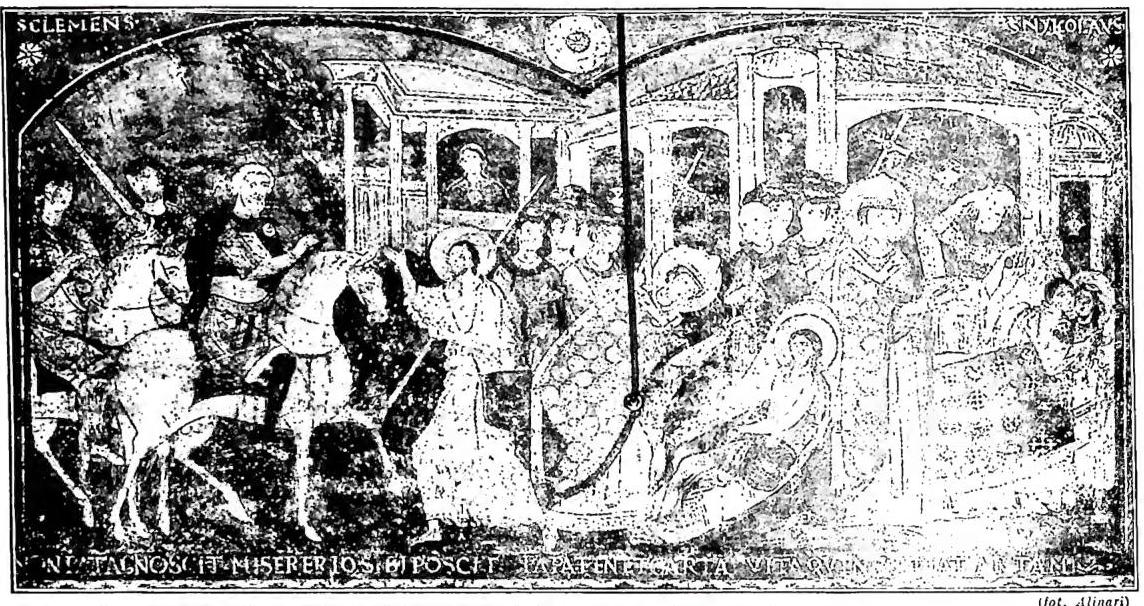
The monastery must have existed when the church was a deaconry; its renown, however, dates from the time of Sergio (d.
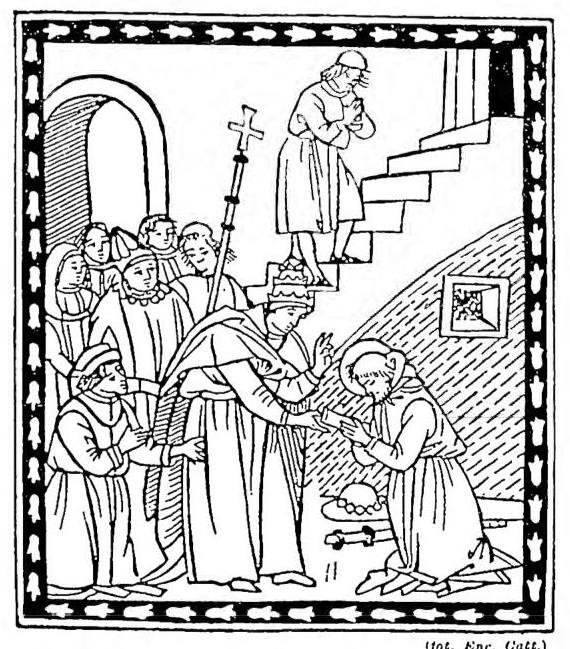
(photo Enc. Catt.) ALESSIO, saint - The Representation of s. A. Florentine woodcut (16th century).
and Dalmatia to Calabria and Apulia in numerous versions, some of which, of high poetic value, rank among the finest examples of Italian popular poetry. In the Romagna versions the protagonist is called s. Fabiano, confusion having arisen with the name of the saint’s father, Eufemiano, and, through distortion, Fabiano.
Besides this narrative song, which still survives in the oral tradition of the various peoples of Italy, there are ancient poems in a popular vein: the famous Ritmo di s. A., in monorhymed laisses, considered the work of a Marchigiano jongleur, from the early thirteenth century and perhaps even earlier, published by E. Monaci, to whom it was brought by the priest V. Paoletti of Amandola (Reud. R. Acc. d. Lincei, Classe Scienze Morali St. e Fil., 5ª series, 16 [1907], pp. 103–32); a poem in 73 ottave, which already appears in an incunabulum of the Casanatense library; and another, also in ottave, from the sixteenth century, both reprinted several times down to the present day in popular booklets adorned with crude woodcuts, in addition to various adaptations of lesser interest.
The legend has also been treated in dramatic form. Sanudo recalls in his diaries a performance of s. A. given at the monastery of S. Salvatore in Venice on 13 February 1515; noteworthy are a sacra rappresentazione in ottave (known first edition 1517) and a maggio of the Tuscan countryside (ed. Sborgi, Volterra 1867).