
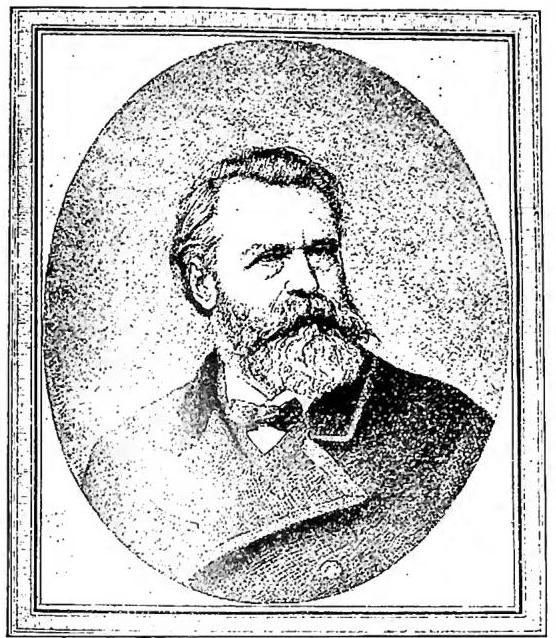
GREGOROVIUS, FERDINAND. – German historian, b. on 19 January 1821 at Neidenburg (East Prussia), d. in Munich on 1 May 1891. Of a family of Polish origin (Grzegorzewski), in which the career of a Protestant pastor was traditional, he was sent to study at the gymnasium of Gumbinnen and then, for theology, at Königsberg.
At a very young age he was touched by the idea of the Polish revolution; nevertheless, he was and always felt himself to be a Prussian patriot. In 1845 he published a novel; in 1851 an essay on the Emperor Hadrian. In 1852, having come to Rome, he began his library and archival studies for the History of the City of Rome in the Middle Ages, which he began writing three years later and completed in 1871. In 1889 he published a History of Athens in the Middle Ages, quite different from that of Rome, both as a work of scholarship and as a work of art. Among his poetic works, his Years of Travel in Italy, prose that may be called lyrical, should be remembered, and, among the minor works, a translation of the Sicilian Anacreontic poet Giovanni Meli. G.’s last work was an attempt at a synthesis, On the Great Monarchies, published in Nuova antologia a few days before his death, in which he tended to present Prussia as the heir to the tradition of universal empire that began with Egyptian and Assyrian civilization, and defined the true German idea as “to establish the empire of moral freedom, truth, duty, and labor in its most humane form.”
G. sincerely loved Italy and especially Rome, of which he was made an honorary citizen. His name remains linked to the history of the Urbs, which he carried from Alaric’s conquest (410) to the Sack (1527), and which was placed on the Index in 1874 for its anti-Catholic tendentiousness. The archaeological and documentary discoveries and the new studies that have followed one another have rendered this work antiquated in many respects, in which the poet often takes control
G. saw in the so-called Lutheran Reformation “the greatest national work of the German people” (Wanderjahre, VI, p. 128), “the rebirth of Christianity, the new formation of the world of culture through German national vitality, the liberation of the human intellect, of knowledge and the right of personality, of science and the State from the constraints of a supernatural authority.” Consequently, Protestant education and German patriotism, which undeniably emerge, despite his effort to remain impartial, together with his rationalism lend the History a bias that diminishes its scientific serenity.
Despite this, G.’s work remains a great attempt at synthesis, which cannot be ignored by anyone wishing to know the history of medieval Rome. Nothing, however, prevents it from also being regarded as an epic poem in prose: the author himself authorizes this view, since in his Diary he often speaks of it as a work of art rather than of science, recounting the romantic moment of its inspiration on the Ponte dei Quattro Capi, the enthusiasm, and the travail of creation. His History of Rome was the inspired offspring of the romantic love that G. cherished for the old city, almost crystallized in its monumental stratification, which he still had the opportunity to admire before 1870.
Principal works: Geschichte des römischen Kaisers Hadrian (Königsberg 1851); Euphorion, eine Dichtung aus Pompei (Leipzig 1858); Geschichte der Stadt Rom im Mittelalter, vom V. bis zum XVI. Jahrhundert (Stuttgart 1859–1872 [in the Index, 5 February 1854], many subsequent editions; among the many Italian translations, the best, with copious bibliographical additions and incorporating the results of the latest studies, is that edited by L. Trompeo, in 16 vols., Città di Castello 1938–44); Die Insel Capri (Leipzig 1868); Corsica (Stuttgart 1869, Italian translation Rome 1912); Lucrezia Borgia (Stuttgart 1875, Italian translation Milan 1932); Alcuni cenni storici sulla cittadinanza romana (Rome 1877); Wanderjahre in Italien (Leipzig 1880–83 [vol. V in the Index, 15 December 1882], Italian translation Rome 1906–1909); Die Grabdenkmäler der Päpste (Leipzig 1881 [in the Index, 27 June 1881], Italian translation Rome 1931); Athenäis, Geschichte einer byzantinischen Kaiserin (Leipzig 1882 [in the Index, 10 July 1882], Italian translation Turin 1882); Der Kaiser Hadrian, Gemälde der römisch-hellenischen Welt
zu seiner Zeit (Stuttgart 1884, Italian translation Rome 1910); Kleine Schriften (Leipzig 1887–92); Geschichte der Stadt Athen im Mittelalter (Stuttgart 1889); Le grandi monarchie ossia gl'imperi universali nella storia, in Nuova antologia, 115–20 (1891); Gedichte (Leipzig 1892); Römische Tagebücher (Stuttgart 1892, Italian translation Milan 1895).